



 Chat with AI
Exam 16: Monopolistic Competition

Exam 1: Ten Principles of Economics455 Questions
Exam 2: Thinking Like an Economist645 Questions
Exam 3: Interdependence and the Gains From Trade550 Questions
Exam 4: The Market Forces of Supply and Demand693 Questions
Exam 5: Elasticity and Its Application625 Questions
Exam 6: Supply, Demand, and Government Policies671 Questions
Exam 7: Consumers, Producers, and the Efficiency of Markets547 Questions
Exam 8: Application: The Costs of Taxation507 Questions
Exam 9: Application: International Trade521 Questions
Exam 10: Externalities543 Questions
Exam 11: Public Goods and Common Resources453 Questions
Exam 12: The Design of the Tax System563 Questions
Exam 13: The Costs of Production649 Questions
Exam 14: Firms in Competitive Markets608 Questions
Exam 15: Monopoly662 Questions
Exam 16: Monopolistic Competition649 Questions
Exam 17: Oligopoly522 Questions
Exam 18: The Markets for the Factors of Production592 Questions
Exam 19: Earnings and Discrimination511 Questions
Exam 20: Income Inequality and Poverty478 Questions
Exam 21: The Theory of Consumer Choice568 Questions
Exam 22: Frontiers in Microeconomics461 Questions
Select questions type


Describe the shape of the monopolistically competitive firm's demand curve.
(Short Answer)
4.8/5  (97)
(97) Economists defend brand names as useful to consumers because brand names
(Multiple Choice)
4.8/5 (64)
(64) Monopolistic competition is characterized by a few sellers offering similar products, whereas oligopoly is characterized by many sellers offering differentiated products.
(True/False)
4.9/5 (77)
(77) Figure 16-12 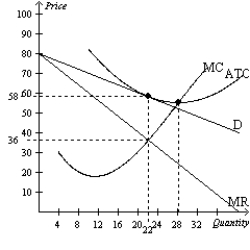 -Refer to Figure 16-12. Compare the price and marginal cost in this market with price and marginal cost if this were a perfectly competitive market.
 (Essay)
4.8/5 (73)
(73) Figure 16-14 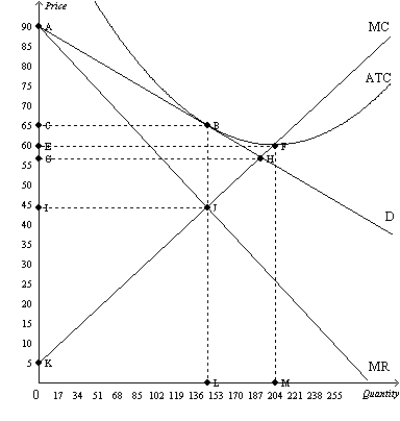 -Refer to Figure 16-14. Which of the following represents the excess capacity of this firm?
 (Multiple Choice)
4.9/5 (74)
(74) The term excess capacity refers to the fact that a firm operates on the upward-sloping portion of its average-total-cost curve.
(True/False)
4.8/5 (90)
(90) Figure 16-9
The figure is drawn for a monopolistically-competitive firm. 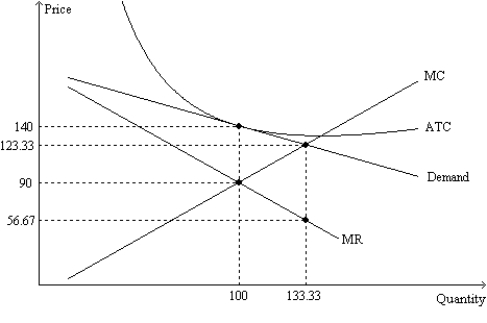 -Refer to Figure 16-9. As the figure is drawn, the firm is in
 (Multiple Choice)
4.8/5 (83)
(83) Figure 16-10
The figure is drawn for a monopolistically-competitive firm. 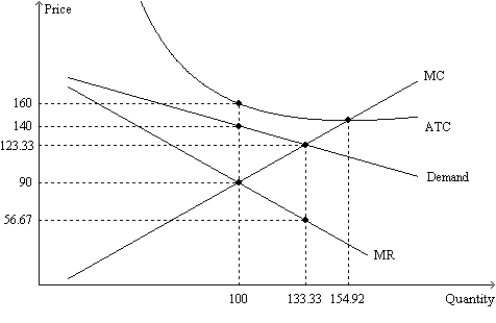 -Refer to Figure 16-10. If the firm were to produce 154.92 units of output,
 (Multiple Choice)
4.9/5 (75)
(75) When a profit-maximizing firm in a monopolistically competitive market is in long-run equilibrium,
(Multiple Choice)
4.8/5 (78)
(78) Evidence suggests that, in markets with differentiated products but little advertising,
(Multiple Choice)
4.7/5 (79)
(79) According to one theory, advertising sends a signal to consumers about the quality of the product being offered. An implication of this theory is that
(Multiple Choice)
4.8/5 (63)
(63) New firms will likely enter a monopolistically competitive market when price exceeds
(Multiple Choice)
4.7/5 (87)
(87) Table 16-3
The following table shows the output produced by each of the top eight firms in four industries as well as the total industry output for those industries. 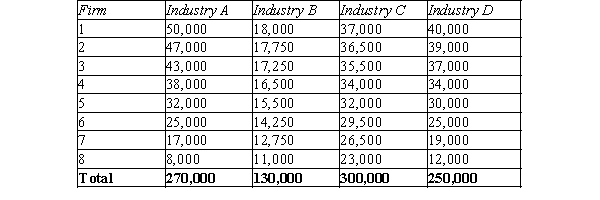 -Refer to Table 16-3. What is the concentration ratio for Industry D?
 (Multiple Choice)
4.9/5 (63)
(63) Table 16-7
A monopolistically competitive firm faces the following demand schedule for its product. In addition, the firm has total fixed costs equal to 20.  -Refer to Table 16-7. If this firm profit maximizes and faces a constant marginal cost of $7, does it have excess capacity? How do you know?
 (Short Answer)
4.9/5 (81)
(81) Professional organizations and producer groups have an incentive to
(Multiple Choice)
4.8/5 (76)
(76) When a profit-maximizing firm in a monopolistically competitive market is in long-run equilibrium, marginal cost must lie below average total cost.
(True/False)
4.8/5 (86)
(86) A profit-maximizing firm in a monopolistically competitive market charges a price equal to marginal cost.
(True/False)
4.9/5 (80)
(80) 
Filters
- Essay(0)
- Multiple Choice(0)
- Short Answer(0)
- True False(0)
- Matching(0)