



 Chat with AI
Exam 16: Monopolistic Competition

Exam 1: Ten Principles of Economics455 Questions
Exam 2: Thinking Like an Economist645 Questions
Exam 3: Interdependence and the Gains From Trade550 Questions
Exam 4: The Market Forces of Supply and Demand693 Questions
Exam 5: Elasticity and Its Application625 Questions
Exam 6: Supply, Demand, and Government Policies671 Questions
Exam 7: Consumers, Producers, and the Efficiency of Markets547 Questions
Exam 8: Application: The Costs of Taxation507 Questions
Exam 9: Application: International Trade521 Questions
Exam 10: Externalities543 Questions
Exam 11: Public Goods and Common Resources453 Questions
Exam 12: The Design of the Tax System563 Questions
Exam 13: The Costs of Production649 Questions
Exam 14: Firms in Competitive Markets608 Questions
Exam 15: Monopoly662 Questions
Exam 16: Monopolistic Competition649 Questions
Exam 17: Oligopoly522 Questions
Exam 18: The Markets for the Factors of Production592 Questions
Exam 19: Earnings and Discrimination511 Questions
Exam 20: Income Inequality and Poverty478 Questions
Exam 21: The Theory of Consumer Choice568 Questions
Exam 22: Frontiers in Microeconomics461 Questions
Select questions type


Figure 16-13 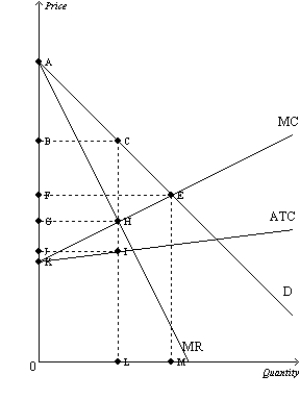 -Refer to Figure 16-13. Which letter represents the profit-maximizing price?
 (Short Answer)
4.8/5  (73)
(73) Considering perfect competition, monopolistic competition, and monopoly, which of the market structures results in production of the welfare-maximizing level of output?
(Short Answer)
4.8/5 (67)
(67) Figure 16-4 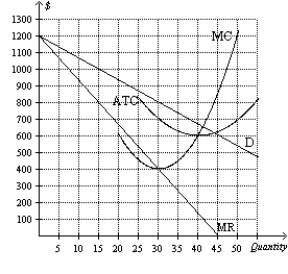 -Refer to Figure 16-4. Which of the following will occur in the long run in this industry?
 (Multiple Choice)
4.8/5 (79)
(79) Monopolistically competitive markets may be socially inefficient because
(Multiple Choice)
4.7/5 (84)
(84) Table 16-4
This table shows the demand schedule, marginal cost, and average total cost for a monopolistically competitive firm. 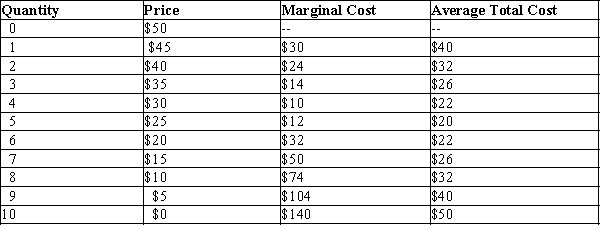 -Refer to Table 16-4. If the government forces this firm to produce at its efficient output level, how much profit will this firm earn?
 (Multiple Choice)
4.9/5 (81)
(81) Table 16-7
A monopolistically competitive firm faces the following demand schedule for its product. In addition, the firm has total fixed costs equal to 20.  -Refer to Table 16-7. If the firm has a constant marginal cost of $7 per unit, what price should the firm charge to maximize profit?
 (Multiple Choice)
4.9/5 (82)
(82) When consumers are exposed to additional choices that result from the introduction of a new product,
(Multiple Choice)
4.7/5 (72)
(72) Of the following market structures, which are considered imperfectly competitive? i.Perfect competition
Ii)Monopoly
IIi)Monopolistic competition
IV)
Oligopoly
(Multiple Choice)
4.9/5 (64)
(64) Scenario 16-9
Dean goes to the grocery store to buy chips and soda for a party. He purchases brand name products even though generic versions are available at lower prices. His friend John says he was irrational to spend more for a nearly identical product. His friend Martina agreed with Dean's decision to spend more for the brand name products.
-Refer to Scenario 16-9. If Dean bought the brand name because of advertising he saw for the product, a defender of advertising would say
(Essay)
4.9/5 (74)
(74) In the short run, a firm operating in a monopolistically competitive market can earn
(Multiple Choice)
4.9/5 (82)
(82) Scenario 16-6
Ike's Ice Cream has decided to open a new ice cream parlor in Mayville, MS. The market for ice cream parlors is monopolistically competitive.
-Refer to Scenario 16-6. As a result of the new Ike's Ice Cream parlor, existing ice cream shops located in Mayville are likely to experience a
(Multiple Choice)
4.7/5 (60)
(60) Figure 16-8
The lines in the figures below illustrate the potential effect of entry and exit in a monopolistically competitive market on either the demand curve or the marginal cost curve of existing firms. 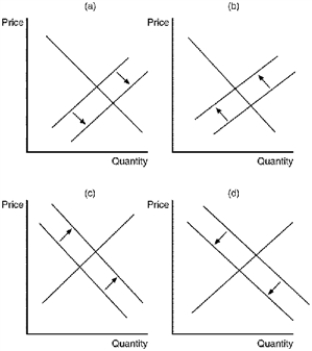 -Refer to Figure 16-8. Panel (d) illustrates the change that would occur if existing firms faced
 (Multiple Choice)
4.8/5 (84)
(84) Figure 16-11 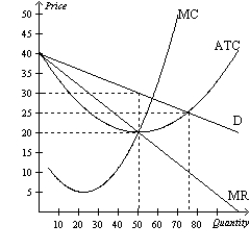 -Refer to Figure 16-11. The graph depicts a monopolistically competitive firm in the short run. Which of the following explanations best describes the long run adjustment?
 (Multiple Choice)
4.8/5 (80)
(80) Scenario 16-2
Suppose market demand for a product is given by the equation P = 20 - Q. For this market demand curve, marginal revenue is MR = 20 - 2Q.
-Refer to Scenario 16-2. If the marginal cost of producing this good is 4, what price would a profit-maximizing monopolist charge for the product?
(Multiple Choice)
4.9/5 (100)
(100) In some countries, brand name fast-food restaurants are not allowed to operate. Such restrictions are likely to
(Multiple Choice)
4.8/5 (86)
(86) Monopolistic competition is characterized by i)
Efficient scale
Ii)
Markup pricing over marginal cost
Iii)
Deadweight loss
Iv)
Excess capacity
(Multiple Choice)
4.9/5 (71)
(71) Figure 16-11 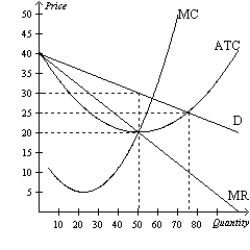 -Refer to Figure 16-11. If this firm profit-maximizes, how much revenue will it earn?
 (Short Answer)
4.9/5 (75)
(75) Figure 16-13 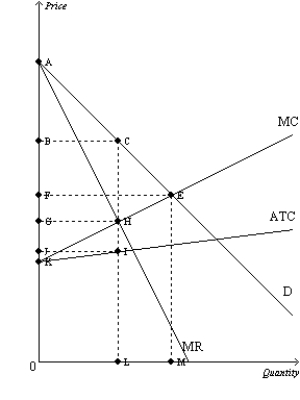 -Refer to Figure 16-13. Use the letters to identify the area of total revenue for this firm.
 (Short Answer)
5.0/5 (70)
(70) Deadweight losses are associated with monopolistic competition:
(Multiple Choice)
5.0/5 (79)
(79) Figure 16-12 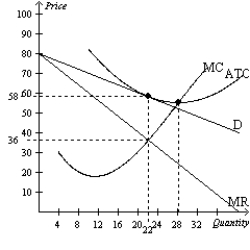 -Refer to Figure 16-12. What, if any, long run adjustment will take place in this industry?
 (Short Answer)
4.8/5 (67)
(67) 
Filters
- Essay(0)
- Multiple Choice(0)
- Short Answer(0)
- True False(0)
- Matching(0)