



 Chat with AI
Exam 16: Monopolistic Competition

Exam 1: Ten Principles of Economics455 Questions
Exam 2: Thinking Like an Economist645 Questions
Exam 3: Interdependence and the Gains From Trade550 Questions
Exam 4: The Market Forces of Supply and Demand693 Questions
Exam 5: Elasticity and Its Application625 Questions
Exam 6: Supply, Demand, and Government Policies671 Questions
Exam 7: Consumers, Producers, and the Efficiency of Markets547 Questions
Exam 8: Application: The Costs of Taxation507 Questions
Exam 9: Application: International Trade521 Questions
Exam 10: Externalities543 Questions
Exam 11: Public Goods and Common Resources453 Questions
Exam 12: The Design of the Tax System563 Questions
Exam 13: The Costs of Production649 Questions
Exam 14: Firms in Competitive Markets608 Questions
Exam 15: Monopoly662 Questions
Exam 16: Monopolistic Competition649 Questions
Exam 17: Oligopoly522 Questions
Exam 18: The Markets for the Factors of Production592 Questions
Exam 19: Earnings and Discrimination511 Questions
Exam 20: Income Inequality and Poverty478 Questions
Exam 21: The Theory of Consumer Choice568 Questions
Exam 22: Frontiers in Microeconomics461 Questions
Select questions type


Which of the following might be an example of an economic argument against advertising?
(Multiple Choice)
4.9/5  (82)
(82) Figure 16-13 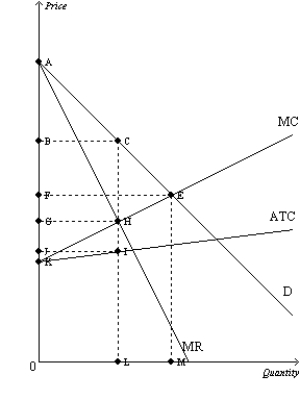 -Refer to Figure 16-13. Which of the following areas represents the profit for this profit maximizing monopolistically competitive firm?
 (Multiple Choice)
4.9/5 (94)
(94) Figure 16-9
The figure is drawn for a monopolistically-competitive firm. 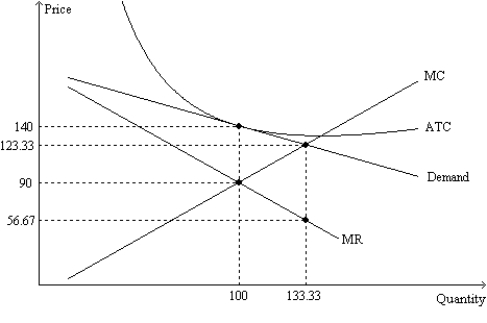 -Refer to Figure 16-9. When the firm is maximizing its profit, the markup over marginal cost amounts to
 (Multiple Choice)
4.9/5 (93)
(93) Under which of the following market structures would consumers likely receive the most product variety?
(Multiple Choice)
4.9/5 (86)
(86) Table 16-3
The following table shows the output produced by each of the top eight firms in four industries as well as the total industry output for those industries. 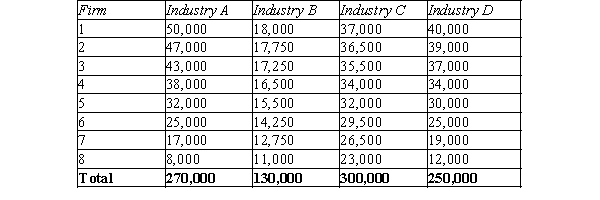 -Refer to Table 16-3. Based on the concentration ratio, which industry is the least competitive?
 (Multiple Choice)
4.8/5 (88)
(88) Scenario 16-7
Consider the problem facing two firms, YumYum and Bertollini, in the frozen food market. Each firm has just come up with an idea for a new "frozen meal for two" which it would sell for $9. Assume that the marginal cost for each new product is a constant $2, and the only fixed cost is for advertising. Each company knows that if it spends $12 million on advertising it will get 1.5 million consumers to try its new product. YumYum has done market research which suggests that its product does not have any "staying" power in the market. Even though it could get 1.5 million consumers to buy the product once, it is unlikely that they will continue to buy the product in the future. Bertollini's market research suggests that its product is very good, and consumers who try the product will continue to be consumers over the ensuing year. On the basis of its market research, Bertollini estimates that its initial 1.5 million customers will buy one unit of the product each month in the coming year, for a total of 18 million units.
-Refer to Scenario 16-7. Which of the following is most likely?
(Multiple Choice)
4.8/5 (82)
(82) Figure 16-5 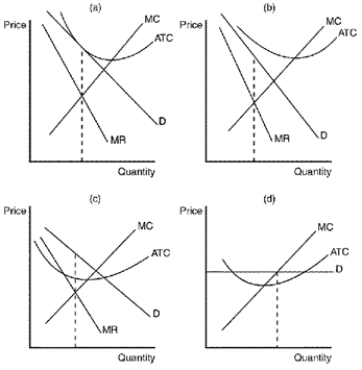 -Refer to Figure 16-5. Which of the graphs depicts a short-run equilibrium that will not encourage either the entry or exit of firms in a monopolistically competitive industry?
 (Multiple Choice)
4.7/5 (82)
(82) Figure 16-11 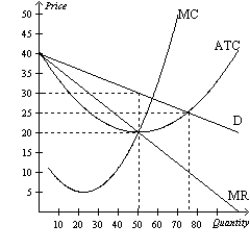 -Refer to Figure 16-11. If this firm profit-maximizes, how much profit or loss will it earn?
 (Short Answer)
4.8/5 (92)
(92) Figure 16-2. The figure is drawn for a monopolistically competitive firm.
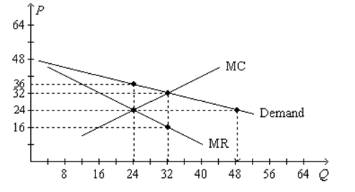 -Refer to Figure 16-2. If the average variable cost is $24 at the profit-maximizing quantity, and if the firm's fixed costs amount to $60, then the firm's maximum profit is
 (Multiple Choice)
4.8/5 (80)
(80) The commercial jetliner industry consisting of Boeing and Airbus would best be described as a (an)
(Multiple Choice)
4.9/5 (72)
(72) Free entry and exit means that the number of firms in the market adjusts until
(Multiple Choice)
4.9/5 (79)
(79) Scenario 16-7
Consider the problem facing two firms, YumYum and Bertollini, in the frozen food market. Each firm has just come up with an idea for a new "frozen meal for two" which it would sell for $9. Assume that the marginal cost for each new product is a constant $2, and the only fixed cost is for advertising. Each company knows that if it spends $12 million on advertising it will get 1.5 million consumers to try its new product. YumYum has done market research which suggests that its product does not have any "staying" power in the market. Even though it could get 1.5 million consumers to buy the product once, it is unlikely that they will continue to buy the product in the future. Bertollini's market research suggests that its product is very good, and consumers who try the product will continue to be consumers over the ensuing year. On the basis of its market research, Bertollini estimates that its initial 1.5 million customers will buy one unit of the product each month in the coming year, for a total of 18 million units.
-Refer to Scenario 16-7. If YumYum decides to advertise its product it can expect to
(Multiple Choice)
4.9/5 (77)
(77) To maximize its profit, a monopolistically competitive firm chooses its level of output by looking for the level of output at which
(Multiple Choice)
4.9/5 (88)
(88) The product-variety externality and the business-stealing externality are both spillover benefits of new firms entering a monopolistically competitive market.
(True/False)
4.8/5 (66)
(66) Piper consumes Ragu spaghetti sauce exclusively. She claims that there is a clear taste difference and that competing brands of spaghetti sauce leave an unsavory taste in her mouth. However, in a blind taste test, Piper is found to prefer generic store-brand spaghetti sauce to Ragu spaghetti sauce eight out of ten times. The results of Piper's taste test would reinforce claims by critics of brand names that
(Multiple Choice)
4.9/5 (60)
(60) Scenario 16-9
Dean goes to the grocery store to buy chips and soda for a party. He purchases brand name products even though generic versions are available at lower prices. His friend John says he was irrational to spend more for a nearly identical product. His friend Martina agreed with Dean's decision to spend more for the brand name products.
-Refer to Scenario 16-9. Martina offers two reasons for agreeing with Dean's decision. What are they?
(Essay)
4.9/5 (81)
(81) When monopolistically competitive firms advertise, in the long run
(Multiple Choice)
4.8/5 (78)
(78) 
Filters
- Essay(0)
- Multiple Choice(0)
- Short Answer(0)
- True False(0)
- Matching(0)