



 Chat with AI
Exam 16: Monopolistic Competition

Exam 1: Ten Principles of Economics455 Questions
Exam 2: Thinking Like an Economist645 Questions
Exam 3: Interdependence and the Gains From Trade550 Questions
Exam 4: The Market Forces of Supply and Demand693 Questions
Exam 5: Elasticity and Its Application625 Questions
Exam 6: Supply, Demand, and Government Policies671 Questions
Exam 7: Consumers, Producers, and the Efficiency of Markets547 Questions
Exam 8: Application: The Costs of Taxation507 Questions
Exam 9: Application: International Trade521 Questions
Exam 10: Externalities543 Questions
Exam 11: Public Goods and Common Resources453 Questions
Exam 12: The Design of the Tax System563 Questions
Exam 13: The Costs of Production649 Questions
Exam 14: Firms in Competitive Markets608 Questions
Exam 15: Monopoly662 Questions
Exam 16: Monopolistic Competition649 Questions
Exam 17: Oligopoly522 Questions
Exam 18: The Markets for the Factors of Production592 Questions
Exam 19: Earnings and Discrimination511 Questions
Exam 20: Income Inequality and Poverty478 Questions
Exam 21: The Theory of Consumer Choice568 Questions
Exam 22: Frontiers in Microeconomics461 Questions
Select questions type


Scenario 16-2
Suppose market demand for a product is given by the equation P = 20 - Q. For this market demand curve, marginal revenue is MR = 20 - 2Q.
-Refer to Scenario 16-2. If the marginal cost of producing this good is 0, how much total consumer surplus would consumers receive in this market?
(Multiple Choice)
4.8/5  (82)
(82) Scenario 16-3
Peter operates an ice cream shop in the center of Fairfield. He sells several unusual flavors of organic, homemade ice cream so he has a monopoly over his own ice cream, though he competes with many other firms selling ice cream in Fairfield for the same customers. Peter's demand and cost values for sales per day are given in the table below. (Everyone who purchases Peter's ice cream buys a double scoop cone because it's so delicious.) 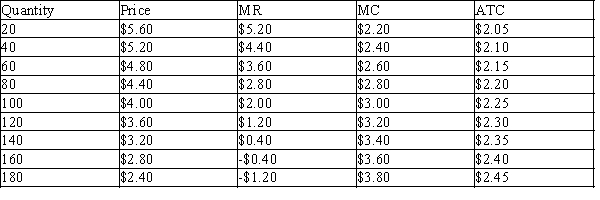 -Refer to Scenario 16-3. When Peter maximizes his profits, what is his total cost per day?
 (Short Answer)
4.8/5 (82)
(82) In markets where the government imposes an excise tax on unit sales, it also has a tendency to dabble with restrictions on advertising (for example, cigarettes and hard liquor). Do potential (or actual) restrictions on advertising in these markets serve the interest of a government that is interested in maximizing its tax revenue from the sale of these products? Explain your answer.
(Essay)
4.9/5 (85)
(85) Long-run profit earned by a monopolistically competitive firm is driven to the competitive level due to a(n)
(Multiple Choice)
4.8/5 (84)
(84) Empirical evidence suggests that advertising usually leads to an increase in the price for advertised products.
(True/False)
4.8/5 (72)
(72) For a profit-maximizing monopolistically competitive firm, marginal revenue exceeds marginal cost in
(Multiple Choice)
4.8/5 (86)
(86) The government of Italy will not allow any Hard Rock Cafe restaurants to open in Italy. Defenders of the efficiency of brand-name markets would argue that this has hindered restaurant market efficiency in Italy.
(True/False)
4.9/5 (86)
(86) Figure 16-12 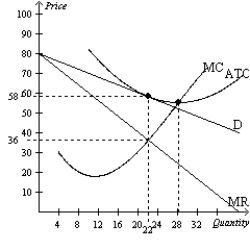 -Refer to Figure 16-12. What is the efficient scale of production?
 (Multiple Choice)
5.0/5 (93)
(93) Which of the following goods is most likely to be associated with monopolistic competition?
(Multiple Choice)
4.7/5 (82)
(82) Entry of firms in a monopolistically competitive industry is characterized by two externalities. List them and briefly describe how consumers and existing firms are influenced by them.
(Essay)
5.0/5 (82)
(82) For the economy as a whole, spending on advertising comprises about what percent of total firm revenue?
(Multiple Choice)
4.9/5 (93)
(93) Which of the following goods is most likely to be associated with monopolistic competition?
(Multiple Choice)
4.8/5 (81)
(81) In many college towns, private independent bookstores typically locate on the periphery of the college campus. However, in some college towns, the university has used political power to restrict private bookstores near campus through community zoning laws. Use your knowledge of markets to predict the price and quality of service differences in the market for college textbooks under the two different market regimes.
(Essay)
4.9/5 (55)
(55) Which of the following conditions is characteristic of a monopolistically competitive firm in short-run equilibrium?
(Multiple Choice)
4.7/5 (80)
(80) A market structure with only a few sellers, each offering similar or identical products, is known as
(Multiple Choice)
4.9/5 (71)
(71) A profit-maximizing firm operating in a monopolistically competitive market that is in a long-run equilibrium has
(Multiple Choice)
5.0/5 (75)
(75) Scenario 16-3
Peter operates an ice cream shop in the center of Fairfield. He sells several unusual flavors of organic, homemade ice cream so he has a monopoly over his own ice cream, though he competes with many other firms selling ice cream in Fairfield for the same customers. Peter's demand and cost values for sales per day are given in the table below. (Everyone who purchases Peter's ice cream buys a double scoop cone because it's so delicious.) 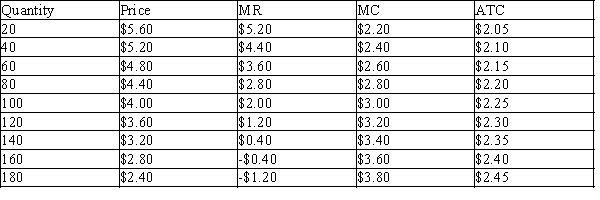 -Refer to Scenario 16-3. Which of the following statements best describes the long run adjustment in this market?
 (Multiple Choice)
4.9/5 (81)
(81) Scenario 16-1
Suppose the following are the sales for all of the firms in two different industries. 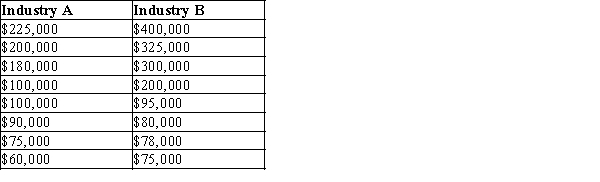 -Refer to Scenario 16-1. Which of the following statements is correct regarding the competitiveness of these two industries?
 (Multiple Choice)
4.7/5 (70)
(70) 
Filters
- Essay(0)
- Multiple Choice(0)
- Short Answer(0)
- True False(0)
- Matching(0)