



 Chat with AI
Exam 31: Fungi

Exam 1: Evolution, the Themes of Biology, and Scientific Inquiry51 Questions
Exam 2: The Chemical Context of Life61 Questions
Exam 3: Water and Life55 Questions
Exam 4: Carbon and the Molecular Diversity of Life58 Questions
Exam 5: The Structure and Function of Large Biological Molecules70 Questions
Exam 6: A Tour of the Cell66 Questions
Exam 7: Membrane Structure and Function68 Questions
Exam 8: An Introduction to Metabolism67 Questions
Exam 9: Cellular Respiration and Fermentation68 Questions
Exam 10: Photosynthesis65 Questions
Exam 11: Cell Communication65 Questions
Exam 12: The Cell Cycle66 Questions
Exam 13: Meiosis and Sexual Life Cycles64 Questions
Exam 14: Mendel and the Gene Idea62 Questions
Exam 15: The Chromosomal Basis of Inheritance58 Questions
Exam 16: The Molecular Basis of Inheritance65 Questions
Exam 17: Gene Expression: From Gene to Protein67 Questions
Exam 18: Regulation of Gene Expression66 Questions
Exam 19: Viruses54 Questions
Exam 20: Dna Tools and Biotechnology57 Questions
Exam 21: Genomes and Their Evolution44 Questions
Exam 22: Descent With Modification: a Darwinian View of Life60 Questions
Exam 23: The Evolution of Populations64 Questions
Exam 24: The Origin of Species67 Questions
Exam 25: The History of Life on Earth59 Questions
Exam 26: Phylogeny and the Tree of Life75 Questions
Exam 27: Bacteria and Archaea75 Questions
Exam 28: Protists79 Questions
Exam 29: Plant Diversity I: How Plants Colonised Land82 Questions
Exam 30: Plant Diversity Ii: the Evolution of Seed Plants80 Questions
Exam 31: Fungi70 Questions
Exam 32: An Overview of Animal Diversity67 Questions
Exam 33: An Introduction to Invertebrates83 Questions
Exam 34: The Origin and Evolution of Vertebrates82 Questions
Exam 35: Vascular Plant Structure, Growth, and Development65 Questions
Exam 36: Resource Acquisition and Transport in Vascular Plants74 Questions
Exam 37: Soil and Plant Nutrition52 Questions
Exam 38: Angiosperm Reproduction and Biotechnology60 Questions
Exam 39: Plant Responses to Internal and External Signals61 Questions
Exam 40: Basic Principles of Animal Form and Function68 Questions
Exam 41: Animal Nutrition64 Questions
Exam 42: Circulation and Gas Exchange67 Questions
Exam 43: The Immune System69 Questions
Exam 44: Osmoregulation and Excretion64 Questions
Exam 45: Hormones and the Endocrine System66 Questions
Exam 46: Animal Reproduction68 Questions
Exam 47: Animal Development70 Questions
Exam 48: Neurons, Synapses, and Signalling68 Questions
Exam 49: Nervous Systems65 Questions
Exam 50: Sensory and Motor Mechanisms67 Questions
Select questions type


If all fungi in an environment that perform decomposition were to suddenly die, then which group of organisms should benefit most, due to the fact that their fungal competitors have been removed?
(Multiple Choice)
4.7/5  (87)
(87) If you wanted to use fungi to improve the environment, which of the following research goals would make the most sense?
(Multiple Choice)
4.8/5 (70)
(70) Early fungi probably formed mutualistic associations with early plants, providing nutrients to the plant and receiving energy-containing compounds. Evidence that plants' ability to form a mutualistic association with fungi is due to ancient genes includes which of the following occurrences?
(Multiple Choice)
4.9/5 (86)
(86) There is much discussion in the media about protecting biodiversity. But does biodiversity really matter? Canadian and Swiss researchers wanted to know if the diversity of arbuscular mycorrhizal fungi (AMF) was important to the productivity of grasslands (M.G.A. van der Heijden, J. N. Klironomos, M. Ursic, P. Moutoglis, R. Streitwolf-Engel, T. Boler, A. Wiemken, and I. R. Sanders. 1998. Mycorrhizal fungal diversity determines plant biodiversity, ecosystem variability, and productivity. Nature 396:69-72). Specifically, they wanted to know if it mattered which specific AMF species were present, or just that some type of AMF was present. They grew various plants in combination with one of four AMF species (A, B, C, and D), no AMF species (O), or all four AMF species together (A + B + C + D); and they measured plant growth under each set of conditions. All plant species were grown in each plot, so they always competed with each other, with the only difference being which AMF species were present.
On the graphs, the x-axis labels indicate the number and identity of AMF species (bar 0 = no fungi; bars A - D = individual AMF species; bar A + B + C + D = all AMF species together). The y-axis indicates the amount (grams) of plant biomass for the species shown in italics above each graph. 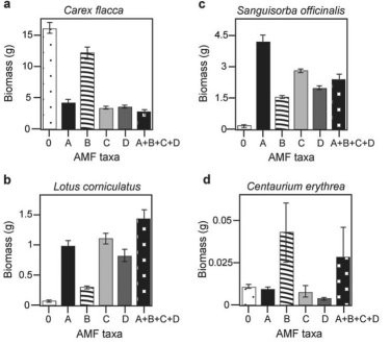 -Examine all four graphs and choose the plant species that grows best with a combination of AMF species.
 (Multiple Choice)
5.0/5 (78)
(78) There is much discussion in the media about protecting biodiversity. But does biodiversity really matter? Canadian and Swiss researchers wanted to know if the diversity of arbuscular mycorrhizal fungi (AMF) was important to the productivity of grasslands (M.G.A. van der Heijden, J. N. Klironomos, M. Ursic, P. Moutoglis, R. Streitwolf-Engel, T. Boler, A. Wiemken, and I. R. Sanders. 1998. Mycorrhizal fungal diversity determines plant biodiversity, ecosystem variability, and productivity. Nature 396:69-72). Specifically, they wanted to know if it mattered which specific AMF species were present, or just that some type of AMF was present. They grew various plants in combination with one of four AMF species (A, B, C, and D), no AMF species (O), or all four AMF species together (A + B + C + D); and they measured plant growth under each set of conditions. All plant species were grown in each plot, so they always competed with each other, with the only difference being which AMF species were present.
On the graphs, the x-axis labels indicate the number and identity of AMF species (bar 0 = no fungi; bars A - D = individual AMF species; bar A + B + C + D = all AMF species together). The y-axis indicates the amount (grams) of plant biomass for the species shown in italics above each graph.
-Examine the effect of AMF species on Sanguisorba officinalis. Which of the following conclusions can be correctly drawn from the data?
-Examine the effect of AMF species on Sanguisorba officinalis. Which of the following conclusions can be correctly drawn from the data? (Multiple Choice)
4.8/5 (82)
(82) Suzanne Simard and colleagues knew that the same mycorrhizal fungal species could colonise multiple types of trees. They wondered if the same fungal individual would colonise different trees, forming an underground network that potentially could transport carbon and nutrients from one tree to another (S. Simard et al. 1997. Net transfer of carbon between mycorrhizal tree species in the field. Nature 388:579-82).
Pots containing seedlings of three different tree species were set up and grown under natural conditions for three years (Fig.A). Two of the three species (Douglas fir, birch) could form ectomycorrhizal connections with the same fungal species, but the third species (cedar) could not form an ectomycorrhizal connection with the fungal species. In some of the pots, the researchers placed airtight bags over the Douglas fir and birch seedlings and injected carbon dioxide made from carbon-13 into the bags with the Douglas fir and carbon dioxide made from carbon-14 into the bags with the birch. (13C and 14C are different isotopes of carbon that can be detected and measured by researchers.) As the seedlings photosynthesised, the carbon dioxide was converted into sugars that could be tracked and measured by the researchers. The researchers measured whether the sugars in each plant contained only the carbon isotope that was in the air of their plastic bag or also the carbon isotope from the air around the other plant.
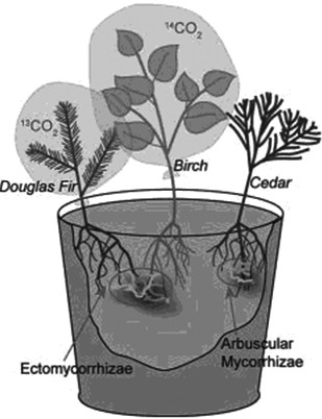 Figure A
-Referring to Simard et al. (1997), what is the result that would most strongly refute their hypothesis? [Hypothesis: Sugars made by one plant during photosynthesis can travel through a mycorrhizal fungus and be incorporated into the tissues of another plant.]
Figure A
-Referring to Simard et al. (1997), what is the result that would most strongly refute their hypothesis? [Hypothesis: Sugars made by one plant during photosynthesis can travel through a mycorrhizal fungus and be incorporated into the tissues of another plant.] (Multiple Choice)
4.7/5 (77)
(77) Some nematode worms suck plant juices from the roots of plants and are economically important agricultural pests. Some fungi are usually decomposers of plant material, but some trap and kill nematodes at times. Arthrobotrys traps and kills nematodes, especially when they lack nitrogen sources. These two facts suggest that farmers could find Arthrobotrys an important tool in combating nematode infestations. Which of the following research questions would make a good starting point for developing such a defence against plant-sucking nematodes?
(Multiple Choice)
4.8/5 (81)
(81) Suzanne Simard and colleagues knew that the same mycorrhizal fungal species could colonise multiple types of trees. They wondered if the same fungal individual would colonise different trees, forming an underground network that potentially could transport carbon and nutrients from one tree to another (S. Simard et al. 1997. Net transfer of carbon between mycorrhizal tree species in the field. Nature 388:579-82).
Pots containing seedlings of three different tree species were set up and grown under natural conditions for three years (Fig.A). Two of the three species (Douglas fir, birch) could form ectomycorrhizal connections with the same fungal species, but the third species (cedar) could not form an ectomycorrhizal connection with the fungal species. In some of the pots, the researchers placed airtight bags over the Douglas fir and birch seedlings and injected carbon dioxide made from carbon-13 into the bags with the Douglas fir and carbon dioxide made from carbon-14 into the bags with the birch. (13C and 14C are different isotopes of carbon that can be detected and measured by researchers.) As the seedlings photosynthesised, the carbon dioxide was converted into sugars that could be tracked and measured by the researchers. The researchers measured whether the sugars in each plant contained only the carbon isotope that was in the air of their plastic bag or also the carbon isotope from the air around the other plant.
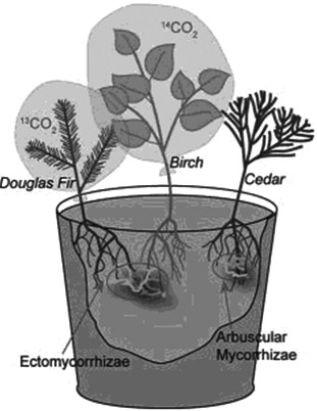 Figure A
-Based on the idea that fungi have pores between their cell walls that allow cytoplasm to move from one end of the mycelium to the other, which of the following hypotheses is the most plausible?
Figure A
-Based on the idea that fungi have pores between their cell walls that allow cytoplasm to move from one end of the mycelium to the other, which of the following hypotheses is the most plausible? (Multiple Choice)
4.8/5 (81)
(81) There is much discussion in the media about protecting biodiversity. But does biodiversity really matter? Canadian and Swiss researchers wanted to know if the diversity of arbuscular mycorrhizal fungi (AMF) was important to the productivity of grasslands (M.G.A. van der Heijden, J. N. Klironomos, M. Ursic, P. Moutoglis, R. Streitwolf-Engel, T. Boler, A. Wiemken, and I. R. Sanders. 1998. Mycorrhizal fungal diversity determines plant biodiversity, ecosystem variability, and productivity. Nature 396:69-72). Specifically, they wanted to know if it mattered which specific AMF species were present, or just that some type of AMF was present. They grew various plants in combination with one of four AMF species (A, B, C, and D), no AMF species (O), or all four AMF species together (A + B + C + D); and they measured plant growth under each set of conditions. All plant species were grown in each plot, so they always competed with each other, with the only difference being which AMF species were present.
On the graphs, the x-axis labels indicate the number and identity of AMF species (bar 0 = no fungi; bars A - D = individual AMF species; bar A + B + C + D = all AMF species together). The y-axis indicates the amount (grams) of plant biomass for the species shown in italics above each graph.
-Based on the graphs in the figure, which of the following plant species is most likely not to form mycorrhizal associations?
-Based on the graphs in the figure, which of the following plant species is most likely not to form mycorrhizal associations? (Multiple Choice)
4.8/5 (77)
(77) Fungi have an extremely high surface-to-volume ratio. What is the advantage of this characteristic to an organism that gets most of its nutrition through absorption?
(Multiple Choice)
4.9/5 (87)
(87) Along with bacteria and protozoa, some chytrid fungi live in the digestive tracts of cattle and aid in the digestion of plant matter; thus, all three groups represent potential mutualists with cattle. In an experiment designed to test how much of a contribution to cell wall digestion was made by fungi in one part of the stomach (rumen), Lee et al. fed grain to cattle and then removed samples of the rumen contents. They took these samples to the laboratory and experimentally treated them with various chemicals to produce fractions that contained (A) only fungi, (B) only bacteria, (C) only protozoa, and (D) all of the potential mutualists. They then measured the percent of the cell wall that was degraded (see the figure). 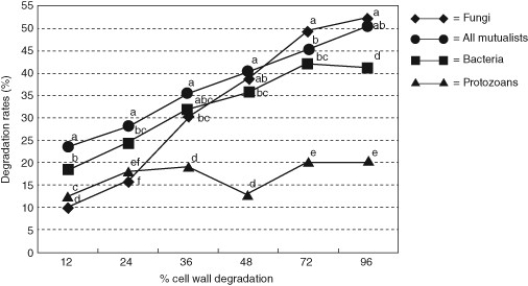 Degradation rates of cell walls extracted from Orchard grass by the monoculture system to assess the relative contributions of digestion by bacterial (square), protozoan (triangle), and fungal (diamond) systems, and all components (closed circle) as a control. The lowercase letters above the spots indicate statistical significance; mean values with different letters are significantly different (P < 0.05).
-Predict the results if the researchers had used a control that contained no potential mutualists (negative control).
Degradation rates of cell walls extracted from Orchard grass by the monoculture system to assess the relative contributions of digestion by bacterial (square), protozoan (triangle), and fungal (diamond) systems, and all components (closed circle) as a control. The lowercase letters above the spots indicate statistical significance; mean values with different letters are significantly different (P < 0.05).
-Predict the results if the researchers had used a control that contained no potential mutualists (negative control). (Multiple Choice)
4.8/5 (90)
(90) Along with bacteria and protozoa, some chytrid fungi live in the digestive tracts of cattle and aid in the digestion of plant matter; thus, all three groups represent potential mutualists with cattle. In an experiment designed to test how much of a contribution to cell wall digestion was made by fungi in one part of the stomach (rumen), Lee et al. fed grain to cattle and then removed samples of the rumen contents. They took these samples to the laboratory and experimentally treated them with various chemicals to produce fractions that contained (A) only fungi, (B) only bacteria, (C) only protozoa, and (D) all of the potential mutualists. They then measured the percent of the cell wall that was degraded (see the figure). 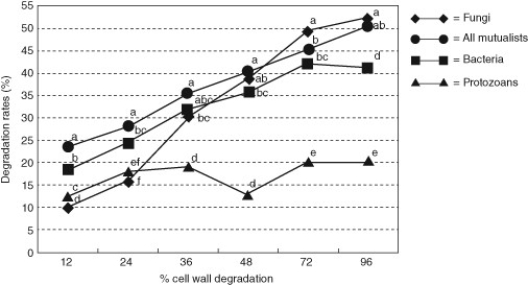 Degradation rates of cell walls extracted from Orchard grass by the monoculture system to assess the relative contributions of digestion by bacterial (square), protozoan (triangle), and fungal (diamond) systems, and all components (closed circle) as a control. The lowercase letters above the spots indicate statistical significance; mean values with different letters are significantly different (P < 0.05).
Which of the following conclusions can be drawn correctly from the data?
Degradation rates of cell walls extracted from Orchard grass by the monoculture system to assess the relative contributions of digestion by bacterial (square), protozoan (triangle), and fungal (diamond) systems, and all components (closed circle) as a control. The lowercase letters above the spots indicate statistical significance; mean values with different letters are significantly different (P < 0.05).
Which of the following conclusions can be drawn correctly from the data? (Multiple Choice)
4.8/5 (69)
(69) Asexual reproduction in yeasts occurs by budding. Due to unequal cytokinesis, the "bud" cell receives less cytoplasm than the parent cell. Which of the following statements should be an accurate characterisation of the smaller cell until it reaches the size of the larger cell?
(Multiple Choice)
4.8/5 (66)
(66) Which feature seen in chytrids supports the hypothesis that they diverged earliest in fungal evolution?
(Multiple Choice)
4.9/5 (81)
(81) When pathogenic fungi are found growing on the roots of grape vines, grape farmers sometimes respond by covering the ground around their vines with plastic sheeting and pumping a gaseous fungicide into the soil. The most important concern of grape farmers who engage in this practice should be that the ________.
(Multiple Choice)
4.9/5 (75)
(75) Mycorrhizae are to the roots of vascular plants as endophytes are to the ________ of vascular plants.
(Multiple Choice)
5.0/5 (69)
(69) You observe the gametes of a fungal species under the microscope and realise that they resemble animal sperm. To which of the following groups does the fungus belong?
(Multiple Choice)
5.0/5 (75)
(75) 
Filters
- Essay(0)
- Multiple Choice(0)
- Short Answer(0)
- True False(0)
- Matching(0)