



 Chat with AI
Exam 3: Water and Life

Exam 1: Evolution, the Themes of Biology, and Scientific Inquiry51 Questions
Exam 2: The Chemical Context of Life61 Questions
Exam 3: Water and Life55 Questions
Exam 4: Carbon and the Molecular Diversity of Life58 Questions
Exam 5: The Structure and Function of Large Biological Molecules70 Questions
Exam 6: A Tour of the Cell66 Questions
Exam 7: Membrane Structure and Function68 Questions
Exam 8: An Introduction to Metabolism67 Questions
Exam 9: Cellular Respiration and Fermentation68 Questions
Exam 10: Photosynthesis65 Questions
Exam 11: Cell Communication65 Questions
Exam 12: The Cell Cycle66 Questions
Exam 13: Meiosis and Sexual Life Cycles64 Questions
Exam 14: Mendel and the Gene Idea62 Questions
Exam 15: The Chromosomal Basis of Inheritance58 Questions
Exam 16: The Molecular Basis of Inheritance65 Questions
Exam 17: Gene Expression: From Gene to Protein67 Questions
Exam 18: Regulation of Gene Expression66 Questions
Exam 19: Viruses54 Questions
Exam 20: Dna Tools and Biotechnology57 Questions
Exam 21: Genomes and Their Evolution44 Questions
Exam 22: Descent With Modification: a Darwinian View of Life60 Questions
Exam 23: The Evolution of Populations64 Questions
Exam 24: The Origin of Species67 Questions
Exam 25: The History of Life on Earth59 Questions
Exam 26: Phylogeny and the Tree of Life75 Questions
Exam 27: Bacteria and Archaea75 Questions
Exam 28: Protists79 Questions
Exam 29: Plant Diversity I: How Plants Colonised Land82 Questions
Exam 30: Plant Diversity Ii: the Evolution of Seed Plants80 Questions
Exam 31: Fungi70 Questions
Exam 32: An Overview of Animal Diversity67 Questions
Exam 33: An Introduction to Invertebrates83 Questions
Exam 34: The Origin and Evolution of Vertebrates82 Questions
Exam 35: Vascular Plant Structure, Growth, and Development65 Questions
Exam 36: Resource Acquisition and Transport in Vascular Plants74 Questions
Exam 37: Soil and Plant Nutrition52 Questions
Exam 38: Angiosperm Reproduction and Biotechnology60 Questions
Exam 39: Plant Responses to Internal and External Signals61 Questions
Exam 40: Basic Principles of Animal Form and Function68 Questions
Exam 41: Animal Nutrition64 Questions
Exam 42: Circulation and Gas Exchange67 Questions
Exam 43: The Immune System69 Questions
Exam 44: Osmoregulation and Excretion64 Questions
Exam 45: Hormones and the Endocrine System66 Questions
Exam 46: Animal Reproduction68 Questions
Exam 47: Animal Development70 Questions
Exam 48: Neurons, Synapses, and Signalling68 Questions
Exam 49: Nervous Systems65 Questions
Exam 50: Sensory and Motor Mechanisms67 Questions
Select questions type


One of the buffers that contribute to pH stability in human blood is carbonic acid (H₂CO₃). Carbonic acid is a weak acid that, when placed in an aqueous solution, dissociates into a bicarbonate ion (HCO₃-) and a hydrogen ion (H⁺). (See figure.)  If the pH of blood drops, one would expect ________.
Free
(Multiple Choice)
4.8/5  (70)
(70) Correct Answer: Verified
C
Measurements show that the pH of a particular lake is 4.0. What is the hydrogen ion concentration of the lake?
Free
(Multiple Choice)
4.8/5 (85)
(85) Correct Answer:Verified
VerifiedC
Thermal energy of the water in a bathtub is ________ than in freshly brewed coffee because of its ________.
Free
(Multiple Choice)
4.8/5 (70)
(70) Correct Answer:Verified
VerifiedA
A beaker contains 100 millilitres (mL) of NaOH solution at pH = 13. A technician carefully pours into the beaker 10 mL of HCl at pH = 1. Which of the following statements correctly describes the result of this mixing?
(Multiple Choice)
4.8/5 (78)
(78) Which of the following can be attributed to water's high specific heat?
(Multiple Choice)
4.9/5 (75)
(75) Measurements show that the pH of a particular lake is 4.0. What is the hydroxide ion concentration of the lake?
(Multiple Choice)
4.7/5 (88)
(88) A 0.01 M solution of a substance has a pH of 2. What can you conclude about this substance?
(Multiple Choice)
4.8/5 (80)
(80) A slice of pizza has 500 kcal. If we could burn the pizza and use all the heat to warm a 50-L container of cold water, what would be the approximate increase in the temperature of the water? (Note: A litre of cold water weighs about 1 kg.)
(Multiple Choice)
4.7/5 (82)
(82) To act as an effective coolant in a car's radiator, a substance has to have the capacity to absorb a great deal of heat. You have a reference book with tables listing the physical properties of many liquids. In choosing a coolant for your car, which table would you check first?
(Multiple Choice)
5.0/5 (86)
(86) The loss of water from a plant by transpiration cools the leaf. Movement of water in transpiration requires both adhesion to the conducting walls and wood fibres of the plant and cohesion of the molecules to each other. A scientist wanted to increase the rate of transpiration of a crop species to extend its range into warmer climates. The scientist substituted a nonpolar solution with an atomic mass similar to that of water for hydrating the plants. What do you expect the scientist's data will indicate from this experiment?
(Multiple Choice)
4.9/5 (85)
(85) You have a freshly prepared 0.1 M sucrose (molecular mass 342) solution, which means ________.
(Multiple Choice)
4.9/5 (79)
(79) 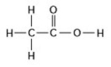 Two moles of the compound in the figure would weigh how many grams? (Note: The atomic masses, in daltons, are approximately 12 for carbon, 1 for hydrogen and 16 for oxygen.)
 (Multiple Choice)
4.8/5 (75)
(75) We can be sure that a mole of table sugar and a mole of vitamin C are equal in their
(Multiple Choice)
4.9/5 (83)
(83) The molar mass of glucose is 180 grams per mole (g/mol). Which of the following procedures should you carry out to make a 1 M solution of glucose? In 0.8 litre (L) of water, dissolve ________.
(Multiple Choice)
4.7/5 (72)
(72) Which of the following is considered to be a strong base (alkali)?
(Multiple Choice)
4.7/5 (68)
(68) The partial negative charge at one end of a water molecule is attracted to the partial positive charge of another water molecule. What is this attraction called?
(Multiple Choice)
4.7/5 (80)
(80) A dietary Calorie equals 1 kilocalorie. One kilocalorie equals ________.
(Multiple Choice)
4.9/5 (76)
(76) A solution with a pH of 2 has how many more protons in it than a solution with a pH of 4?
(Multiple Choice)
4.9/5 (84)
(84) Which of the following statements is true about buffer solutions?
(Multiple Choice)
4.9/5 (70)
(70) 
Filters
- Essay(0)
- Multiple Choice(0)
- Short Answer(0)
- True False(0)
- Matching(0)