



 Chat with AI
Exam 23: The Evolution of Populations

Exam 1: Evolution, the Themes of Biology, and Scientific Inquiry51 Questions
Exam 2: The Chemical Context of Life61 Questions
Exam 3: Water and Life55 Questions
Exam 4: Carbon and the Molecular Diversity of Life58 Questions
Exam 5: The Structure and Function of Large Biological Molecules70 Questions
Exam 6: A Tour of the Cell66 Questions
Exam 7: Membrane Structure and Function68 Questions
Exam 8: An Introduction to Metabolism67 Questions
Exam 9: Cellular Respiration and Fermentation68 Questions
Exam 10: Photosynthesis65 Questions
Exam 11: Cell Communication65 Questions
Exam 12: The Cell Cycle66 Questions
Exam 13: Meiosis and Sexual Life Cycles64 Questions
Exam 14: Mendel and the Gene Idea62 Questions
Exam 15: The Chromosomal Basis of Inheritance58 Questions
Exam 16: The Molecular Basis of Inheritance65 Questions
Exam 17: Gene Expression: From Gene to Protein67 Questions
Exam 18: Regulation of Gene Expression66 Questions
Exam 19: Viruses54 Questions
Exam 20: Dna Tools and Biotechnology57 Questions
Exam 21: Genomes and Their Evolution44 Questions
Exam 22: Descent With Modification: a Darwinian View of Life60 Questions
Exam 23: The Evolution of Populations64 Questions
Exam 24: The Origin of Species67 Questions
Exam 25: The History of Life on Earth59 Questions
Exam 26: Phylogeny and the Tree of Life75 Questions
Exam 27: Bacteria and Archaea75 Questions
Exam 28: Protists79 Questions
Exam 29: Plant Diversity I: How Plants Colonised Land82 Questions
Exam 30: Plant Diversity Ii: the Evolution of Seed Plants80 Questions
Exam 31: Fungi70 Questions
Exam 32: An Overview of Animal Diversity67 Questions
Exam 33: An Introduction to Invertebrates83 Questions
Exam 34: The Origin and Evolution of Vertebrates82 Questions
Exam 35: Vascular Plant Structure, Growth, and Development65 Questions
Exam 36: Resource Acquisition and Transport in Vascular Plants74 Questions
Exam 37: Soil and Plant Nutrition52 Questions
Exam 38: Angiosperm Reproduction and Biotechnology60 Questions
Exam 39: Plant Responses to Internal and External Signals61 Questions
Exam 40: Basic Principles of Animal Form and Function68 Questions
Exam 41: Animal Nutrition64 Questions
Exam 42: Circulation and Gas Exchange67 Questions
Exam 43: The Immune System69 Questions
Exam 44: Osmoregulation and Excretion64 Questions
Exam 45: Hormones and the Endocrine System66 Questions
Exam 46: Animal Reproduction68 Questions
Exam 47: Animal Development70 Questions
Exam 48: Neurons, Synapses, and Signalling68 Questions
Exam 49: Nervous Systems65 Questions
Exam 50: Sensory and Motor Mechanisms67 Questions
Select questions type


HIV's genome of RNA includes the code for reverse transcriptase (RT), an enzyme that acts early in infection to synthesise a DNA genome off of an RNA template. The HIV genome also codes for protease (PR), an enzyme that acts later in infection by cutting long viral polyproteins into smaller, functional proteins. Both RT and PR represent potential targets for antiretroviral drugs. Drugs called nucleoside analogues (NA) act against RT, whereas drugs called protease inhibitors (PI) act against PR.
Which mechanism produces variation for evolution by shuffling existing alleles?

Free
(Multiple Choice)
4.9/5  (71)
(71) Correct Answer: Verified
B
In the formula for determining a population's genotype frequencies, the "2" in the term 2pq is necessary because ________.
Free
(Multiple Choice)
4.8/5 (80)
(80) Correct Answer:Verified
VerifiedB
The inability of organisms to evolve anything that could be an advantage reflects ________.
Free
(Multiple Choice)
4.9/5 (86)
(86) Correct Answer:Verified
VerifiedA
No two people are genetically identical, except for identical twins. The main source of genetic variation among humans is
(Multiple Choice)
4.9/5 (79)
(79) Comparisons of Neanderthal DNA revealed that there are more similarities to non-African DNA than reference sequences from West Africans. Additionally, scientists found that Neanderthal DNA is as closely related to East Asians as to Europeans. This indicates that interbreeding occurred before human migration further east. What process of population genetics generated these results?
(Multiple Choice)
4.9/5 (85)
(85) Cystic fibrosis is a genetic disorder in homozygous recessives that causes death during the teenage years. If 9 in 10,000 newborn babies have the disease, what are the expected frequencies of the dominant (A1) and recessive (A2) alleles according to the Hardy-Weinberg equation?
(Multiple Choice)
4.8/5 (77)
(77) The Dunkers are a religious group that moved from Germany to Pennsylvania in the mid-1700s. They do not marry with members outside their own immediate community. Today, the Dunkers are genetically unique and differ in gene frequencies, at many loci, from all other populations including those in their original homeland. Which of the following mechanisms likely explains the genetic uniqueness of this population?
(Multiple Choice)
4.9/5 (67)
(67) The following experiment is used for the corresponding question.
A researcher discovered a species of moth that lays its eggs on oak trees. Eggs are laid at two distinct times of the year: early in spring when the oak trees are flowering and in midsummer when flowering is past. Caterpillars from eggs that hatch in spring feed on oak flowers and look like oak flowers. But caterpillars that hatch in summer feed on oak leaves and look like oak twigs.
How does the same population of moths produce such different-looking caterpillars on the same trees? To answer this question, the biologist caught many female moths from the same population and collected their eggs. He put at least one egg from each female into eight identical cups. The eggs hatched, and at least two larvae from each female were maintained in one of the four temperature and light conditions listed below. 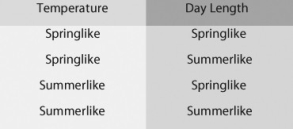 In each of the four environments, one of the caterpillars was fed oak flowers, the other oak leaves. Thus, there were a total of eight treatment groups (4 environments × 2 diets).
Which of the following is a testable hypothesis that would explain the differences in caterpillar appearance observed in this population?
In each of the four environments, one of the caterpillars was fed oak flowers, the other oak leaves. Thus, there were a total of eight treatment groups (4 environments × 2 diets).
Which of the following is a testable hypothesis that would explain the differences in caterpillar appearance observed in this population? (Multiple Choice)
4.8/5 (82)
(82) Which statement about the beak size of finches on the island of Daphne Major during prolonged drought is true?
(Multiple Choice)
4.8/5 (76)
(76) Whenever diploid populations are in Hardy-Weinberg equilibrium at a particular locus, ________.
(Multiple Choice)
4.9/5 (76)
(76) If the nucleotide variability of a locus equals 0%, what is the gene variability and number of alleles at that locus?
(Multiple Choice)
4.8/5 (73)
(73) A large population of laboratory animals has been allowed to breed randomly for a number of generations. After several generations, 25% of the animals display a recessive trait (aa), the same percentage as at the beginning of the breeding program. The rest of the animals show the dominant phenotype, with heterozygotes indistinguishable from the homozygous dominants.
What proportion of the population is probably heterozygous (Aa) for this trait?
(Multiple Choice)
4.8/5 (84)
(84) In a Hardy-Weinberg population with two alleles, A and a, that are in equilibrium, the frequency of the allele a is 0.3. What is the frequency of individuals that are homozygous for this allele?
(Multiple Choice)
4.9/5 (71)
(71) In the formula for determining a population's genotype frequencies, the "pq" in the term 2pq is necessary because ________.
(Multiple Choice)
4.9/5 (88)
(88) Which Hardy-Weinberg condition is affected by population size?
(Multiple Choice)
4.8/5 (85)
(85) Anopheles mosquitoes, which carry the malaria parasite, cannot live above elevations of 1,800 metres. In addition, oxygen availability decreases with higher altitude. Consider a hypothetical human population that is adapted to life on the slopes of Mt. Kilimanjaro in Tanzania, a country in equatorial Africa. Mt. Kilimanjaro's base is about 800 metres above sea level and its peak is 5,895 metres above sea level. If the incidence of the sickle-cell allele in the population is plotted against altitude (metres above sea level), which of the following distributions is most likely, assuming little migration of people up or down the mountain?
(Multiple Choice)
4.8/5 (77)
(77) Swine are vulnerable to infection by bird flu virus and human flu virus, which can both be present in an individual pig at the same time. When this occurs, it is possible for genes from bird flu virus and human flu virus to be combined. If the human flu virus contributes a gene for Tamiflu resistance (Tamiflu is an antiviral drug) to the new virus, and if the new virus is introduced to an environment lacking Tamiflu, then what is most likely to occur?
(Multiple Choice)
4.7/5 (96)
(96) Researchers studying a small milkweed population note that some plants produce a toxin and other plants do not. They identify the gene responsible for toxin production. The dominant allele (T) codes for an enzyme that makes the toxin, and the recessive allele (t) codes for a nonfunctional enzyme that cannot produce the toxin. Heterozygotes produce an intermediate amount of toxin. The genotypes of all individuals in the population are determined (see chart) and used to determine the actual allele frequencies in the population.  Is this population in Hardy-Weinberg equilibrium?
 (Multiple Choice)
4.8/5 (99)
(99) Martin Wikelski and L. Michael Romero (Body size, performance and fitness in Galápagos marine iguanas, Integrative and Comparative Biology 43 [2003]:376-86) measured the snout-to-vent (anus) length of Galápagos marine iguanas and observed the percent survival of different-sized animals, all of the same age. The graph shows the log snout-vent length (SVL, a measure of overall body size) plotted against the percent survival of these different size classes for males and females. 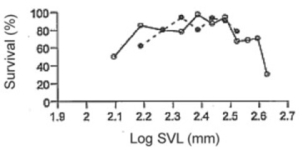 -Currently the only predators of Galápagos marine iguanas are Galápagos hawks. Iguana body size is not correlated with risk of hawk predation, although small iguanas can sprint faster than large iguanas. If predators (for example, cats) that preferably catch and eat slower iguanas are introduced to the island, iguana body size is likely to ________ in the absence of other factors; the iguanas would then be under ________ selection.
 (Multiple Choice)
4.8/5 (69)
(69) Suppose 64% of a remote mountain village can taste phenylthiocarbamide (PTC) and must, therefore, have at least one copy of the dominant PTC taster allele. If this population conforms to Hardy-Weinberg (1908) equilibrium for this gene, what percentage of the population must be heterozygous for this trait?
(Multiple Choice)
4.9/5 (82)
(82) 
Filters
- Essay(0)
- Multiple Choice(0)
- Short Answer(0)
- True False(0)
- Matching(0)