



 Chat with AI
Exam 41: Animal Nutrition

Exam 1: Evolution, the Themes of Biology, and Scientific Inquiry51 Questions
Exam 2: The Chemical Context of Life61 Questions
Exam 3: Water and Life55 Questions
Exam 4: Carbon and the Molecular Diversity of Life58 Questions
Exam 5: The Structure and Function of Large Biological Molecules70 Questions
Exam 6: A Tour of the Cell66 Questions
Exam 7: Membrane Structure and Function68 Questions
Exam 8: An Introduction to Metabolism67 Questions
Exam 9: Cellular Respiration and Fermentation68 Questions
Exam 10: Photosynthesis65 Questions
Exam 11: Cell Communication65 Questions
Exam 12: The Cell Cycle66 Questions
Exam 13: Meiosis and Sexual Life Cycles64 Questions
Exam 14: Mendel and the Gene Idea62 Questions
Exam 15: The Chromosomal Basis of Inheritance58 Questions
Exam 16: The Molecular Basis of Inheritance65 Questions
Exam 17: Gene Expression: From Gene to Protein67 Questions
Exam 18: Regulation of Gene Expression66 Questions
Exam 19: Viruses54 Questions
Exam 20: Dna Tools and Biotechnology57 Questions
Exam 21: Genomes and Their Evolution44 Questions
Exam 22: Descent With Modification: a Darwinian View of Life60 Questions
Exam 23: The Evolution of Populations64 Questions
Exam 24: The Origin of Species67 Questions
Exam 25: The History of Life on Earth59 Questions
Exam 26: Phylogeny and the Tree of Life75 Questions
Exam 27: Bacteria and Archaea75 Questions
Exam 28: Protists79 Questions
Exam 29: Plant Diversity I: How Plants Colonised Land82 Questions
Exam 30: Plant Diversity Ii: the Evolution of Seed Plants80 Questions
Exam 31: Fungi70 Questions
Exam 32: An Overview of Animal Diversity67 Questions
Exam 33: An Introduction to Invertebrates83 Questions
Exam 34: The Origin and Evolution of Vertebrates82 Questions
Exam 35: Vascular Plant Structure, Growth, and Development65 Questions
Exam 36: Resource Acquisition and Transport in Vascular Plants74 Questions
Exam 37: Soil and Plant Nutrition52 Questions
Exam 38: Angiosperm Reproduction and Biotechnology60 Questions
Exam 39: Plant Responses to Internal and External Signals61 Questions
Exam 40: Basic Principles of Animal Form and Function68 Questions
Exam 41: Animal Nutrition64 Questions
Exam 42: Circulation and Gas Exchange67 Questions
Exam 43: The Immune System69 Questions
Exam 44: Osmoregulation and Excretion64 Questions
Exam 45: Hormones and the Endocrine System66 Questions
Exam 46: Animal Reproduction68 Questions
Exam 47: Animal Development70 Questions
Exam 48: Neurons, Synapses, and Signalling68 Questions
Exam 49: Nervous Systems65 Questions
Exam 50: Sensory and Motor Mechanisms67 Questions
Select questions type


Pepsinogen is converted to its active form in the stomach by ________.

Free
(Multiple Choice)
4.8/5  (77)
(77) Correct Answer: Verified
A
A zoologist analyses the jawbones of an extinct mammal and concludes that it was an herbivore. The zoologist most likely came to this conclusion based upon the ________.
Free
(Multiple Choice)
4.9/5 (76)
(76) Correct Answer:Verified
VerifiedB
Because the foods eaten by animals are often composed largely of macromolecules, animals need to have mechanisms for ________.
Free
(Multiple Choice)
4.8/5 (76)
(76) Correct Answer:Verified
VerifiedB
Lysine is an essential amino acid for animals. If an animal did not consume lysine in its diet, you might expect that the animal ________.
(Multiple Choice)
4.9/5 (86)
(86) If a mammal did not obtain enough iodine in its diet, you might expect ________.
(Multiple Choice)
4.7/5 (72)
(72) Examine the digestive system structures in the figure. 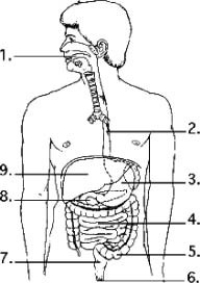 - The highest rate of nutrient absorption occurs at location ________.
 (Multiple Choice)
4.8/5 (83)
(83) In a healthy person, after a carbohydrate-rich meal, the production of ________ will increase, causing the uptake of ________ from the blood into liver cells.
(Multiple Choice)
4.9/5 (66)
(66) Feelings of hunger can be stimulated by the hormone ________, but suppressed by the hormone ________.
(Multiple Choice)
4.8/5 (79)
(79) Nutrient-rich blood from the intestine is carried through the ________ to the liver.
(Multiple Choice)
4.7/5 (75)
(75) The absorption of fats differs from that of carbohydrates in that ________.
(Multiple Choice)
5.0/5 (89)
(89) If you put the following events in the order they occur in the human digestive system, the third event in the series would be:
(Multiple Choice)
4.9/5 (78)
(78) After surgical removal of the gallbladder, a person might need to limit his or her dietary intake of
(Multiple Choice)
4.8/5 (62)
(62) Mechanical digestion, the process of breaking down large chunks of food into smaller pieces, is important because smaller pieces of food ________.
(Multiple Choice)
4.9/5 (76)
(76) 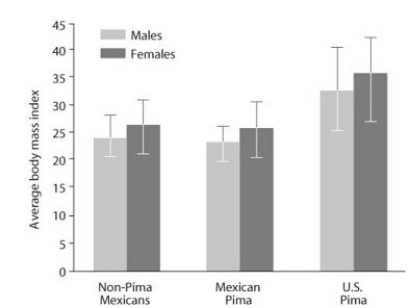 The Pimas are a group of people living in the south-western United States and Mexico. Although Pima Indians living in the United States and Mexico have a similar genetic background, a five-fold increase in the incidence of type II diabetes mellitus among US Pima has been reported. The body mass index of Mexicans of non-Pima descent, Mexicans of Pima descent, and Pimas living in the US is shown in the figure. Based on this information and the graph, what can you infer about the incidence of type II diabetes mellitus?
 (Multiple Choice)
4.8/5 (86)
(86) Jahasz-Pocsine and co-workers found a correlation between gastric bypass surgery and neurological complications. Surgeons performed gastric bypass surgery on 150 patients at the University of Arkansas for Medical Sciences Neurology Clinic. Of the 150 patients, 26 experienced neurological complications related to the surgery. What is the most likely cause for the neurological complications?
(Multiple Choice)
4.9/5 (69)
(69) 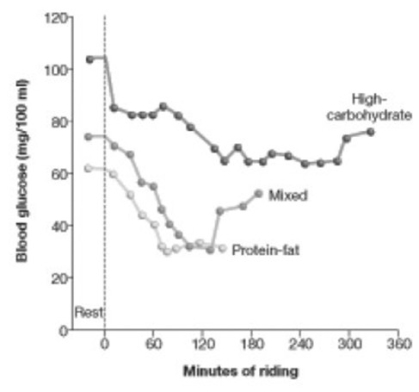 Three groups of cyclists consumed three different types of diets: high-carbohydrate; a diet mixed in carbohydrates, fat, and protein; or a diet higher in protein and fat. The average time each group could spend cycling over a six-hour period is shown in the accompanying graph. What conclusion from the data would help an athlete or trainer improve performance?
 (Multiple Choice)
4.9/5 (79)
(79) If there is a strong genetic link for type II diabetes mellitus in your family, how might you minimise your risk of developing the disorder?
(Multiple Choice)
4.9/5 (88)
(88) The following table shows the contents of a multivitamin supplement and its percentage of recommended daily values (% DV).
Vitamin A 70 Vitamin C 100 Vitamin D 100 Vitamin E 150 Vitamin K 13 Vitamin B1 100 Vitamin B 100 Folic acid 100 Vitamin B12 41.7 Calcium 20 Phosphorus 5 Iodine 100 Magnesium 25 Zinc 100 Copper 100 Chromium 125 Molybdenum 100 Iron 0
The most likely reason that some of the vitamins and minerals in this supplement are found at less than 100% is that ________.
(Multiple Choice)
5.0/5 (65)
(65) 
Filters
- Essay(0)
- Multiple Choice(0)
- Short Answer(0)
- True False(0)
- Matching(0)