



 Chat with AI
Exam 41: Animal Nutrition

Exam 1: Evolution, the Themes of Biology, and Scientific Inquiry51 Questions
Exam 2: The Chemical Context of Life61 Questions
Exam 3: Water and Life55 Questions
Exam 4: Carbon and the Molecular Diversity of Life58 Questions
Exam 5: The Structure and Function of Large Biological Molecules70 Questions
Exam 6: A Tour of the Cell66 Questions
Exam 7: Membrane Structure and Function68 Questions
Exam 8: An Introduction to Metabolism67 Questions
Exam 9: Cellular Respiration and Fermentation68 Questions
Exam 10: Photosynthesis65 Questions
Exam 11: Cell Communication65 Questions
Exam 12: The Cell Cycle66 Questions
Exam 13: Meiosis and Sexual Life Cycles64 Questions
Exam 14: Mendel and the Gene Idea62 Questions
Exam 15: The Chromosomal Basis of Inheritance58 Questions
Exam 16: The Molecular Basis of Inheritance65 Questions
Exam 17: Gene Expression: From Gene to Protein67 Questions
Exam 18: Regulation of Gene Expression66 Questions
Exam 19: Viruses54 Questions
Exam 20: Dna Tools and Biotechnology57 Questions
Exam 21: Genomes and Their Evolution44 Questions
Exam 22: Descent With Modification: a Darwinian View of Life60 Questions
Exam 23: The Evolution of Populations64 Questions
Exam 24: The Origin of Species67 Questions
Exam 25: The History of Life on Earth59 Questions
Exam 26: Phylogeny and the Tree of Life75 Questions
Exam 27: Bacteria and Archaea75 Questions
Exam 28: Protists79 Questions
Exam 29: Plant Diversity I: How Plants Colonised Land82 Questions
Exam 30: Plant Diversity Ii: the Evolution of Seed Plants80 Questions
Exam 31: Fungi70 Questions
Exam 32: An Overview of Animal Diversity67 Questions
Exam 33: An Introduction to Invertebrates83 Questions
Exam 34: The Origin and Evolution of Vertebrates82 Questions
Exam 35: Vascular Plant Structure, Growth, and Development65 Questions
Exam 36: Resource Acquisition and Transport in Vascular Plants74 Questions
Exam 37: Soil and Plant Nutrition52 Questions
Exam 38: Angiosperm Reproduction and Biotechnology60 Questions
Exam 39: Plant Responses to Internal and External Signals61 Questions
Exam 40: Basic Principles of Animal Form and Function68 Questions
Exam 41: Animal Nutrition64 Questions
Exam 42: Circulation and Gas Exchange67 Questions
Exam 43: The Immune System69 Questions
Exam 44: Osmoregulation and Excretion64 Questions
Exam 45: Hormones and the Endocrine System66 Questions
Exam 46: Animal Reproduction68 Questions
Exam 47: Animal Development70 Questions
Exam 48: Neurons, Synapses, and Signalling68 Questions
Exam 49: Nervous Systems65 Questions
Exam 50: Sensory and Motor Mechanisms67 Questions
Select questions type


A fasting animal whose energy needs exceed those provided in its diet will draw on its stored resources in which order?
(Multiple Choice)
4.9/5  (91)
(91) A significant contribution of intestinal bacteria to human nutrition is the benefit of bacterial ________.
(Multiple Choice)
4.8/5 (74)
(74) The active ingredient orlistat acts to decrease the amount of fat that is absorbed by attaching to enzymes that digest fat. Which of the following are potential targets of orlistat?
(Multiple Choice)
4.8/5 (80)
(80) Examine the digestive system structures in the figure. 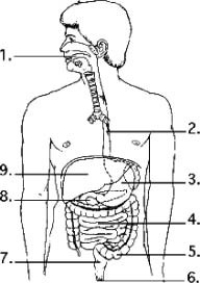 -Most of the digestion of fats occurs in structure(s) ________.
 (Multiple Choice)
4.8/5 (70)
(70) Upon activation by stomach acidity, the secretions of the parietal cells ________.
(Multiple Choice)
4.7/5 (79)
(79) If you found a vertebrate skull in the bush and the teeth were sharp and scissor-like, what type of food would you expect this animal to eat?
(Multiple Choice)
4.8/5 (97)
(97) Animals that migrate great distances would obtain the greatest energetic benefit of storing chemical energy as ________.
(Multiple Choice)
4.9/5 (87)
(87) When the digestion and absorption of organic carbohydrates results in more energy-rich molecules than are immediately required by an animal, the excess is ________.
(Multiple Choice)
4.9/5 (86)
(86) Coprophagy is important for the nutritional balance of ________.
(Multiple Choice)
4.9/5 (73)
(73) Examine the digestive system structures in the figure. 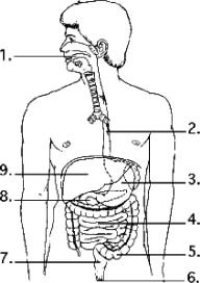 -The agents that help emulsify fats are produced in location ________.
 (Multiple Choice)
4.9/5 (88)
(88) Why do the cells of the digestive system secrete proteolytic enzymes, such as pepsin, in their inactive forms?
(Multiple Choice)
4.8/5 (81)
(81) Cattle are able to survive on a diet consisting almost entirely of plant material because cattle ________.
(Multiple Choice)
4.9/5 (89)
(89) If you were to jog one kilometre a few hours after lunch, which stored fuel would you probably tap?
(Multiple Choice)
4.8/5 (69)
(69) The large surface area in the gut directly facilitates ________.
(Multiple Choice)
4.9/5 (89)
(89) An advantage of a complete digestive system over a gastrovascular cavity is that the complete system ________.
(Multiple Choice)
4.9/5 (74)
(74) What is the importance of the mucus that are released by salivary glands?
(Multiple Choice)
4.7/5 (77)
(77) The process of obtaining food is known as ________ and requires specialised feeding mechanisms.
(Multiple Choice)
4.9/5 (64)
(64) 
Filters
- Essay(0)
- Multiple Choice(0)
- Short Answer(0)
- True False(0)
- Matching(0)