



 Chat with AI
Exam 46: Animal Reproduction

Exam 1: Evolution, the Themes of Biology, and Scientific Inquiry51 Questions
Exam 2: The Chemical Context of Life61 Questions
Exam 3: Water and Life55 Questions
Exam 4: Carbon and the Molecular Diversity of Life58 Questions
Exam 5: The Structure and Function of Large Biological Molecules70 Questions
Exam 6: A Tour of the Cell66 Questions
Exam 7: Membrane Structure and Function68 Questions
Exam 8: An Introduction to Metabolism67 Questions
Exam 9: Cellular Respiration and Fermentation68 Questions
Exam 10: Photosynthesis65 Questions
Exam 11: Cell Communication65 Questions
Exam 12: The Cell Cycle66 Questions
Exam 13: Meiosis and Sexual Life Cycles64 Questions
Exam 14: Mendel and the Gene Idea62 Questions
Exam 15: The Chromosomal Basis of Inheritance58 Questions
Exam 16: The Molecular Basis of Inheritance65 Questions
Exam 17: Gene Expression: From Gene to Protein67 Questions
Exam 18: Regulation of Gene Expression66 Questions
Exam 19: Viruses54 Questions
Exam 20: Dna Tools and Biotechnology57 Questions
Exam 21: Genomes and Their Evolution44 Questions
Exam 22: Descent With Modification: a Darwinian View of Life60 Questions
Exam 23: The Evolution of Populations64 Questions
Exam 24: The Origin of Species67 Questions
Exam 25: The History of Life on Earth59 Questions
Exam 26: Phylogeny and the Tree of Life75 Questions
Exam 27: Bacteria and Archaea75 Questions
Exam 28: Protists79 Questions
Exam 29: Plant Diversity I: How Plants Colonised Land82 Questions
Exam 30: Plant Diversity Ii: the Evolution of Seed Plants80 Questions
Exam 31: Fungi70 Questions
Exam 32: An Overview of Animal Diversity67 Questions
Exam 33: An Introduction to Invertebrates83 Questions
Exam 34: The Origin and Evolution of Vertebrates82 Questions
Exam 35: Vascular Plant Structure, Growth, and Development65 Questions
Exam 36: Resource Acquisition and Transport in Vascular Plants74 Questions
Exam 37: Soil and Plant Nutrition52 Questions
Exam 38: Angiosperm Reproduction and Biotechnology60 Questions
Exam 39: Plant Responses to Internal and External Signals61 Questions
Exam 40: Basic Principles of Animal Form and Function68 Questions
Exam 41: Animal Nutrition64 Questions
Exam 42: Circulation and Gas Exchange67 Questions
Exam 43: The Immune System69 Questions
Exam 44: Osmoregulation and Excretion64 Questions
Exam 45: Hormones and the Endocrine System66 Questions
Exam 46: Animal Reproduction68 Questions
Exam 47: Animal Development70 Questions
Exam 48: Neurons, Synapses, and Signalling68 Questions
Exam 49: Nervous Systems65 Questions
Exam 50: Sensory and Motor Mechanisms67 Questions
Select questions type


Mature human sperm and ova are similar in that they ________.

Free
(Multiple Choice)
4.8/5  (84)
(84) Correct Answer: Verified
A
A primary response by the Leydig cells in the testes to the presence of luteinising hormone is an increase in the synthesis and secretion of ________.
Free
(Multiple Choice)
4.9/5 (84)
(84) Correct Answer:Verified
VerifiedB
In an animal that switches between sexual and asexual reproduction, when is sexual reproduction more likely to occur?
Free
(Multiple Choice)
4.9/5 (64)
(64) Correct Answer:Verified
VerifiedB
The surgical removal of the seminal vesicles would likely ________.
(Multiple Choice)
4.9/5 (85)
(85) Egg laying in fruit flies can be triggered (induced) when males deposit their sperm in the spermathecae of the females. What is the selective advantage of induced egg laying for the male flies?
(Multiple Choice)
4.8/5 (69)
(69) Asexual reproduction results in greater reproductive success than does sexual reproduction when ________.
(Multiple Choice)
4.9/5 (89)
(89) Refer to the following figure, which diagrams the reproductive anatomy of the human female, to answer the question. 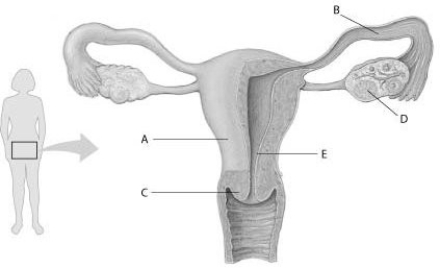 In the figure, which structure is the site of embryo implantation?
 (Multiple Choice)
4.7/5 (79)
(79) Females of many insect species, including honeybee queens, can store gametes shed by their mating partners in ________.
(Multiple Choice)
4.7/5 (79)
(79) Which hormone is released from the Sertoli cells that inhibits the release of follicle stimulating hormone?
(Multiple Choice)
4.8/5 (77)
(77) Which of the following is the most likely explanation for the absence of a protective filter blocking the passage of alcohol between the maternal and foetal circulations in humans?
(Multiple Choice)
4.7/5 (84)
(84) In correct chronological order, the three phases of the human ovarian cycle that gives rise to a mature oocyte are ________.
(Multiple Choice)
4.8/5 (75)
(75) For which of the following is the number the same in human males and females?
(Multiple Choice)
4.9/5 (81)
(81) In correct chronological order, the three phases of the human uterine cycle are ________.
(Multiple Choice)
4.9/5 (77)
(77) An inactivating mutation in the progesterone receptor gene would likely result in ________.
(Multiple Choice)
4.9/5 (69)
(69) 
Filters
- Essay(0)
- Multiple Choice(0)
- Short Answer(0)
- True False(0)
- Matching(0)