



 Chat with AI
Exam 17: Gene Expression: From Gene to Protein

Exam 1: Evolution, the Themes of Biology, and Scientific Inquiry51 Questions
Exam 2: The Chemical Context of Life61 Questions
Exam 3: Water and Life55 Questions
Exam 4: Carbon and the Molecular Diversity of Life58 Questions
Exam 5: The Structure and Function of Large Biological Molecules70 Questions
Exam 6: A Tour of the Cell66 Questions
Exam 7: Membrane Structure and Function68 Questions
Exam 8: An Introduction to Metabolism67 Questions
Exam 9: Cellular Respiration and Fermentation68 Questions
Exam 10: Photosynthesis65 Questions
Exam 11: Cell Communication65 Questions
Exam 12: The Cell Cycle66 Questions
Exam 13: Meiosis and Sexual Life Cycles64 Questions
Exam 14: Mendel and the Gene Idea62 Questions
Exam 15: The Chromosomal Basis of Inheritance58 Questions
Exam 16: The Molecular Basis of Inheritance65 Questions
Exam 17: Gene Expression: From Gene to Protein67 Questions
Exam 18: Regulation of Gene Expression66 Questions
Exam 19: Viruses54 Questions
Exam 20: Dna Tools and Biotechnology57 Questions
Exam 21: Genomes and Their Evolution44 Questions
Exam 22: Descent With Modification: a Darwinian View of Life60 Questions
Exam 23: The Evolution of Populations64 Questions
Exam 24: The Origin of Species67 Questions
Exam 25: The History of Life on Earth59 Questions
Exam 26: Phylogeny and the Tree of Life75 Questions
Exam 27: Bacteria and Archaea75 Questions
Exam 28: Protists79 Questions
Exam 29: Plant Diversity I: How Plants Colonised Land82 Questions
Exam 30: Plant Diversity Ii: the Evolution of Seed Plants80 Questions
Exam 31: Fungi70 Questions
Exam 32: An Overview of Animal Diversity67 Questions
Exam 33: An Introduction to Invertebrates83 Questions
Exam 34: The Origin and Evolution of Vertebrates82 Questions
Exam 35: Vascular Plant Structure, Growth, and Development65 Questions
Exam 36: Resource Acquisition and Transport in Vascular Plants74 Questions
Exam 37: Soil and Plant Nutrition52 Questions
Exam 38: Angiosperm Reproduction and Biotechnology60 Questions
Exam 39: Plant Responses to Internal and External Signals61 Questions
Exam 40: Basic Principles of Animal Form and Function68 Questions
Exam 41: Animal Nutrition64 Questions
Exam 42: Circulation and Gas Exchange67 Questions
Exam 43: The Immune System69 Questions
Exam 44: Osmoregulation and Excretion64 Questions
Exam 45: Hormones and the Endocrine System66 Questions
Exam 46: Animal Reproduction68 Questions
Exam 47: Animal Development70 Questions
Exam 48: Neurons, Synapses, and Signalling68 Questions
Exam 49: Nervous Systems65 Questions
Exam 50: Sensory and Motor Mechanisms67 Questions
Select questions type


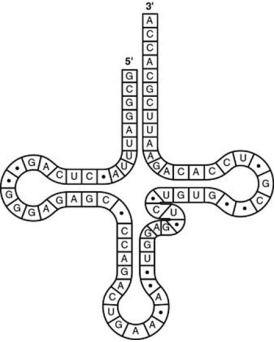 The figure represents tRNA that recognises and binds a particular amino acid (in this instance, phenylalanine).
-Which codon on the mRNA strand codes for this amino acid?
The figure represents tRNA that recognises and binds a particular amino acid (in this instance, phenylalanine).
-Which codon on the mRNA strand codes for this amino acid?
Free
(Multiple Choice)
4.8/5  (87)
(87) Correct Answer: Verified
D
In an experimental situation, a student researcher inserts an mRNA molecule into a eukaryotic cell after she has removed its 5′ cap and poly-A tail. Which of the following processes would you expect her to find to have occurred?
Free
(Multiple Choice)
4.7/5 (81)
(81) Correct Answer:Verified
VerifiedD
Which of the following statements correctly describes a ribozyme?
Free
(Multiple Choice)
4.9/5 (91)
(91) Correct Answer:Verified
VerifiedB
Rank the following one-base point mutations with respect to their likelihood of affecting the structure of the corresponding polypeptide (from most likely to least likely).
1) insertion mutation deep within an intron
2) substitution mutation at the third position of a codon in an exon
3) substitution mutation at the second position of a codon in an exon
4) deletion mutation within the first exon of the gene
(Multiple Choice)
4.8/5 (85)
(85) How might a single base substitution in the sequence of a gene affect the amino acid sequence of a protein encoded by the gene?
(Multiple Choice)
4.8/5 (69)
(69) A single base substitution mutation is likely to have a less deleterious effect when the base change exhibits which of the following results?
(Multiple Choice)
4.7/5 (81)
(81) In bacteria, there are 61 mRNA codons that specify an amino acid, but only 45 tRNAs. Which of the following statements explains this fact?
(Multiple Choice)
4.9/5 (85)
(85) Which of the following processes occurs when termination of translation takes place?
(Multiple Choice)
4.9/5 (86)
(86) A particular triplet of bases in the coding sequence of DNA is AAA. The anticodon on the tRNA that binds the mRNA codon is ________.
(Multiple Choice)
5.0/5 (78)
(78) According to the central dogma, what is the intermediate molecule involved in the flow of information in a cell that should go in the blank?
DNA → ________ → Proteins
(Multiple Choice)
4.8/5 (77)
(77) Which of the following processes is the first event to take place in translation in eukaryotes?
(Multiple Choice)
4.9/5 (72)
(72) The genetic code is essentially the same for all organisms. From this, one can logically assume which of the following statements to be true?
(Multiple Choice)
4.8/5 (89)
(89) Post-translational modifications of proteins may include which of the following processes?
(Multiple Choice)
4.8/5 (88)
(88) Which of the following statements correctly describes the function of a signal peptide?
(Multiple Choice)
4.8/5 (63)
(63) Which of the following molecular structures contain codons?
(Multiple Choice)
4.9/5 (82)
(82) Which of the following properties is associated with a protein that will be secreted from a eukaryotic cell?
(Multiple Choice)
4.8/5 (75)
(75) Which of the following statements is the most current description of a gene?
(Multiple Choice)
4.8/5 (68)
(68) Which of the following statements best describes the significance of the TATA box in the promoters of eukaryotes?
(Multiple Choice)
4.9/5 (85)
(85) How does the primary transcript in the nucleus of a prokaryotic cell compare to the functional mRNA?
(Multiple Choice)
4.8/5 (75)
(75) 
Filters
- Essay(0)
- Multiple Choice(0)
- Short Answer(0)
- True False(0)
- Matching(0)