



 Chat with AI
Exam 44: Osmoregulation and Excretion

Exam 1: Evolution, the Themes of Biology, and Scientific Inquiry51 Questions
Exam 2: The Chemical Context of Life61 Questions
Exam 3: Water and Life55 Questions
Exam 4: Carbon and the Molecular Diversity of Life58 Questions
Exam 5: The Structure and Function of Large Biological Molecules70 Questions
Exam 6: A Tour of the Cell66 Questions
Exam 7: Membrane Structure and Function68 Questions
Exam 8: An Introduction to Metabolism67 Questions
Exam 9: Cellular Respiration and Fermentation68 Questions
Exam 10: Photosynthesis65 Questions
Exam 11: Cell Communication65 Questions
Exam 12: The Cell Cycle66 Questions
Exam 13: Meiosis and Sexual Life Cycles64 Questions
Exam 14: Mendel and the Gene Idea62 Questions
Exam 15: The Chromosomal Basis of Inheritance58 Questions
Exam 16: The Molecular Basis of Inheritance65 Questions
Exam 17: Gene Expression: From Gene to Protein67 Questions
Exam 18: Regulation of Gene Expression66 Questions
Exam 19: Viruses54 Questions
Exam 20: Dna Tools and Biotechnology57 Questions
Exam 21: Genomes and Their Evolution44 Questions
Exam 22: Descent With Modification: a Darwinian View of Life60 Questions
Exam 23: The Evolution of Populations64 Questions
Exam 24: The Origin of Species67 Questions
Exam 25: The History of Life on Earth59 Questions
Exam 26: Phylogeny and the Tree of Life75 Questions
Exam 27: Bacteria and Archaea75 Questions
Exam 28: Protists79 Questions
Exam 29: Plant Diversity I: How Plants Colonised Land82 Questions
Exam 30: Plant Diversity Ii: the Evolution of Seed Plants80 Questions
Exam 31: Fungi70 Questions
Exam 32: An Overview of Animal Diversity67 Questions
Exam 33: An Introduction to Invertebrates83 Questions
Exam 34: The Origin and Evolution of Vertebrates82 Questions
Exam 35: Vascular Plant Structure, Growth, and Development65 Questions
Exam 36: Resource Acquisition and Transport in Vascular Plants74 Questions
Exam 37: Soil and Plant Nutrition52 Questions
Exam 38: Angiosperm Reproduction and Biotechnology60 Questions
Exam 39: Plant Responses to Internal and External Signals61 Questions
Exam 40: Basic Principles of Animal Form and Function68 Questions
Exam 41: Animal Nutrition64 Questions
Exam 42: Circulation and Gas Exchange67 Questions
Exam 43: The Immune System69 Questions
Exam 44: Osmoregulation and Excretion64 Questions
Exam 45: Hormones and the Endocrine System66 Questions
Exam 46: Animal Reproduction68 Questions
Exam 47: Animal Development70 Questions
Exam 48: Neurons, Synapses, and Signalling68 Questions
Exam 49: Nervous Systems65 Questions
Exam 50: Sensory and Motor Mechanisms67 Questions
Select questions type


African lungfish, which are often found in small stagnant pools of fresh water, produce urea as a nitrogenous waste. What is the advantage of this adaptation?

Free
(Multiple Choice)
4.8/5  (84)
(84) Correct Answer: Verified
B
Unlike most bony fishes, sharks maintain body fluids that are isoosmotic to seawater, so they are considered by many to be osmoconformers. Nonetheless, these sharks osmoregulate at least partially, by ________.
Free
(Multiple Choice)
4.9/5 (86)
(86) Correct Answer:Verified
VerifiedC
Unlike an earthworm's metanephridia, a mammalian nephron
Free
(Multiple Choice)
4.9/5 (85)
(85) Correct Answer:Verified
VerifiedC
Antidiuretic hormone (ADH) and the renin-angiotensin-aldosterone system (RAAS) work together in maintaining osmoregulatory homeostasis through which of the following ways?
(Multiple Choice)
5.0/5 (80)
(80) The transfer of fluid from the glomerulus to Bowman's capsule ________.
(Multiple Choice)
4.8/5 (81)
(81) Within a normally functioning kidney, red blood cells can be found in ________.
(Multiple Choice)
4.7/5 (79)
(79) After blood flow is artificially reduced at one kidney, you would expect that kidney to secrete more of the hormone known as ________.
(Multiple Choice)
4.8/5 (87)
(87) Which nitrogenous waste has the greatest number of nitrogen atoms?
(Multiple Choice)
4.9/5 (70)
(70) 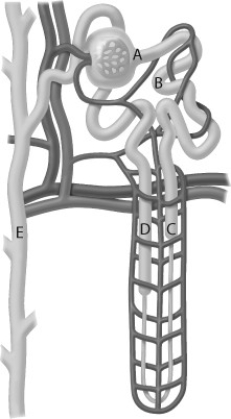 - Filtration takes place in the structure labelled ________.
 (Multiple Choice)
4.7/5 (90)
(90) A human who has no access to fresh water but is forced to drink seawater instead will ________.
(Multiple Choice)
4.9/5 (81)
(81) The body fluids of an osmoconformer would be ________ with its ________ environment
(Multiple Choice)
5.0/5 (86)
(86) The advantage of excreting nitrogenous wastes as urea rather than as ammonia is that ________.
(Multiple Choice)
4.8/5 (87)
(87) African lungfish, which are often found in small, stagnant pools of fresh water, produce urea as a nitrogenous waste. What is the advantage of this adaptation?
(Multiple Choice)
4.9/5 (88)
(88) An excretory system that is partly based on the filtration of fluid under high hydrostatic pressure is the ________.
(Multiple Choice)
4.8/5 (73)
(73) Birds secrete uric acid as their nitrogenous waste because uric acid ________.
(Multiple Choice)
4.9/5 (78)
(78)
- In which of the labelled structures does passive water reabsorption take place?
- In which of the labelled structures does passive water reabsorption take place? (Multiple Choice)
4.8/5 (84)
(84) Natural selection should favour the highest proportion of juxtamedullary nephrons in which of the following species?
(Multiple Choice)
4.9/5 (91)
(91)
-The structure labelled ________ can be influenced by hormones to change the concentration of the urine.
-The structure labelled ________ can be influenced by hormones to change the concentration of the urine. (Multiple Choice)
4.9/5 (93)
(93) 
Filters
- Essay(0)
- Multiple Choice(0)
- Short Answer(0)
- True False(0)
- Matching(0)