



 Chat with AI
Exam 34: The Origin and Evolution of Vertebrates

Exam 1: Evolution, the Themes of Biology, and Scientific Inquiry51 Questions
Exam 2: The Chemical Context of Life61 Questions
Exam 3: Water and Life55 Questions
Exam 4: Carbon and the Molecular Diversity of Life58 Questions
Exam 5: The Structure and Function of Large Biological Molecules70 Questions
Exam 6: A Tour of the Cell66 Questions
Exam 7: Membrane Structure and Function68 Questions
Exam 8: An Introduction to Metabolism67 Questions
Exam 9: Cellular Respiration and Fermentation68 Questions
Exam 10: Photosynthesis65 Questions
Exam 11: Cell Communication65 Questions
Exam 12: The Cell Cycle66 Questions
Exam 13: Meiosis and Sexual Life Cycles64 Questions
Exam 14: Mendel and the Gene Idea62 Questions
Exam 15: The Chromosomal Basis of Inheritance58 Questions
Exam 16: The Molecular Basis of Inheritance65 Questions
Exam 17: Gene Expression: From Gene to Protein67 Questions
Exam 18: Regulation of Gene Expression66 Questions
Exam 19: Viruses54 Questions
Exam 20: Dna Tools and Biotechnology57 Questions
Exam 21: Genomes and Their Evolution44 Questions
Exam 22: Descent With Modification: a Darwinian View of Life60 Questions
Exam 23: The Evolution of Populations64 Questions
Exam 24: The Origin of Species67 Questions
Exam 25: The History of Life on Earth59 Questions
Exam 26: Phylogeny and the Tree of Life75 Questions
Exam 27: Bacteria and Archaea75 Questions
Exam 28: Protists79 Questions
Exam 29: Plant Diversity I: How Plants Colonised Land82 Questions
Exam 30: Plant Diversity Ii: the Evolution of Seed Plants80 Questions
Exam 31: Fungi70 Questions
Exam 32: An Overview of Animal Diversity67 Questions
Exam 33: An Introduction to Invertebrates83 Questions
Exam 34: The Origin and Evolution of Vertebrates82 Questions
Exam 35: Vascular Plant Structure, Growth, and Development65 Questions
Exam 36: Resource Acquisition and Transport in Vascular Plants74 Questions
Exam 37: Soil and Plant Nutrition52 Questions
Exam 38: Angiosperm Reproduction and Biotechnology60 Questions
Exam 39: Plant Responses to Internal and External Signals61 Questions
Exam 40: Basic Principles of Animal Form and Function68 Questions
Exam 41: Animal Nutrition64 Questions
Exam 42: Circulation and Gas Exchange67 Questions
Exam 43: The Immune System69 Questions
Exam 44: Osmoregulation and Excretion64 Questions
Exam 45: Hormones and the Endocrine System66 Questions
Exam 46: Animal Reproduction68 Questions
Exam 47: Animal Development70 Questions
Exam 48: Neurons, Synapses, and Signalling68 Questions
Exam 49: Nervous Systems65 Questions
Exam 50: Sensory and Motor Mechanisms67 Questions
Select questions type


Which of the following is the most inclusive (most general) group in which all of the members have fully opposable thumbs?

Free
(Multiple Choice)
4.9/5  (67)
(67) Correct Answer: Verified
C
Marsupials survived in Australia (as opposed to Asia) because ________.
Free
(Multiple Choice)
4.8/5 (82)
(82) Correct Answer:Verified
VerifiedC
Ancient fossils that seem to be an intermediate stage in the evolution from fish to tetrapods had which of the following characteristics?
Free
(Multiple Choice)
4.8/5 (81)
(81) Correct Answer:Verified
VerifiedA
A team of researchers has developed a poison that has proven effective against lamprey larvae in freshwater cultures. The poison is ingested and causes paralysis by detaching segmental muscles from the skeletal structures. The team wants to test the poison's effectiveness in creeks flowing into major waterways, but one critic worries about potential effects on lancelets, which are similar to lampreys in many ways. Why is this concern misplaced?
(Multiple Choice)
4.8/5 (85)
(85) 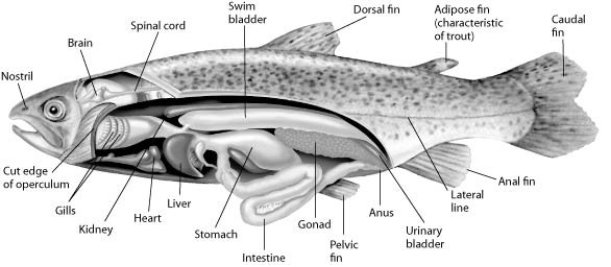 Fishes that have swim bladders can regulate their density and, thus, their buoyancy. There are two types of swim bladder: physostomous and physoclistous. The ancestral version is the physostomous version, in which the swim bladder is connected to the oesophagus via a short tube (see the figure). The fish fills this version by swimming to the surface, taking gulps of air, and directing them into the swim bladder. Air is removed from this version by "belching". The physoclistous version is more derived and has lost its connection to the oesophagus. Instead, gas enters and leaves the swim bladder via special circulatory mechanisms within the wall of the swim bladder.
-If a ray-finned fish is to both hover (remain stationary) in the water column and ventilate its gills effectively, then what other structure besides its swim bladder will it use?
Fishes that have swim bladders can regulate their density and, thus, their buoyancy. There are two types of swim bladder: physostomous and physoclistous. The ancestral version is the physostomous version, in which the swim bladder is connected to the oesophagus via a short tube (see the figure). The fish fills this version by swimming to the surface, taking gulps of air, and directing them into the swim bladder. Air is removed from this version by "belching". The physoclistous version is more derived and has lost its connection to the oesophagus. Instead, gas enters and leaves the swim bladder via special circulatory mechanisms within the wall of the swim bladder.
-If a ray-finned fish is to both hover (remain stationary) in the water column and ventilate its gills effectively, then what other structure besides its swim bladder will it use? (Multiple Choice)
4.9/5 (78)
(78) Why do adult urochordates (tunicates) lack notochords, even though larval urochordates have them? Larvae use notochords to ________.
(Multiple Choice)
4.9/5 (86)
(86) Which of these might have been observed in the common ancestor of chondrichthyans and osteichthyans?
(Multiple Choice)
4.8/5 (61)
(61) Primate evolution and behaviour, such as hunting skills, have been directed in part by the development of depth perception. What anatomical change made depth perception possible?
(Multiple Choice)
4.7/5 (83)
(83) Due to its system of air sacs connected to the lungs, the respiratory system of birds is arguably the most effective respiratory system of all air-breathers. Upon inhalation, air first flows into posterior air sacs, then into the lungs, and then into anterior air sacs on the way to being exhaled. Thus, there is one-way flow of air through the lungs, along thousands of tubules called parabronchi.
-The one-way flow of air along parabronchi makes what type of gas exchange mechanism possible, at least theoretically?
(Multiple Choice)
4.8/5 (71)
(71) During chordate evolution, what is the sequence (from earliest to most recent) in which the following structures arose?
(Multiple Choice)
4.9/5 (72)
(72) Which structure of the amniotic egg most closely surrounds the embryo?
(Multiple Choice)
4.9/5 (80)
(80) Chordate pharyngeal slits appear to have functioned first as ________.
(Multiple Choice)
4.9/5 (65)
(65) Which of the following types of evidence would be useful in understanding if the impact of a comet caused the extinction of the dinosaurs?
(Multiple Choice)
4.8/5 (80)
(80) Brown et al. and Morwood et al. reported in 2004 that they had found skeletal remains of a previously unknown type of hominin, now dubbed Homo floresiensis, on the Indonesian island of Flores. These hominins were small (approximately 1 metre tall) with small braincases (approximately 380 cubic centimetres) as compared with other hominins. The remains of H. floresiensis were found alongside handmade stone tools and the remains of dwarf elephants that also inhabited the island, suggesting that H. floresiensis was able both to make tools and to coordinate the hunting of animals much larger than itself. H. floresiensis is estimated to have lived at the site where the remains were found from at least 38,000 years ago to 18,000 years ago.
Which would be the most feasible method of figuring out to which other hominin species H. floresiensis was most closely related?
(Multiple Choice)
4.8/5 (86)
(86) Arrange these groups in order from most inclusive (most general) to least inclusive (most specific).
(Multiple Choice)
4.8/5 (82)
(82) Fishes that have swim bladders can regulate their density and, thus, their buoyancy. There are two types of swim bladder: physostomous and physoclistous. The ancestral version is the physostomous version, in which the swim bladder is connected to the oesophagus via a short tube (see the figure). The fish fills this version by swimming to the surface, taking gulps of air, and directing them into the swim bladder. Air is removed from this version by "belching". The physoclistous version is more derived and has lost its connection to the oesophagus. Instead, gas enters and leaves the swim bladder via special circulatory mechanisms within the wall of the swim bladder.
-Which shark structure is closest in function to a swim bladder full of gas?
Fishes that have swim bladders can regulate their density and, thus, their buoyancy. There are two types of swim bladder: physostomous and physoclistous. The ancestral version is the physostomous version, in which the swim bladder is connected to the oesophagus via a short tube (see the figure). The fish fills this version by swimming to the surface, taking gulps of air, and directing them into the swim bladder. Air is removed from this version by "belching". The physoclistous version is more derived and has lost its connection to the oesophagus. Instead, gas enters and leaves the swim bladder via special circulatory mechanisms within the wall of the swim bladder.
-Which shark structure is closest in function to a swim bladder full of gas? (Multiple Choice)
5.0/5 (78)
(78) Scientific views are based on evidence rather than an appeal to authority. Which of the following statements demonstrates a conclusion based on evidence?
(Multiple Choice)
4.9/5 (59)
(59) Suppose you travelled back in time and located the first animals to have evolved feathers. You found that these animals were tree-dwelling ectotherms, able to run quickly but unable to fly. You also noticed that only males had feathers. Which hypothesis of feather evolution would these data most support? Feathers initially evolved in a role associated with ________.
(Multiple Choice)
4.8/5 (82)
(82) Living vertebrates can be divided into two major clades. Select the appropriate pair.
(Multiple Choice)
4.8/5 (82)
(82) 
Filters
- Essay(0)
- Multiple Choice(0)
- Short Answer(0)
- True False(0)
- Matching(0)