



 Chat with AI
Exam 34: The Origin and Evolution of Vertebrates

Exam 1: Evolution, the Themes of Biology, and Scientific Inquiry51 Questions
Exam 2: The Chemical Context of Life61 Questions
Exam 3: Water and Life55 Questions
Exam 4: Carbon and the Molecular Diversity of Life58 Questions
Exam 5: The Structure and Function of Large Biological Molecules70 Questions
Exam 6: A Tour of the Cell66 Questions
Exam 7: Membrane Structure and Function68 Questions
Exam 8: An Introduction to Metabolism67 Questions
Exam 9: Cellular Respiration and Fermentation68 Questions
Exam 10: Photosynthesis65 Questions
Exam 11: Cell Communication65 Questions
Exam 12: The Cell Cycle66 Questions
Exam 13: Meiosis and Sexual Life Cycles64 Questions
Exam 14: Mendel and the Gene Idea62 Questions
Exam 15: The Chromosomal Basis of Inheritance58 Questions
Exam 16: The Molecular Basis of Inheritance65 Questions
Exam 17: Gene Expression: From Gene to Protein67 Questions
Exam 18: Regulation of Gene Expression66 Questions
Exam 19: Viruses54 Questions
Exam 20: Dna Tools and Biotechnology57 Questions
Exam 21: Genomes and Their Evolution44 Questions
Exam 22: Descent With Modification: a Darwinian View of Life60 Questions
Exam 23: The Evolution of Populations64 Questions
Exam 24: The Origin of Species67 Questions
Exam 25: The History of Life on Earth59 Questions
Exam 26: Phylogeny and the Tree of Life75 Questions
Exam 27: Bacteria and Archaea75 Questions
Exam 28: Protists79 Questions
Exam 29: Plant Diversity I: How Plants Colonised Land82 Questions
Exam 30: Plant Diversity Ii: the Evolution of Seed Plants80 Questions
Exam 31: Fungi70 Questions
Exam 32: An Overview of Animal Diversity67 Questions
Exam 33: An Introduction to Invertebrates83 Questions
Exam 34: The Origin and Evolution of Vertebrates82 Questions
Exam 35: Vascular Plant Structure, Growth, and Development65 Questions
Exam 36: Resource Acquisition and Transport in Vascular Plants74 Questions
Exam 37: Soil and Plant Nutrition52 Questions
Exam 38: Angiosperm Reproduction and Biotechnology60 Questions
Exam 39: Plant Responses to Internal and External Signals61 Questions
Exam 40: Basic Principles of Animal Form and Function68 Questions
Exam 41: Animal Nutrition64 Questions
Exam 42: Circulation and Gas Exchange67 Questions
Exam 43: The Immune System69 Questions
Exam 44: Osmoregulation and Excretion64 Questions
Exam 45: Hormones and the Endocrine System66 Questions
Exam 46: Animal Reproduction68 Questions
Exam 47: Animal Development70 Questions
Exam 48: Neurons, Synapses, and Signalling68 Questions
Exam 49: Nervous Systems65 Questions
Exam 50: Sensory and Motor Mechanisms67 Questions
Select questions type


Which of the following taxonomic groups is the most successful?
(Multiple Choice)
4.8/5  (68)
(68) Which of the following characteristics is shared by a hagfish and a lamprey?
(Multiple Choice)
4.7/5 (78)
(78) What group of mammals have (a) embryos that spend more time feeding through the placenta than the mother's nipples, (b) young that feed on milk, and (c) a prolonged period of maternal care after leaving the placenta?
(Multiple Choice)
4.9/5 (78)
(78) All chordates studied to date, except tunicates, share a set of ________.
(Multiple Choice)
4.9/5 (81)
(81) Which of the following is a characteristic of all chordates at some point during their life cycle?
(Multiple Choice)
4.8/5 (83)
(83) The evolution of similar insulating skin coverings such as fur, hair, and feathers in mammals and birds is a result of ________.
(Multiple Choice)
4.8/5 (85)
(85) 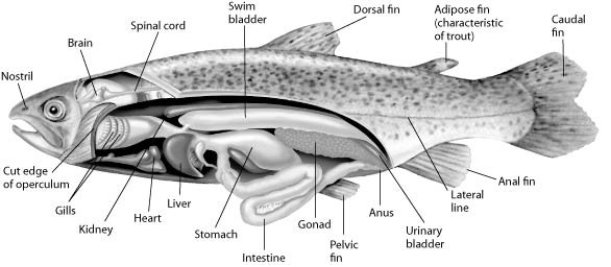 Fishes that have swim bladders can regulate their density and, thus, their buoyancy. There are two types of swim bladder: physostomous and physoclistous. The ancestral version is the physostomous version, in which the swim bladder is connected to the oesophagus via a short tube (see the figure). The fish fills this version by swimming to the surface, taking gulps of air, and directing them into the swim bladder. Air is removed from this version by "belching". The physoclistous version is more derived and has lost its connection to the oesophagus. Instead, gas enters and leaves the swim bladder via special circulatory mechanisms within the wall of the swim bladder.
-The presence of a swim bladder allows the typical ray-finned fish to stop swimming and still ________.
Fishes that have swim bladders can regulate their density and, thus, their buoyancy. There are two types of swim bladder: physostomous and physoclistous. The ancestral version is the physostomous version, in which the swim bladder is connected to the oesophagus via a short tube (see the figure). The fish fills this version by swimming to the surface, taking gulps of air, and directing them into the swim bladder. Air is removed from this version by "belching". The physoclistous version is more derived and has lost its connection to the oesophagus. Instead, gas enters and leaves the swim bladder via special circulatory mechanisms within the wall of the swim bladder.
-The presence of a swim bladder allows the typical ray-finned fish to stop swimming and still ________. (Multiple Choice)
5.0/5 (78)
(78) While on an intersession course in tropical ecology, Kris pulls a large, snakelike organism from a burrow (the class was granted a collecting permit). The 1-metre-long organism has smooth skin, which appears to be segmented. It has two tiny eyes that are hard to see because they seem to be covered by skin. Kris brings it back to the lab at the field station, where it is a source of puzzlement to the class. Kris says that it is a giant oligochaete worm; Shaun suggests it is a legless amphibian; Kelly proposes it belongs to a snake species that is purely fossorial (lives in a burrow).
-The class decided to humanely euthanise the organism and subsequently dissect it. Having decided that it was probably not a reptile, two of their original hypotheses regarding its identity remained. Which of the following, if observed, should help them arrive at a conclusive answer?
(Multiple Choice)
4.9/5 (83)
(83) Which of these traits is most strongly associated with the adoption of bipedalism?
(Multiple Choice)
5.0/5 (68)
(68) How did the evolution of the jaw contribute to diversification of early vertebrate lineages?
(Multiple Choice)
4.9/5 (85)
(85) Scientific views are based on evidence rather than an appeal to authority. Which of the following statements demonstrates a conclusion based on an appeal to authority?
(Multiple Choice)
5.0/5 (90)
(90) To reproduce, many plants produce seeds-structures containing embryonic offspring along with nutrients inside a tough coat. These offspring develop after being released by the parent plant. To which animal reproductive "strategy" is seed production most comparable?
(Multiple Choice)
4.8/5 (81)
(81) Which of the following statements would be most acceptable to most zoologists?
(Multiple Choice)
4.9/5 (75)
(75) In what respect do hominins differ from all other anthropoids?
(Multiple Choice)
4.8/5 (75)
(75) Which of the following could be considered the most recent common ancestor of living tetrapods?
(Multiple Choice)
4.9/5 (100)
(100) At one time, Chondrichthyes were thought to have split off from other vertebrates before the evolution of bone. Now we have concluded that the Chondrichthyes split off after the evolution of bone had started. This change demonstrates ________.
(Multiple Choice)
5.0/5 (81)
(81) Which characteristic is common to all the modern representatives of all major reptilian lineages (turtles, lepidosaurs, crocodilians, and birds)?
(Multiple Choice)
4.9/5 (83)
(83) 
Filters
- Essay(0)
- Multiple Choice(0)
- Short Answer(0)
- True False(0)
- Matching(0)