



 Chat with AI
Exam 31: Fungi

Exam 1: Evolution, the Themes of Biology, and Scientific Inquiry51 Questions
Exam 2: The Chemical Context of Life61 Questions
Exam 3: Water and Life55 Questions
Exam 4: Carbon and the Molecular Diversity of Life58 Questions
Exam 5: The Structure and Function of Large Biological Molecules70 Questions
Exam 6: A Tour of the Cell66 Questions
Exam 7: Membrane Structure and Function68 Questions
Exam 8: An Introduction to Metabolism67 Questions
Exam 9: Cellular Respiration and Fermentation68 Questions
Exam 10: Photosynthesis65 Questions
Exam 11: Cell Communication65 Questions
Exam 12: The Cell Cycle66 Questions
Exam 13: Meiosis and Sexual Life Cycles64 Questions
Exam 14: Mendel and the Gene Idea62 Questions
Exam 15: The Chromosomal Basis of Inheritance58 Questions
Exam 16: The Molecular Basis of Inheritance65 Questions
Exam 17: Gene Expression: From Gene to Protein67 Questions
Exam 18: Regulation of Gene Expression66 Questions
Exam 19: Viruses54 Questions
Exam 20: Dna Tools and Biotechnology57 Questions
Exam 21: Genomes and Their Evolution44 Questions
Exam 22: Descent With Modification: a Darwinian View of Life60 Questions
Exam 23: The Evolution of Populations64 Questions
Exam 24: The Origin of Species67 Questions
Exam 25: The History of Life on Earth59 Questions
Exam 26: Phylogeny and the Tree of Life75 Questions
Exam 27: Bacteria and Archaea75 Questions
Exam 28: Protists79 Questions
Exam 29: Plant Diversity I: How Plants Colonised Land82 Questions
Exam 30: Plant Diversity Ii: the Evolution of Seed Plants80 Questions
Exam 31: Fungi70 Questions
Exam 32: An Overview of Animal Diversity67 Questions
Exam 33: An Introduction to Invertebrates83 Questions
Exam 34: The Origin and Evolution of Vertebrates82 Questions
Exam 35: Vascular Plant Structure, Growth, and Development65 Questions
Exam 36: Resource Acquisition and Transport in Vascular Plants74 Questions
Exam 37: Soil and Plant Nutrition52 Questions
Exam 38: Angiosperm Reproduction and Biotechnology60 Questions
Exam 39: Plant Responses to Internal and External Signals61 Questions
Exam 40: Basic Principles of Animal Form and Function68 Questions
Exam 41: Animal Nutrition64 Questions
Exam 42: Circulation and Gas Exchange67 Questions
Exam 43: The Immune System69 Questions
Exam 44: Osmoregulation and Excretion64 Questions
Exam 45: Hormones and the Endocrine System66 Questions
Exam 46: Animal Reproduction68 Questions
Exam 47: Animal Development70 Questions
Exam 48: Neurons, Synapses, and Signalling68 Questions
Exam 49: Nervous Systems65 Questions
Exam 50: Sensory and Motor Mechanisms67 Questions
Select questions type


Suzanne Simard and colleagues knew that the same mycorrhizal fungal species could colonise multiple types of trees. They wondered if the same fungal individual would colonise different trees, forming an underground network that potentially could transport carbon and nutrients from one tree to another (S. Simard et al. 1997. Net transfer of carbon between mycorrhizal tree species in the field. Nature 388:579-82).
Pots containing seedlings of three different tree species were set up and grown under natural conditions for three years (Fig.A). Two of the three species (Douglas fir, birch) could form ectomycorrhizal connections with the same fungal species, but the third species (cedar) could not form an ectomycorrhizal connection with the fungal species. In some of the pots, the researchers placed airtight bags over the Douglas fir and birch seedlings and injected carbon dioxide made from carbon-13 into the bags with the Douglas fir and carbon dioxide made from carbon-14 into the bags with the birch. (13C and 14C are different isotopes of carbon that can be detected and measured by researchers.) As the seedlings photosynthesised, the carbon dioxide was converted into sugars that could be tracked and measured by the researchers. The researchers measured whether the sugars in each plant contained only the carbon isotope that was in the air of their plastic bag or also the carbon isotope from the air around the other plant.
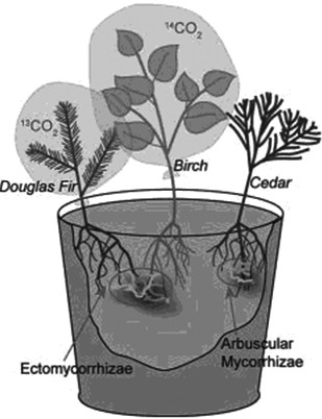 Figure A
-Referring to Simard et al. (1997), which design element is the control in this experiment and why?
Figure A
-Referring to Simard et al. (1997), which design element is the control in this experiment and why?
Free
(Multiple Choice)
4.8/5  (71)
(71) Correct Answer: Verified
D
Rose-picker's disease is caused by the yeast Sporothrix schenkii (S. schenkii). The yeast grows on the exteriors of rose-bush thorns. If a human gets pricked by such a thorn, the yeasts can be introduced under the skin. The yeasts then assume a hyphal morphology and grow along the interiors of lymphatic vessels until they reach a lymph node. This often results in the accumulation of pus in the lymph node, which subsequently ulcerates through the skin surface and then drains.
Humans have immune systems in which lymph nodes are important, because many white blood cells (phagocytes and lymphocytes) reside there. Given that a successful infection by S. schenkii damages lymph nodes themselves, which of the following is most probable?
Free
(Multiple Choice)
4.8/5 (75)
(75) Correct Answer:Verified
VerifiedB
The closest relatives of fungi are thought to be the
Free
(Multiple Choice)
4.9/5 (82)
(82) Correct Answer:Verified
VerifiedA
Along with bacteria and protozoa, some chytrid fungi live in the digestive tracts of cattle and aid in the digestion of plant matter; thus, all three groups represent potential mutualists with cattle. In an experiment designed to test how much of a contribution to cell wall digestion was made by fungi in one part of the stomach (rumen), Lee et al. fed grain to cattle and then removed samples of the rumen contents. They took these samples to the laboratory and experimentally treated them with various chemicals to produce fractions that contained (A) only fungi, (B) only bacteria, (C) only protozoa, and (D) all of the potential mutualists. They then measured the percent of the cell wall that was degraded (see the figure). 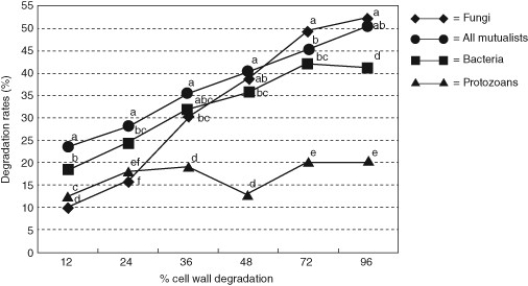 Degradation rates of cell walls extracted from Orchard grass by the monoculture system to assess the relative contributions of digestion by bacterial (square), protozoan (triangle), and fungal (diamond) systems, and all components (closed circle) as a control. The lowercase letters above the spots indicate statistical significance; mean values with different letters are significantly different (P < 0.05).
-Which of the following reasons provides the best explanation for the use of a control that contained all potential mutualists? Comparison to a fraction that contained all potential mutualists allowed the researchers to ________.
Degradation rates of cell walls extracted from Orchard grass by the monoculture system to assess the relative contributions of digestion by bacterial (square), protozoan (triangle), and fungal (diamond) systems, and all components (closed circle) as a control. The lowercase letters above the spots indicate statistical significance; mean values with different letters are significantly different (P < 0.05).
-Which of the following reasons provides the best explanation for the use of a control that contained all potential mutualists? Comparison to a fraction that contained all potential mutualists allowed the researchers to ________. (Multiple Choice)
4.9/5 (71)
(71) For several decades now, amphibian species worldwide have been in decline. A significant proportion of the decline seems to be due to the spread of the chytrid fungus, Batrachochytrium dendrobatidis (Bd). Chytrid sporangia reside within the epidermal cells of infected animals, animals that consequently show areas of sloughed skin. They can also be lethargic, which is expressed through failure to hide and failure to flee. The infection cycle typically takes four to five days, at the end of which zoospores are released from sporangia into the environment. In some amphibian species, mortality rates approach 100%; other species seem able to survive the infection.
Apart from direct amphibian-to-amphibian contact, what is the most likely means by which the zoospores spread from one free-living amphibian to another?
(Multiple Choice)
4.9/5 (74)
(74) Arrange the following in order from largest to smallest, assuming that they all come from the same fungus.
(Multiple Choice)
4.9/5 (81)
(81) Heterobasidion is a basidiomycete that contributes to mortality of trees. Kuhlman isolated 23 strains of Heterobasidion and applied them to 16 seedlings of 10 different tree species. Partial results of this experiment are shown in the table. (From Kuhlman, E. G. 1970. Seedling inoculations with Fomes annosus show variation in virulence and in host susceptibility. Phytopathology 60:1743-1746. https://www.apsnet.org/publications/phytopathology/backissues/Documents/1970Articles/Phyto60n12_1743.PDF)
% mortality of five host species from five Heterobasidion isolates
Isolate Isolate Isolate Isolate Isolate Host 63 117 195 126 118 Slash Pine 50 69 94 100 94 Shortleaf Pine 75 56 94 94 100 Red Cedar 38 32 19 50 25 Yellow-Poplar 0 0 6 6 6 Sycamore 0 0 0 0 6
-Which of the following conclusions can best be drawn from these results?
(Multiple Choice)
4.9/5 (76)
(76) In most fungi, karyogamy does not immediately follow plasmogamy, which consequently ________.
(Multiple Choice)
4.9/5 (84)
(84) The Neurospora genome is quite compact, lacking many of the noncoding DNA sequences that occur in humans and many other eukaryotes. Which of the following are probable benefits of the compactness of the genome?
(Multiple Choice)
4.8/5 (83)
(83) The figure depicts the outline of a large fairy ring that has appeared overnight in an open paddock, as viewed from above. The fairy ring represents the furthest advance of this mycelium through the soil. Locations A-D are all 0.5 metres below the soil surface. 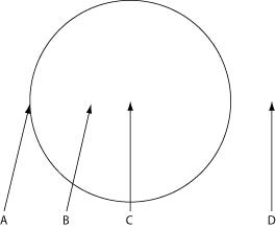 If the fungus that produced the fairy ring can also produce arbuscules, then which of the following is most likely to be buried at location "C"?
 (Multiple Choice)
4.9/5 (83)
(83) The figure depicts the outline of a large fairy ring that has appeared overnight in an open paddock, as viewed from above. The fairy ring represents the furthest advance of this mycelium through the soil. Locations A-D are all 0.5 metres below the soil surface. 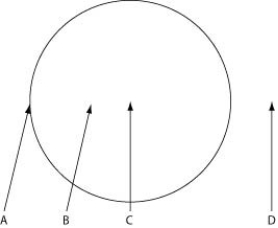 Which location is nearest to basidiocarps?
 (Multiple Choice)
4.9/5 (79)
(79) Fungi produce many compounds that humans are able to use medically. How can you account for these compounds?
(Multiple Choice)
4.9/5 (95)
(95) In the United States and Canada, bats use one of two strategies to survive winter. They either migrate south, or they hibernate. Recently, those that hibernate seem to have come under attack by a fungus, Geomyces destructans (Gd). Many infected bats have a delicate, white filamentous mat on their muzzles, which is referred to as white-nose syndrome (WNS). The fungus invades the bat tissues, causes discomfort, and awakens the bat from its hibernation. The bat fidgets and wastes calories, using up its stored fat. The bat then behaves abnormally, leaving its cave during daytime in winter to search for food. Their food, primarily insects, is scarce during the winter, and the bats ultimately starve to death. Since 2006, it is estimated that over six million bats have perished from WNS.
-The Gd mat on the fur of the bats should be expected to consist of ________.
(Multiple Choice)
5.0/5 (78)
(78) For several decades now, amphibian species worldwide have been in decline. A significant proportion of the decline seems to be due to the spread of the chytrid fungus, Batrachochytrium dendrobatidis (Bd). Chytrid sporangia reside within the epidermal cells of infected animals, animals that consequently show areas of sloughed skin. They can also be lethargic, which is expressed through failure to hide and failure to flee. The infection cycle typically takes four to five days, at the end of which zoospores are released from sporangia into the environment. In some amphibian species, mortality rates approach 100%; other species seem able to survive the infection.
When adult amphibian skin harbours populations of the bacterium Janthinobacterium lividum (Jl), chytrid infection seems to be inhibited. Which of the following represents the best experimental design to test whether this inhibition is real?
(Multiple Choice)
4.8/5 (79)
(79) Chitin is a long-chain polymer derived from glucose. It strengthens cell walls of fungi and the outer covering (exoskeleton) of arthropods (including crabs, shrimps, and insects). The presence of chitin in these groups is likely due to ________.
(Multiple Choice)
4.8/5 (82)
(82) Which of the following characteristics would be most helpful in distinguishing among different species of fungi?
(Multiple Choice)
4.8/5 (87)
(87) After cytokinesis occurs in budding yeasts, the daughter cell has a ________.
(Multiple Choice)
4.9/5 (86)
(86) The multicellular condition of animals and fungi seems to have arisen ________.
(Multiple Choice)
4.7/5 (71)
(71) A fungal spore germinates, giving rise to a mycelium that grows outward into the soil surrounding the site where the spore originally landed. Which of the following accounts for the fungal movement, as described here?
(Multiple Choice)
4.9/5 (83)
(83) The ascomycete Brachiola gambiae parasitises the mosquito Anopheles gambiae. Adult female mosquitoes must take blood meals for their eggs to develop, and it is while they take blood that they transmit malarial parasites to humans. Male mosquitoes drink flower nectar. If humans are to safely and effectively use Brachiola gambiae as a biological control to reduce human deaths from malaria, then which of the following statements should be correct?
(Multiple Choice)
4.9/5 (72)
(72) 
Filters
- Essay(0)
- Multiple Choice(0)
- Short Answer(0)
- True False(0)
- Matching(0)