



 Chat with AI
Exam 28: Protists

Exam 1: Evolution, the Themes of Biology, and Scientific Inquiry51 Questions
Exam 2: The Chemical Context of Life61 Questions
Exam 3: Water and Life55 Questions
Exam 4: Carbon and the Molecular Diversity of Life58 Questions
Exam 5: The Structure and Function of Large Biological Molecules70 Questions
Exam 6: A Tour of the Cell66 Questions
Exam 7: Membrane Structure and Function68 Questions
Exam 8: An Introduction to Metabolism67 Questions
Exam 9: Cellular Respiration and Fermentation68 Questions
Exam 10: Photosynthesis65 Questions
Exam 11: Cell Communication65 Questions
Exam 12: The Cell Cycle66 Questions
Exam 13: Meiosis and Sexual Life Cycles64 Questions
Exam 14: Mendel and the Gene Idea62 Questions
Exam 15: The Chromosomal Basis of Inheritance58 Questions
Exam 16: The Molecular Basis of Inheritance65 Questions
Exam 17: Gene Expression: From Gene to Protein67 Questions
Exam 18: Regulation of Gene Expression66 Questions
Exam 19: Viruses54 Questions
Exam 20: Dna Tools and Biotechnology57 Questions
Exam 21: Genomes and Their Evolution44 Questions
Exam 22: Descent With Modification: a Darwinian View of Life60 Questions
Exam 23: The Evolution of Populations64 Questions
Exam 24: The Origin of Species67 Questions
Exam 25: The History of Life on Earth59 Questions
Exam 26: Phylogeny and the Tree of Life75 Questions
Exam 27: Bacteria and Archaea75 Questions
Exam 28: Protists79 Questions
Exam 29: Plant Diversity I: How Plants Colonised Land82 Questions
Exam 30: Plant Diversity Ii: the Evolution of Seed Plants80 Questions
Exam 31: Fungi70 Questions
Exam 32: An Overview of Animal Diversity67 Questions
Exam 33: An Introduction to Invertebrates83 Questions
Exam 34: The Origin and Evolution of Vertebrates82 Questions
Exam 35: Vascular Plant Structure, Growth, and Development65 Questions
Exam 36: Resource Acquisition and Transport in Vascular Plants74 Questions
Exam 37: Soil and Plant Nutrition52 Questions
Exam 38: Angiosperm Reproduction and Biotechnology60 Questions
Exam 39: Plant Responses to Internal and External Signals61 Questions
Exam 40: Basic Principles of Animal Form and Function68 Questions
Exam 41: Animal Nutrition64 Questions
Exam 42: Circulation and Gas Exchange67 Questions
Exam 43: The Immune System69 Questions
Exam 44: Osmoregulation and Excretion64 Questions
Exam 45: Hormones and the Endocrine System66 Questions
Exam 46: Animal Reproduction68 Questions
Exam 47: Animal Development70 Questions
Exam 48: Neurons, Synapses, and Signalling68 Questions
Exam 49: Nervous Systems65 Questions
Exam 50: Sensory and Motor Mechanisms67 Questions
Select questions type


The mechanism of cell crawling in protist species is not well defined. Pseudopodia extension involves interactions between actin and myosin (the same molecules that are involved in vertebrate muscle contraction). However, prior to the study described below, no-one had provided convincing data that actin and myosin were actually involved in cell crawling in protists. Anatomical studies had identified the cytoskeletal protein actin just below the surface of the cell membrane in several species of protist, but physiological studies had failed to show a functional link between actin, myosin, and cell crawling.
In a study by N. Poulsen et al. (Diatom gliding is the result of an actin-myosin motility system, Cell Motility and the Cytoskeleton 44 (1999):23-22), researchers tested whether motility in a particular species of diatom involves interactions between actin and myosin. 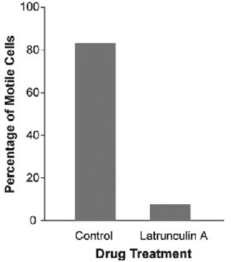 -Refer to the study by Poulsen et al. and the figure above. Latrunculin A is a reversible toxin that disrupts the formation of actin fibres. A culture of a particular species of diatom was treated with this toxin diluted in a buffer, while another culture was treated only with the buffer (no toxin; control). The motility of cells in each culture was assessed by counting the number of cells that were moving during a defined period of time. Which of the following conclusions is reasonable based on the above figure?
Free
(Multiple Choice)
4.8/5  (77)
(77) Correct Answer: Verified
C
Which of the following have chloroplasts (or structures since evolved from chloroplasts) thought to be derived from ancestral green algae?
Free
(Multiple Choice)
4.9/5 (78)
(78) Correct Answer:Verified
VerifiedD
Imagine that some members of an aquatic species of motile, photosynthetic protists evolve to become parasitic to fish. They gain the ability to live in the fish gut, absorbing nutrients as the fish digests food. Over time, which of the following phenotypic changes would you expect to observe in this population of protists?
Free
(Multiple Choice)
5.0/5 (75)
(75) Correct Answer:Verified
VerifiedB
________ is an important group of protists that produce ________, a substance useful to humans.
(Multiple Choice)
4.9/5 (86)
(86) A gelatinous seaweed that grows in shallow, cold water and undergoes heteromorphic alternation of generations is most probably what type of alga?
(Multiple Choice)
4.8/5 (75)
(75) Giardia intestinalis is an intestinal parasite of humans and other mammals that causes intestinal ailments in most people who ingest the cysts. Upon ingestion, each cyst releases two motile cells, called "trophozoites". These attach to the small intestine's lining via a ventral adhesive disk. The trophozoites anaerobically metabolise glucose from the host's intestinal contents to produce ATP. Reproduction is completely asexual, occurring by longitudinal binary fission of trophozoites, with each daughter cell receiving two haploid nuclei (n = 5). A trophozoite will often encyst as it passes into the large intestine by secreting around itself a case that is resistant to cold, heat, and dehydration. Infection usually occurs by drinking untreated water that contains cysts.
-Given its mode of reproduction and internal structures, which of the following should be expected to occur in Giardia at some stage of its life cycle?
(Multiple Choice)
4.8/5 (79)
(79) Healthy individuals of Paramecium bursaria contain photosynthetic algal endosymbionts of the genus Chlorella. When within their hosts, the algae are referred to as "zoochlorellae". In aquaria with light coming from only one side, P. bursaria gather at the well-lit side, whereas other species of Paramecium gather at the opposite side. The zoochlorellae provide their hosts with glucose and oxygen, and P. bursaria provides its zoochlorellae with protection and motility. P. bursaria can lose its zoochlorellae in two ways: (1) if kept in darkness, the algae will die; and (2) if prey items (mostly bacteria) are absent from its habitat, P. bursaria will digest its zoochlorellae.
-Which process in Paramecium results in genetic recombination but no increase in population size?
(Multiple Choice)
4.8/5 (89)
(89) Super cells characteristic of plasmodial slime moulds result when which one of the following common cellular processes does not occur?
(Multiple Choice)
4.9/5 (77)
(77) Similar to most amoebozoans, the forams and the radiolarians also have pseudopods, as do some of the white blood cells of animals (monocytes). If one were to erect a taxon that included all organisms that have cells with pseudopods, the taxon would ________.
(Multiple Choice)
4.8/5 (69)
(69) You are given four test tubes, each containing an unknown protist, and your task is to read the following description and match these four protists to the correct test tube.
When light, especially red and blue light, is shone on the tubes, oxygen bubbles accumulate on the inside of test tubes 1 and 2. Chemical analysis of test tube 1 indicates the presence of a chemical that is toxic to fish and humans. Chemical analysis of test tube 2 indicates the presence of substantial amounts of silica. Microscopic analysis of organisms in test tubes 1, 3, and 4 reveals the presence of permanent, membrane-bounded sacs just under the plasma membrane. Microscopic analysis of organisms in test tube 3 reveals the presence of an apicoplast in each. Microscopic analysis of the contents in test tube 4 reveals the presence of one large nucleus and one small nucleus in each organism.
-Test tube 4 contains ________.
(Multiple Choice)
4.7/5 (76)
(76) Giardia intestinalis is an intestinal parasite of humans and other mammals that causes intestinal ailments in most people who ingest the cysts. Upon ingestion, each cyst releases two motile cells, called "trophozoites". These attach to the small intestine's lining via a ventral adhesive disk. The trophozoites anaerobically metabolise glucose from the host's intestinal contents to produce ATP. Reproduction is completely asexual, occurring by longitudinal binary fission of trophozoites, with each daughter cell receiving two haploid nuclei (n = 5). A trophozoite will often encyst as it passes into the large intestine by secreting around itself a case that is resistant to cold, heat, and dehydration. Infection usually occurs by drinking untreated water that contains cysts.
-
Giardia's mitosome can be said to be "doubly degenerate", because it is a degenerate type of ________, an organelle that is itself a degenerate form of ________.
(Multiple Choice)
4.9/5 (72)
(72) Healthy individuals of Paramecium bursaria contain photosynthetic algal endosymbionts of the genus Chlorella. When within their hosts, the algae are referred to as "zoochlorellae". In aquaria with light coming from only one side, P. bursaria gather at the well-lit side, whereas other species of Paramecium gather at the opposite side. The zoochlorellae provide their hosts with glucose and oxygen, and P. bursaria provides its zoochlorellae with protection and motility. P. bursaria can lose its zoochlorellae in two ways: (1) if kept in darkness, the algae will die; and (2) if prey items (mostly bacteria) are absent from its habitat, P. bursaria will digest its zoochlorellae.
-Theoretically, P. bursaria can obtain zoochlorellae either vertically (via the asexual reproduction of its mother cell) or horizontally (by ingesting free-living Chlorella from its habitat). Consider a P. bursaria cell containing zoochlorellae but whose habitat lacks free-living Chlorella. If this cell subsequently undergoes many generations of asexual reproduction, if all of its daughter cells contain roughly the same number of zoochlorellae as it had originally contained, and if the zoochlorellae are all haploid and identical in appearance, then which statement is accurate? The zoochlorellae ________.
(Multiple Choice)
4.8/5 (92)
(92) Giardia intestinalis is an intestinal parasite of humans and other mammals that causes intestinal ailments in most people who ingest the cysts. Upon ingestion, each cyst releases two motile cells, called "trophozoites". These attach to the small intestine's lining via a ventral adhesive disk. The trophozoites anaerobically metabolise glucose from the host's intestinal contents to produce ATP. Reproduction is completely asexual, occurring by longitudinal binary fission of trophozoites, with each daughter cell receiving two haploid nuclei (n = 5). A trophozoite will often encyst as it passes into the large intestine by secreting around itself a case that is resistant to cold, heat, and dehydration. Infection usually occurs by drinking untreated water that contains cysts.
-If the mitosomes of Giardia contain no DNA, yet are descendants of what were once free-living organisms, then where are we likely to find the genes that encode their structures, and what accounts for their current location there?
(Multiple Choice)
4.9/5 (83)
(83) Paulinella chromatophora is one of the few cercozoans that is autotrophic, carrying out aerobic photosynthesis with its two elongated "chromatophores". The chromatophores are contained within vesicles of the host cell, and each is derived from a cyanobacterium, though not the same type of cyanobacterium that gave rise to the chloroplasts of algae and plants.
p. chromatophora secretes around itself a test, or case, of plates made of silica. Which of the following is another rhizarian that would be in competition with P. chromatophora for the silica needed to make these plates, assuming limited quantities of silica in the environment?
(Multiple Choice)
4.9/5 (79)
(79) Predict the most likely outcome of fertilising areas of ocean with iron.
(Multiple Choice)
4.9/5 (86)
(86) Which of the following statements is accurate with regard to the observation that "income levels in countries hard hit by malaria are 33% lower than in similar countries free of the disease"?
(Multiple Choice)
4.9/5 (83)
(83) Trypanosome infections evade attacks by host immune systems through which of the following mechanisms?
(Multiple Choice)
4.8/5 (80)
(80) Healthy individuals of Paramecium bursaria contain photosynthetic algal endosymbionts of the genus Chlorella. When within their hosts, the algae are referred to as "zoochlorellae". In aquaria with light coming from only one side, P. bursaria gather at the well-lit side, whereas other species of Paramecium gather at the opposite side. The zoochlorellae provide their hosts with glucose and oxygen, and P. bursaria provides its zoochlorellae with protection and motility. P. bursaria can lose its zoochlorellae in two ways: (1) if kept in darkness, the algae will die; and (2) if prey items (mostly bacteria) are absent from its habitat, P. bursaria will digest its zoochlorellae.
Which term most accurately describes the nutritional mode of healthy P. bursaria?
(Multiple Choice)
4.8/5 (84)
(84) A biologist discovers an alga that is marine, multicellular, and lives at a depth reached only by blue light. This alga is most likely a type of ________.
(Multiple Choice)
4.7/5 (83)
(83) Previously recognised similarities that seemed to connect slime moulds and fungi are now considered to be ________.
(Multiple Choice)
4.8/5 (78)
(78) 
Filters
- Essay(0)
- Multiple Choice(0)
- Short Answer(0)
- True False(0)
- Matching(0)