



 Chat with AI
Exam 5: The Structure and Function of Large Biological Molecules

Exam 1: Evolution, the Themes of Biology, and Scientific Inquiry51 Questions
Exam 2: The Chemical Context of Life61 Questions
Exam 3: Water and Life55 Questions
Exam 4: Carbon and the Molecular Diversity of Life58 Questions
Exam 5: The Structure and Function of Large Biological Molecules70 Questions
Exam 6: A Tour of the Cell66 Questions
Exam 7: Membrane Structure and Function68 Questions
Exam 8: An Introduction to Metabolism67 Questions
Exam 9: Cellular Respiration and Fermentation68 Questions
Exam 10: Photosynthesis65 Questions
Exam 11: Cell Communication65 Questions
Exam 12: The Cell Cycle66 Questions
Exam 13: Meiosis and Sexual Life Cycles64 Questions
Exam 14: Mendel and the Gene Idea62 Questions
Exam 15: The Chromosomal Basis of Inheritance58 Questions
Exam 16: The Molecular Basis of Inheritance65 Questions
Exam 17: Gene Expression: From Gene to Protein67 Questions
Exam 18: Regulation of Gene Expression66 Questions
Exam 19: Viruses54 Questions
Exam 20: Dna Tools and Biotechnology57 Questions
Exam 21: Genomes and Their Evolution44 Questions
Exam 22: Descent With Modification: a Darwinian View of Life60 Questions
Exam 23: The Evolution of Populations64 Questions
Exam 24: The Origin of Species67 Questions
Exam 25: The History of Life on Earth59 Questions
Exam 26: Phylogeny and the Tree of Life75 Questions
Exam 27: Bacteria and Archaea75 Questions
Exam 28: Protists79 Questions
Exam 29: Plant Diversity I: How Plants Colonised Land82 Questions
Exam 30: Plant Diversity Ii: the Evolution of Seed Plants80 Questions
Exam 31: Fungi70 Questions
Exam 32: An Overview of Animal Diversity67 Questions
Exam 33: An Introduction to Invertebrates83 Questions
Exam 34: The Origin and Evolution of Vertebrates82 Questions
Exam 35: Vascular Plant Structure, Growth, and Development65 Questions
Exam 36: Resource Acquisition and Transport in Vascular Plants74 Questions
Exam 37: Soil and Plant Nutrition52 Questions
Exam 38: Angiosperm Reproduction and Biotechnology60 Questions
Exam 39: Plant Responses to Internal and External Signals61 Questions
Exam 40: Basic Principles of Animal Form and Function68 Questions
Exam 41: Animal Nutrition64 Questions
Exam 42: Circulation and Gas Exchange67 Questions
Exam 43: The Immune System69 Questions
Exam 44: Osmoregulation and Excretion64 Questions
Exam 45: Hormones and the Endocrine System66 Questions
Exam 46: Animal Reproduction68 Questions
Exam 47: Animal Development70 Questions
Exam 48: Neurons, Synapses, and Signalling68 Questions
Exam 49: Nervous Systems65 Questions
Exam 50: Sensory and Motor Mechanisms67 Questions
Select questions type


What does the term insoluble fibre refer to on food packages?

Free
(Multiple Choice)
5.0/5  (88)
(88) Correct Answer: Verified
A
Which of the following statements is true about proteins?
Free
(Multiple Choice)
4.9/5 (81)
(81) Correct Answer:Verified
VerifiedD
What component of amino acid structure varies among different amino acids?
Free
(Multiple Choice)
4.8/5 (75)
(75) Correct Answer:Verified
VerifiedC
The difference between an aldose sugar and a ketose sugar is ________.
(Multiple Choice)
4.9/5 (79)
(79) Which of the following descriptions best fits the class of molecules known as nucleotides?
(Multiple Choice)
4.8/5 (76)
(76) What is the major structural difference between starch and glycogen?
(Multiple Choice)
4.9/5 (85)
(85) 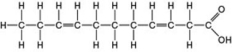 The molecule illustrated in the figure ________.
Which of the following is a major difference between RNA and DNA?
(Multiple Choice)
4.8/5 (80)
(80) The molecular formula for glucose is C₆H₁₂O₆. What would be the molecular formula for a molecule made by linking three glucose molecules together by dehydration reactions?
(Multiple Choice)
4.8/5 (90)
(90) Which of the following best summarises the relationship between dehydration reactions and hydrolysis?
(Multiple Choice)
4.8/5 (81)
(81) "The native structure of h[a]emoglobin (Hb) comprises of two α and two β subunits, each of which carries a h[a]eme group. There appear to be no previous studies that report the in-vitro folding and assembly of Hb from highly unfolded α and β globin in a 'one-pot' reaction. One difficulty that has to be overcome for studies of this kind is the tendency of Hb to aggregate during refolding. This work demonstrates that denaturation of Hb in 40% acetonitrile at pH 10.0 is reversible." (J Am Soc Mass Spectrum 2007, 18, 8-16)
-Haemoglobin, when subjected to 40% acetonitrile at pH 10.0, loses its quaternary structure, which means the ________.
(Multiple Choice)
4.9/5 (78)
(78) 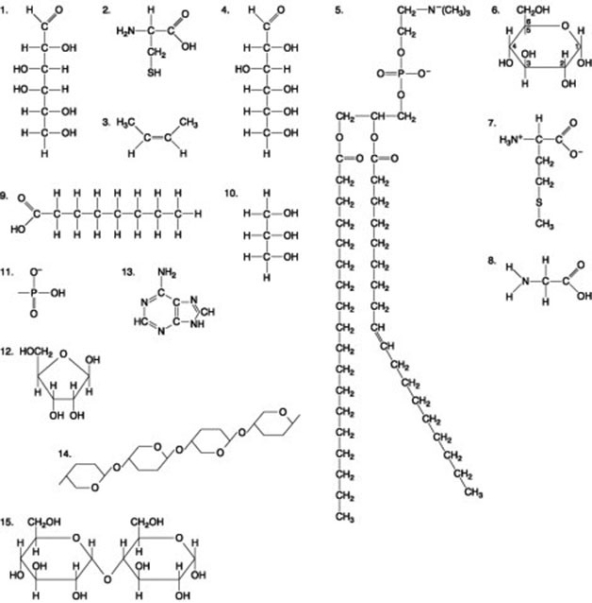 -Which of the following pairs of molecules could be joined together by a peptide bond in a dehydration reaction?
 (Multiple Choice)
4.9/5 (85)
(85) Cooking oil and petrol (a hydrocarbon) are not amphipathic molecules because they ________.
(Multiple Choice)
4.8/5 (88)
(88) 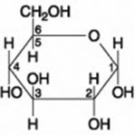 The molecule shown is ________.
Homo sapiens have 23 pairs of chromosomes. This implies that ________.
(Multiple Choice)
4.8/5 (75)
(75) Absorbance at Various pH Levels
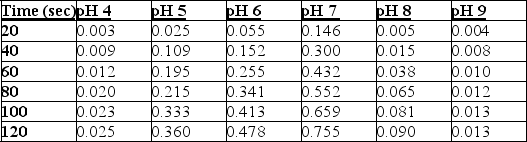 The table represents the results of an experiment where the effects of pH buffers on an enzyme found in saliva (amylase) were studied. A spectrophotometer set at 500 nm was used to measure absorbance at the various pH levels every 20 seconds for 2 minutes. The higher absorbance values would indicate greater enzyme activity. All experiments were conducted at the same temperature.
Which statement correctly identifies the result that the optimum pH for amylase function is 7?
The table represents the results of an experiment where the effects of pH buffers on an enzyme found in saliva (amylase) were studied. A spectrophotometer set at 500 nm was used to measure absorbance at the various pH levels every 20 seconds for 2 minutes. The higher absorbance values would indicate greater enzyme activity. All experiments were conducted at the same temperature.
Which statement correctly identifies the result that the optimum pH for amylase function is 7? (Multiple Choice)
4.8/5 (76)
(76) In sickle-cell disease, as a result of a single amino acid change, the mutant haemoglobin tetramers associate with each other and assemble into large fibres. Based on this information alone, we can conclude that sickle-cell haemoglobin exhibits ________.
(Multiple Choice)
4.7/5 (81)
(81) 
Filters
- Essay(0)
- Multiple Choice(0)
- Short Answer(0)
- True False(0)
- Matching(0)