menu-iconExamlexExamLexServices

Discover

Ask a Question
  1. All Topics
  2. Topic
    Biology
  3. Study Set
    Biology Australian
  4. Exam
    Exam 5: The Structure and Function of Large Biological Molecules
  5. Question
    -Which of the Following Pairs of Molecules Could Be Joined
Solved

-Which of the Following Pairs of Molecules Could Be Joined

Question 14

Question 14

Multiple Choice

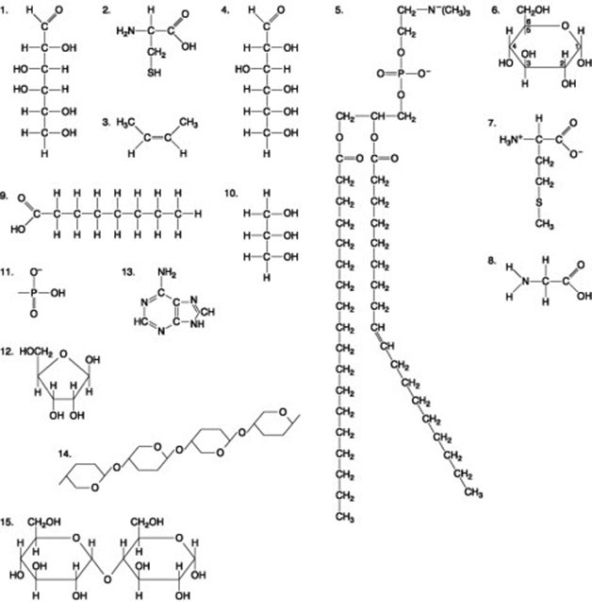
  -Which of the following pairs of molecules could be joined together by a peptide bond in a dehydration reaction? A)  2 and 3 B)  7 and 8 C)  8 and 9 D)  12 and 13
-Which of the following pairs of molecules could be joined together by a peptide bond in a dehydration reaction?


A) 2 and 3
B) 7 and 8
C) 8 and 9
D) 12 and 13

Correct Answer:

verifed

Verified

Unlock this answer now
Get Access to more Verified Answers free of charge

Related Questions

Q10: The molecular formula for glucose is C₆H₁₂O₆.

Q11: What makes lipids/fats hydrophobic?<br>A) Their long carbon

Q12: Which of the following best summarises the

Q13: "The native structure of h[a]emoglobin (Hb) comprises

Q15: Cooking oil and petrol (a hydrocarbon) are

Q16: <img src="https://d2lvgg3v3hfg70.cloudfront.net/TB6149/.jpg" alt=" The molecule shown

Q19: Absorbance at Various pH Levels<br><img src="https://d2lvgg3v3hfg70.cloudfront.net/TB6149/.jpg" alt="Absorbance

Q45: Which of the following is a major

Q48: In an RNA sample, _.<br>A) the number

Q63: Homo sapiens have 23 pairs of chromosomes.

Examlex

ExamLex

About UsContact UsPerks CenterHomeschoolingTest Prep

Work With Us

Campus RepresentativeInfluencers

Links

FaqPricingChrome Extension

Download The App

Get App StoreGet Google Play

Policies

Privacy PolicyTerms of ServiceHonor CodeCommunity Guidelines

Scan To Download

qr-code

Copyright © (2026) ExamLex LLC.

Privacy PolicyTerms Of ServiceHonor CodeCommunity Guidelines