



 Chat with AI
Exam 19: Viruses

Exam 1: Evolution, the Themes of Biology, and Scientific Inquiry51 Questions
Exam 2: The Chemical Context of Life61 Questions
Exam 3: Water and Life55 Questions
Exam 4: Carbon and the Molecular Diversity of Life58 Questions
Exam 5: The Structure and Function of Large Biological Molecules70 Questions
Exam 6: A Tour of the Cell66 Questions
Exam 7: Membrane Structure and Function68 Questions
Exam 8: An Introduction to Metabolism67 Questions
Exam 9: Cellular Respiration and Fermentation68 Questions
Exam 10: Photosynthesis65 Questions
Exam 11: Cell Communication65 Questions
Exam 12: The Cell Cycle66 Questions
Exam 13: Meiosis and Sexual Life Cycles64 Questions
Exam 14: Mendel and the Gene Idea62 Questions
Exam 15: The Chromosomal Basis of Inheritance58 Questions
Exam 16: The Molecular Basis of Inheritance65 Questions
Exam 17: Gene Expression: From Gene to Protein67 Questions
Exam 18: Regulation of Gene Expression66 Questions
Exam 19: Viruses54 Questions
Exam 20: Dna Tools and Biotechnology57 Questions
Exam 21: Genomes and Their Evolution44 Questions
Exam 22: Descent With Modification: a Darwinian View of Life60 Questions
Exam 23: The Evolution of Populations64 Questions
Exam 24: The Origin of Species67 Questions
Exam 25: The History of Life on Earth59 Questions
Exam 26: Phylogeny and the Tree of Life75 Questions
Exam 27: Bacteria and Archaea75 Questions
Exam 28: Protists79 Questions
Exam 29: Plant Diversity I: How Plants Colonised Land82 Questions
Exam 30: Plant Diversity Ii: the Evolution of Seed Plants80 Questions
Exam 31: Fungi70 Questions
Exam 32: An Overview of Animal Diversity67 Questions
Exam 33: An Introduction to Invertebrates83 Questions
Exam 34: The Origin and Evolution of Vertebrates82 Questions
Exam 35: Vascular Plant Structure, Growth, and Development65 Questions
Exam 36: Resource Acquisition and Transport in Vascular Plants74 Questions
Exam 37: Soil and Plant Nutrition52 Questions
Exam 38: Angiosperm Reproduction and Biotechnology60 Questions
Exam 39: Plant Responses to Internal and External Signals61 Questions
Exam 40: Basic Principles of Animal Form and Function68 Questions
Exam 41: Animal Nutrition64 Questions
Exam 42: Circulation and Gas Exchange67 Questions
Exam 43: The Immune System69 Questions
Exam 44: Osmoregulation and Excretion64 Questions
Exam 45: Hormones and the Endocrine System66 Questions
Exam 46: Animal Reproduction68 Questions
Exam 47: Animal Development70 Questions
Exam 48: Neurons, Synapses, and Signalling68 Questions
Exam 49: Nervous Systems65 Questions
Exam 50: Sensory and Motor Mechanisms67 Questions
Select questions type


Which of the following viruses would most likely have reverse transcriptase inside them?

Free
(Multiple Choice)
4.9/5  (66)
(66) Correct Answer: Verified
B
The difference between vertical and horizontal transmission of plant viruses is that vertical transmission is ________.
Free
(Multiple Choice)
4.9/5 (78)
(78) Correct Answer:Verified
VerifiedA
Which of the following characteristics is typical of the lytic cycle of a bacteriophage?
Free
(Multiple Choice)
4.8/5 (70)
(70) Correct Answer:Verified
VerifiedC
Poliovirus is an RNA virus of the picornavirus group, which uses its RNA as mRNA. At its 5′ end, the RNA genome has a viral protein (VPg) instead of a 5′ cap. This is followed by a non-translated leader sequence, and then a single long protein-coding region (~7,000 nucleotides), followed by a poly-A tail. Observations were made that used radioactive amino acids similar in structure to those that are found in viruses and other organisms. Short-period use of the radioactive amino acids result in labelling of only very long proteins, while longer periods of labelling result in several different short polypeptides.
What conclusion is most consistent with the results of the radioactive labelling experiment?
(Multiple Choice)
4.7/5 (76)
(76) If a viral host cell has a mutation that interferes with the addition of carbohydrates to proteins in the Golgi apparatus, which of the following processes could likely result?
(Multiple Choice)
4.8/5 (88)
(88) To cause a human pandemic, the H5N1 avian flu virus would have to
(Multiple Choice)
4.8/5 (90)
(90) Effective antiviral drugs are usually associated with which of the following properties?
(Multiple Choice)
4.9/5 (92)
(92) Which of the following processes can be effective in preventing the onset of viral infection in humans?
(Multiple Choice)
4.8/5 (72)
(72) 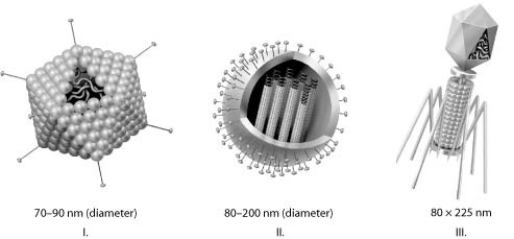 - Which of the three types of viruses shown would you expect to include glycoproteins?
 (Multiple Choice)
4.8/5 (78)
(78) Which of the following events or characteristics accounts for someone who has had regular herpesvirus-mediated cold sores or genital sore flare-ups?
(Multiple Choice)
4.9/5 (91)
(91) Which of the following characteristics correctly describes retroviruses?
(Multiple Choice)
4.8/5 (78)
(78) The first class of antiviral drugs developed to treat HIV infection, such as AZT, were known as reverse "transcriptase inhibitors". How did these drugs carry out their functions?
(Multiple Choice)
4.8/5 (74)
(74) Evidence suggests that factors that contribute towards the virulence of E. coli strain O157:H7, a bacterial strain reported to cause several food poisoning deaths, are caused by genes from a virus that infects bacteria. Considering this evidence, which of the following statements most likely explains how the O157:H7 population acquired the genetic variation that distinguishes the strain from harmless E. coli strains, such as those that reside in our intestines?
(Multiple Choice)
5.0/5 (86)
(86) Which of the following statements is correct regarding viral infections in plants?
(Multiple Choice)
5.0/5 (77)
(77) Viruses use the host cell's machinery to make copies of themselves. However, some human viruses require a type of replication that humans do not normally have. For example, humans normally do not have the ability to convert RNA into DNA. How can these types of viruses infect humans, when human cells cannot perform a particular role that the virus requires?
(Multiple Choice)
4.7/5 (80)
(80) The herpes viruses are important enveloped DNA viruses that cause disease in vertebrates and in some invertebrates such as oysters. Some of the human forms are herpes simplex virus (HSV) types I and II, causing facial and genital lesions, and the varicella zoster virus (VSV), causing chicken pox and shingles. Each of these three actively infects nervous tissue. Primary infections are fairly mild, but the virus is not then cleared from the host; rather, viral genomes are maintained in cells in a latent phase. The virus can later reactivate, replicate again, and infect others.
If scientists are trying to use what they know about the herpes simplex virus to devise a means of protecting other people from being infected, which of the following treatments would have the best chance of lowering the number of new cases of infection?
(Multiple Choice)
4.9/5 (75)
(75) You isolate an infectious substance capable of causing disease in plants, but you do not know whether the infectious agent is a bacterium, virus or prion. You have four methods at your disposal to analyse the substance and determine the nature of the infectious agent.
I. Treat the substance with enzymes that destroy all nucleic acids, and then determine whether the substance is still infectious.
II. Filter the substance to remove all elements smaller than what can be easily seen under a light microscope.
III. Culture the substance on nutritive medium, away from any plant cells.
IV. Treat the sample with proteases that digest all proteins and then determine whether the substance is still infectious.
-If you already know that the infectious agent was either bacterial or viral, which method(s) listed above would allow you to distinguish between these two possibilities?
(Multiple Choice)
4.8/5 (84)
(84) Will treating a viral infection with antibiotics affect the course of the infection?
(Multiple Choice)
4.8/5 (67)
(67) 
Filters
- Essay(0)
- Multiple Choice(0)
- Short Answer(0)
- True False(0)
- Matching(0)