



 Chat with AI
Exam 11: Cell Communication

Exam 1: Evolution, the Themes of Biology, and Scientific Inquiry51 Questions
Exam 2: The Chemical Context of Life61 Questions
Exam 3: Water and Life55 Questions
Exam 4: Carbon and the Molecular Diversity of Life58 Questions
Exam 5: The Structure and Function of Large Biological Molecules70 Questions
Exam 6: A Tour of the Cell66 Questions
Exam 7: Membrane Structure and Function68 Questions
Exam 8: An Introduction to Metabolism67 Questions
Exam 9: Cellular Respiration and Fermentation68 Questions
Exam 10: Photosynthesis65 Questions
Exam 11: Cell Communication65 Questions
Exam 12: The Cell Cycle66 Questions
Exam 13: Meiosis and Sexual Life Cycles64 Questions
Exam 14: Mendel and the Gene Idea62 Questions
Exam 15: The Chromosomal Basis of Inheritance58 Questions
Exam 16: The Molecular Basis of Inheritance65 Questions
Exam 17: Gene Expression: From Gene to Protein67 Questions
Exam 18: Regulation of Gene Expression66 Questions
Exam 19: Viruses54 Questions
Exam 20: Dna Tools and Biotechnology57 Questions
Exam 21: Genomes and Their Evolution44 Questions
Exam 22: Descent With Modification: a Darwinian View of Life60 Questions
Exam 23: The Evolution of Populations64 Questions
Exam 24: The Origin of Species67 Questions
Exam 25: The History of Life on Earth59 Questions
Exam 26: Phylogeny and the Tree of Life75 Questions
Exam 27: Bacteria and Archaea75 Questions
Exam 28: Protists79 Questions
Exam 29: Plant Diversity I: How Plants Colonised Land82 Questions
Exam 30: Plant Diversity Ii: the Evolution of Seed Plants80 Questions
Exam 31: Fungi70 Questions
Exam 32: An Overview of Animal Diversity67 Questions
Exam 33: An Introduction to Invertebrates83 Questions
Exam 34: The Origin and Evolution of Vertebrates82 Questions
Exam 35: Vascular Plant Structure, Growth, and Development65 Questions
Exam 36: Resource Acquisition and Transport in Vascular Plants74 Questions
Exam 37: Soil and Plant Nutrition52 Questions
Exam 38: Angiosperm Reproduction and Biotechnology60 Questions
Exam 39: Plant Responses to Internal and External Signals61 Questions
Exam 40: Basic Principles of Animal Form and Function68 Questions
Exam 41: Animal Nutrition64 Questions
Exam 42: Circulation and Gas Exchange67 Questions
Exam 43: The Immune System69 Questions
Exam 44: Osmoregulation and Excretion64 Questions
Exam 45: Hormones and the Endocrine System66 Questions
Exam 46: Animal Reproduction68 Questions
Exam 47: Animal Development70 Questions
Exam 48: Neurons, Synapses, and Signalling68 Questions
Exam 49: Nervous Systems65 Questions
Exam 50: Sensory and Motor Mechanisms67 Questions
Select questions type


Caffeine is an inhibitor of phosphodiesterase. Therefore, the cells of a person who has recently consumed coffee would have increased levels of which of the following molecules?

Free
(Multiple Choice)
4.8/5  (69)
(69) Correct Answer: Verified
B
If an adult person has a faulty version of the human analogue to ced-4 of the nematode, which of the following is most likely to result?
Free
(Multiple Choice)
4.7/5 (89)
(89) Correct Answer:Verified
VerifiedB
Cells that are infected, damaged, or have reached the end of their functional life span often undergo "programmed cell death". This controlled cell suicide is called "apoptosis". Select the appropriate description of this event on a cell's life cycle.
Free
(Multiple Choice)
4.9/5 (75)
(75) Correct Answer:Verified
VerifiedC
Sutherland discovered that the signalling molecule adrenaline is responsible for which of the following events?
(Multiple Choice)
4.9/5 (67)
(67) Which observation suggested to Sutherland the involvement of a second messenger in adrenalineadrenaline's effect on liver cells?
(Multiple Choice)
4.9/5 (86)
(86) If a pharmaceutical company wished to design a drug to maintain low blood sugar levels, one approach might be to design a compound that does which of the following?
(Multiple Choice)
4.7/5 (90)
(90) When a neuron responds to a particular neurotransmitter by opening gated ion channels, the neurotransmitter is serving as which part of the signal pathway?
(Multiple Choice)
4.9/5 (83)
(83) What role do phosphatases play in signal transduction pathways?
(Multiple Choice)
4.7/5 (77)
(77) At puberty, an adolescent female body changes in both structure and function of several organ systems, primarily under the influence of changing concentrations of oestrogen and other steroid hormones. How can one hormone, such as oestrogen, mediate so many effects?
(Multiple Choice)
4.7/5 (68)
(68) Viagra causes dilation of blood vessels and increased blood flow to the penis, facilitating erection. Viagra acts by inhibiting which of the following events?
(Multiple Choice)
4.9/5 (79)
(79) Phosphorylation cascades involving a series of protein kinases are useful for cellular signal transduction because they ________.
(Multiple Choice)
4.9/5 (79)
(79) 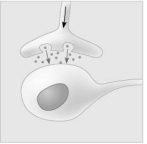 - Which of the following types of signalling is represented in the figure?
 (Multiple Choice)
4.8/5 (83)
(83) Binding of a signalling molecule to which type of receptor leads directly to a change in the distribution of ions on opposite sides of the membrane?
(Multiple Choice)
4.8/5 (82)
(82) Why has C. elegans proven to be a useful model for understanding apoptosis?
(Multiple Choice)
4.9/5 (94)
(94) A mutation that knocks out the GTPase activity of a G protein would have what effect on a cell?
(Multiple Choice)
4.8/5 (89)
(89) Which of the following is true during a typical cAMP-mediated signal transduction event?
(Multiple Choice)
4.9/5 (80)
(80) In the nematode C. elegans, ced-9 prevents apoptosis in a normal cell in which of the following ways?
(Multiple Choice)
4.7/5 (86)
(86) Which of the following provides the best evidence that cell-signalling pathways evolved early in the history of life?
(Multiple Choice)
4.9/5 (73)
(73) Protein kinase is an enzyme that functions in which of the following ways?
(Multiple Choice)
4.9/5 (83)
(83) If an animal cell suddenly lost the ability to produce GTP, what might happen to its signalling system?
(Multiple Choice)
4.8/5 (77)
(77) 
Filters
- Essay(0)
- Multiple Choice(0)
- Short Answer(0)
- True False(0)
- Matching(0)