



 Chat with AI
Exam 11: Cell Communication

Exam 1: Evolution, the Themes of Biology, and Scientific Inquiry51 Questions
Exam 2: The Chemical Context of Life61 Questions
Exam 3: Water and Life55 Questions
Exam 4: Carbon and the Molecular Diversity of Life58 Questions
Exam 5: The Structure and Function of Large Biological Molecules70 Questions
Exam 6: A Tour of the Cell66 Questions
Exam 7: Membrane Structure and Function68 Questions
Exam 8: An Introduction to Metabolism67 Questions
Exam 9: Cellular Respiration and Fermentation68 Questions
Exam 10: Photosynthesis65 Questions
Exam 11: Cell Communication65 Questions
Exam 12: The Cell Cycle66 Questions
Exam 13: Meiosis and Sexual Life Cycles64 Questions
Exam 14: Mendel and the Gene Idea62 Questions
Exam 15: The Chromosomal Basis of Inheritance58 Questions
Exam 16: The Molecular Basis of Inheritance65 Questions
Exam 17: Gene Expression: From Gene to Protein67 Questions
Exam 18: Regulation of Gene Expression66 Questions
Exam 19: Viruses54 Questions
Exam 20: Dna Tools and Biotechnology57 Questions
Exam 21: Genomes and Their Evolution44 Questions
Exam 22: Descent With Modification: a Darwinian View of Life60 Questions
Exam 23: The Evolution of Populations64 Questions
Exam 24: The Origin of Species67 Questions
Exam 25: The History of Life on Earth59 Questions
Exam 26: Phylogeny and the Tree of Life75 Questions
Exam 27: Bacteria and Archaea75 Questions
Exam 28: Protists79 Questions
Exam 29: Plant Diversity I: How Plants Colonised Land82 Questions
Exam 30: Plant Diversity Ii: the Evolution of Seed Plants80 Questions
Exam 31: Fungi70 Questions
Exam 32: An Overview of Animal Diversity67 Questions
Exam 33: An Introduction to Invertebrates83 Questions
Exam 34: The Origin and Evolution of Vertebrates82 Questions
Exam 35: Vascular Plant Structure, Growth, and Development65 Questions
Exam 36: Resource Acquisition and Transport in Vascular Plants74 Questions
Exam 37: Soil and Plant Nutrition52 Questions
Exam 38: Angiosperm Reproduction and Biotechnology60 Questions
Exam 39: Plant Responses to Internal and External Signals61 Questions
Exam 40: Basic Principles of Animal Form and Function68 Questions
Exam 41: Animal Nutrition64 Questions
Exam 42: Circulation and Gas Exchange67 Questions
Exam 43: The Immune System69 Questions
Exam 44: Osmoregulation and Excretion64 Questions
Exam 45: Hormones and the Endocrine System66 Questions
Exam 46: Animal Reproduction68 Questions
Exam 47: Animal Development70 Questions
Exam 48: Neurons, Synapses, and Signalling68 Questions
Exam 49: Nervous Systems65 Questions
Exam 50: Sensory and Motor Mechanisms67 Questions
Select questions type


Which of the following activities would be inhibited by a drug that specifically blocks the addition of phosphate groups to proteins?
(Multiple Choice)
4.8/5  (78)
(78) Which of the following results would most likely be an immediate result of a growth factor binding to its receptor?
(Multiple Choice)
4.9/5 (82)
(82) Many G protein-coupled receptors contain seven transmembrane α-helical domains. The amino end of the protein lies at the exterior of the plasma membrane. Loops of amino acids connect the helices either at the exterior surface or on the cytosolic surface of the membrane. The loop on the cytosolic side between helices 5 and 6 is usually substantially longer than the others. Where would you expect to find the carboxyl end of the protein?
(Multiple Choice)
4.8/5 (88)
(88) Protein phosphorylation is commonly involved with all of the following except
(Multiple Choice)
4.8/5 (73)
(73) Which of the following statements describes a likely effect of a drug designed that inhibits the cellular response to testosterone?
(Multiple Choice)
4.8/5 (83)
(83) Scientists have found that extracellular matrix components may induce specific gene expression in embryonic tissues such as the liver and testes. For this to happen, there must be direct communication between the extracellular matrix and the developing cells. Which kind of transmembrane protein would most likely be involved in this kind of induction?
(Multiple Choice)
4.8/5 (67)
(67) Many G protein-coupled receptors contain seven transmembrane α-helical domains. The amino end of the protein lies at the exterior of the plasma membrane. Loops of amino acids connect the helices either at the exterior surface or on the cytosolic surface of the membrane. The loop on the cytosolic side between helices 5 and 6 is usually substantially longer than the others. Where would a coupled G protein most likely interact with this receptor?
(Multiple Choice)
4.9/5 (70)
(70) Not all intercellular signals require transduction. Which one of the following signals would be processed without transduction?
(Multiple Choice)
4.8/5 (74)
(74) Why does testosterone, a lipid-soluble signalling molecule that crosses the membranes of all cells, affect only target cells?
(Multiple Choice)
4.9/5 (76)
(76) Which of the following amino acids are most frequently phosphorylated by protein kinases in the cytoplasm during signal transduction?
(Multiple Choice)
4.8/5 (82)
(82) Which of the following statements is true of signal molecules?
(Multiple Choice)
4.8/5 (78)
(78) In which of the following ways do plant hormones differ from hormones in animals?
(Multiple Choice)
4.8/5 (97)
(97) Consider this pathway:
Adrenaline → G protein-coupled receptor → G protein → adenylyl cyclase → cAMP
The second messenger in this pathway is ________.
(Multiple Choice)
5.0/5 (72)
(72) The receptors for steroid hormones are located inside the cell instead of the membrane surface like most other signal receptors. How do steroids gain access to their receptors?
(Multiple Choice)
4.8/5 (80)
(80) An inhibitor of which of the following enzymes could be used to block the release of calcium from the endoplasmic reticulum?
(Multiple Choice)
4.8/5 (75)
(75) 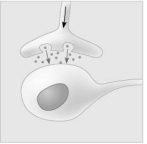 -In the figure, the dots in the space between the two structures represent which of the following?
 (Multiple Choice)
4.9/5 (81)
(81) Which observation suggested to Sutherland (1971 Nobel Prize winner) the involvement of a second messenger in adrenaline's effect on liver cells?
(Multiple Choice)
4.9/5 (82)
(82) 
Filters
- Essay(0)
- Multiple Choice(0)
- Short Answer(0)
- True False(0)
- Matching(0)