



 Chat with AI
Exam 47: Animal Development

Exam 1: Evolution, the Themes of Biology, and Scientific Inquiry51 Questions
Exam 2: The Chemical Context of Life61 Questions
Exam 3: Water and Life55 Questions
Exam 4: Carbon and the Molecular Diversity of Life58 Questions
Exam 5: The Structure and Function of Large Biological Molecules70 Questions
Exam 6: A Tour of the Cell66 Questions
Exam 7: Membrane Structure and Function68 Questions
Exam 8: An Introduction to Metabolism67 Questions
Exam 9: Cellular Respiration and Fermentation68 Questions
Exam 10: Photosynthesis65 Questions
Exam 11: Cell Communication65 Questions
Exam 12: The Cell Cycle66 Questions
Exam 13: Meiosis and Sexual Life Cycles64 Questions
Exam 14: Mendel and the Gene Idea62 Questions
Exam 15: The Chromosomal Basis of Inheritance58 Questions
Exam 16: The Molecular Basis of Inheritance65 Questions
Exam 17: Gene Expression: From Gene to Protein67 Questions
Exam 18: Regulation of Gene Expression66 Questions
Exam 19: Viruses54 Questions
Exam 20: Dna Tools and Biotechnology57 Questions
Exam 21: Genomes and Their Evolution44 Questions
Exam 22: Descent With Modification: a Darwinian View of Life60 Questions
Exam 23: The Evolution of Populations64 Questions
Exam 24: The Origin of Species67 Questions
Exam 25: The History of Life on Earth59 Questions
Exam 26: Phylogeny and the Tree of Life75 Questions
Exam 27: Bacteria and Archaea75 Questions
Exam 28: Protists79 Questions
Exam 29: Plant Diversity I: How Plants Colonised Land82 Questions
Exam 30: Plant Diversity Ii: the Evolution of Seed Plants80 Questions
Exam 31: Fungi70 Questions
Exam 32: An Overview of Animal Diversity67 Questions
Exam 33: An Introduction to Invertebrates83 Questions
Exam 34: The Origin and Evolution of Vertebrates82 Questions
Exam 35: Vascular Plant Structure, Growth, and Development65 Questions
Exam 36: Resource Acquisition and Transport in Vascular Plants74 Questions
Exam 37: Soil and Plant Nutrition52 Questions
Exam 38: Angiosperm Reproduction and Biotechnology60 Questions
Exam 39: Plant Responses to Internal and External Signals61 Questions
Exam 40: Basic Principles of Animal Form and Function68 Questions
Exam 41: Animal Nutrition64 Questions
Exam 42: Circulation and Gas Exchange67 Questions
Exam 43: The Immune System69 Questions
Exam 44: Osmoregulation and Excretion64 Questions
Exam 45: Hormones and the Endocrine System66 Questions
Exam 46: Animal Reproduction68 Questions
Exam 47: Animal Development70 Questions
Exam 48: Neurons, Synapses, and Signalling68 Questions
Exam 49: Nervous Systems65 Questions
Exam 50: Sensory and Motor Mechanisms67 Questions
Select questions type


The formation of the fertilisation envelope requires an increase in the cytosolic concentration of ________.

Free
(Multiple Choice)
4.9/5  (80)
(80) Correct Answer: Verified
A
In humans, identical twins are possible because
Free
(Multiple Choice)
4.8/5 (72)
(72) Correct Answer:Verified
VerifiedC
Which of the following is a result of gastrulation in animals?
I. The archenteron is formed.
II. The body axes are established.
III. The germ layers are formed.
Free
(Multiple Choice)
4.9/5 (75)
(75) Correct Answer:Verified
VerifiedD
The vegetal pole of a frog zygote differs from the animal pole in that ________.
(Multiple Choice)
4.9/5 (83)
(83) Fertilisation of an egg without activation is most like ________.
(Multiple Choice)
4.8/5 (84)
(84) In order to test how sea urchin sperm bind to eggs, scientists isolated the egg receptor protein that binds to the sperm acrosomal protein called bindin. Plastic beads were coated with egg receptor for bindin (ERB1) from eggs of the sea urchin Strongylocentrotus purpuratus, and then the beads mixed with sperm from S. purpuratus or from the related species, S. franciscanus. The researchers counted how many sperm were bound to each bead. The results are shown in the graph below. (Adapted from Kamei and Glabe 2003)
Treatments:
A: S. purpuratus sperm mixed with S. purpuratus ERB1 beads
B: S. purpuratus sperm mixed with beads containing no ERB1 protein
C: S. franciscanus sperm mixed with S. purpuratus ERB1 beads
D: S. franciscanus sperm mixed with beads containing no ERB1 protein 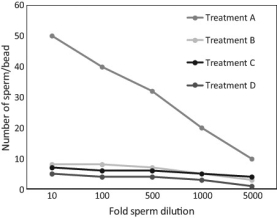 -Based on the description of the experiment, which of the treatments would be considered a "control" treatment for S. purpuratus sperm binding?
 (Multiple Choice)
4.9/5 (60)
(60) Uterine implantation due to enzymatic digestion of the endometrium is initiated by the ________.
(Multiple Choice)
4.8/5 (86)
(86) Select the choice that correctly matches the organ with its embryonic sources.
(Multiple Choice)
4.8/5 (73)
(73) In an egg cell treated with a chemical that binds calcium and magnesium ions, the ________.
(Multiple Choice)
5.0/5 (85)
(85) Even in the absence of sperm, metabolic activity in an egg can be artificially activated by ________.
(Multiple Choice)
4.9/5 (77)
(77) In mammalian eggs, the receptors for sperm are found in the ________.
(Multiple Choice)
4.8/5 (75)
(75) If gastrulation was blocked by an environmental toxin, then ________.
(Multiple Choice)
4.8/5 (65)
(65) The least amount of yolk would be found in the egg of a ________.
(Multiple Choice)
4.8/5 (85)
(85) The cortical reaction of sea urchin eggs functions directly in ________.
(Multiple Choice)
4.9/5 (85)
(85) Which of the following correctly matches the extraembryonic membrane with its function?
(Multiple Choice)
4.8/5 (79)
(79) 
Filters
- Essay(0)
- Multiple Choice(0)
- Short Answer(0)
- True False(0)
- Matching(0)