



 Chat with AI
Exam 31: Fungi

Exam 1: Evolution, the Themes of Biology, and Scientific Inquiry51 Questions
Exam 2: The Chemical Context of Life61 Questions
Exam 3: Water and Life55 Questions
Exam 4: Carbon and the Molecular Diversity of Life58 Questions
Exam 5: The Structure and Function of Large Biological Molecules70 Questions
Exam 6: A Tour of the Cell66 Questions
Exam 7: Membrane Structure and Function68 Questions
Exam 8: An Introduction to Metabolism67 Questions
Exam 9: Cellular Respiration and Fermentation68 Questions
Exam 10: Photosynthesis65 Questions
Exam 11: Cell Communication65 Questions
Exam 12: The Cell Cycle66 Questions
Exam 13: Meiosis and Sexual Life Cycles64 Questions
Exam 14: Mendel and the Gene Idea62 Questions
Exam 15: The Chromosomal Basis of Inheritance58 Questions
Exam 16: The Molecular Basis of Inheritance65 Questions
Exam 17: Gene Expression: From Gene to Protein67 Questions
Exam 18: Regulation of Gene Expression66 Questions
Exam 19: Viruses54 Questions
Exam 20: Dna Tools and Biotechnology57 Questions
Exam 21: Genomes and Their Evolution44 Questions
Exam 22: Descent With Modification: a Darwinian View of Life60 Questions
Exam 23: The Evolution of Populations64 Questions
Exam 24: The Origin of Species67 Questions
Exam 25: The History of Life on Earth59 Questions
Exam 26: Phylogeny and the Tree of Life75 Questions
Exam 27: Bacteria and Archaea75 Questions
Exam 28: Protists79 Questions
Exam 29: Plant Diversity I: How Plants Colonised Land82 Questions
Exam 30: Plant Diversity Ii: the Evolution of Seed Plants80 Questions
Exam 31: Fungi70 Questions
Exam 32: An Overview of Animal Diversity67 Questions
Exam 33: An Introduction to Invertebrates83 Questions
Exam 34: The Origin and Evolution of Vertebrates82 Questions
Exam 35: Vascular Plant Structure, Growth, and Development65 Questions
Exam 36: Resource Acquisition and Transport in Vascular Plants74 Questions
Exam 37: Soil and Plant Nutrition52 Questions
Exam 38: Angiosperm Reproduction and Biotechnology60 Questions
Exam 39: Plant Responses to Internal and External Signals61 Questions
Exam 40: Basic Principles of Animal Form and Function68 Questions
Exam 41: Animal Nutrition64 Questions
Exam 42: Circulation and Gas Exchange67 Questions
Exam 43: The Immune System69 Questions
Exam 44: Osmoregulation and Excretion64 Questions
Exam 45: Hormones and the Endocrine System66 Questions
Exam 46: Animal Reproduction68 Questions
Exam 47: Animal Development70 Questions
Exam 48: Neurons, Synapses, and Signalling68 Questions
Exam 49: Nervous Systems65 Questions
Exam 50: Sensory and Motor Mechanisms67 Questions
Select questions type


The figure depicts the outline of a large fairy ring that has appeared overnight in an open paddock, as viewed from above. The fairy ring represents the furthest advance of this mycelium through the soil. Locations A-D are all 0.5 metres below the soil surface. 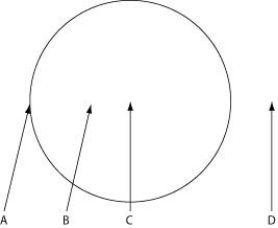 In which of the following human mycoses should one expect to find a growth pattern most similar to that of the mycelium that produced the fairy ring?
 (Multiple Choice)
4.8/5  (85)
(85) A billionaire buys a sterile volcanic island that recently emerged from the sea. To speed the arrival of conditions necessary for plant growth, the billionaire might be advised to aerially sow what over the island?
(Multiple Choice)
4.8/5 (77)
(77) Fungi interact with many organisms in mutualistic ways. Which of the following involves a fungus that is mutualistic with another organism?
(Multiple Choice)
4.9/5 (77)
(77) Which of the following cells or structures are associated with asexual reproduction in fungi?
(Multiple Choice)
4.8/5 (91)
(91) Suzanne Simard and colleagues knew that the same mycorrhizal fungal species could colonise multiple types of trees. They wondered if the same fungal individual would colonise different trees, forming an underground network that potentially could transport carbon and nutrients from one tree to another (S. Simard et al. 1997. Net transfer of carbon between mycorrhizal tree species in the field. Nature 388:579-82).
Pots containing seedlings of three different tree species were set up and grown under natural conditions for three years (Fig.A). Two of the three species (Douglas fir, birch) could form ectomycorrhizal connections with the same fungal species, but the third species (cedar) could not form an ectomycorrhizal connection with the fungal species. In some of the pots, the researchers placed airtight bags over the Douglas fir and birch seedlings and injected carbon dioxide made from carbon-13 into the bags with the Douglas fir and carbon dioxide made from carbon-14 into the bags with the birch. (13C and 14C are different isotopes of carbon that can be detected and measured by researchers.) As the seedlings photosynthesised, the carbon dioxide was converted into sugars that could be tracked and measured by the researchers. The researchers measured whether the sugars in each plant contained only the carbon isotope that was in the air of their plastic bag or also the carbon isotope from the air around the other plant.
 -Simard et al. (1997) further hypothesised that if reciprocal transfer did occur, it would be a source-sink relationship driven by photosynthetic rates. That is, if one seedling is in full sun and the other in deep shade, there will be a net movement of carbon from the seedling in full sun to the one in deep shade. If a shade was placed over the birch seedlings and the cedar, and the Douglas fir was left in full sun, what result could Simard and colleagues expect?
 (Multiple Choice)
4.9/5 (62)
(62) Heterobasidion is a basidiomycete that contributes to mortality of trees. Kuhlman isolated 23 strains of Heterobasidion and applied them to 16 seedlings of 10 different tree species. Partial results of this experiment are shown in the table. (From Kuhlman, E. G. 1970. Seedling inoculations with Fomes annosus show variation in virulence and in host susceptibility. Phytopathology 60:1743-1746. https://www.apsnet.org/publications/phytopathology/backissues/Documents/1970Articles/Phyto60n12_1743.PDF)
% mortality of five host species from five Heterobasidion isolates
Isolate Isolate Isolate Isolate Isolate Host 63 117 195 126 118 Slash Pine 50 69 94 100 94 Shortleaf Pine 75 56 94 94 100 Red Cedar 38 32 19 50 25 Yellow-Poplar 0 0 6 6 6 Sycamore 0 0 0 0 6
-Which of the following conclusions can best be drawn from these results?
(Multiple Choice)
4.8/5 (82)
(82) The figure depicts the outline of a large fairy ring that has appeared overnight in an open paddock, as viewed from above. The fairy ring represents the furthest advance of this mycelium through the soil. Locations A-D are all 0.5 metres below the soil surface. 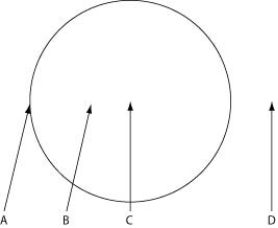 What is the most probable location of the oldest portion of this mycelium?
 (Multiple Choice)
4.8/5 (66)
(66) Rose-picker's disease is caused by the yeast Sporothrix schenkii (S. schenkii). The yeast grows on the exteriors of rose-bush thorns. If a human gets pricked by such a thorn, the yeasts can be introduced under the skin. The yeasts then assume a hyphal morphology and grow along the interiors of lymphatic vessels until they reach a lymph node. This often results in the accumulation of pus in the lymph node, which subsequently ulcerates through the skin surface and then drains.
Suppose that S. schenkii had initially been classified as a deuteromycete. Asci were later discovered in the pus that oozed from an ulcerated lymph node, and the spores therein germinated, giving rise to S. schenkii yeasts. Which of these statements make sense on the basis of this information?
(Multiple Choice)
4.7/5 (69)
(69) The figure depicts the outline of a large fairy ring that has appeared overnight in an open paddock, as viewed from above. The fairy ring represents the furthest advance of this mycelium through the soil. Locations A-D are all 0.5 metres below the soil surface. 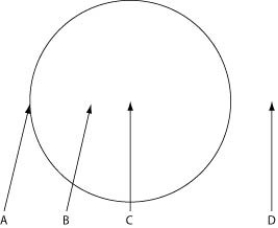 At which location should one find the lowest concentration of fungal enzymes, assuming that the enzymes do not diffuse far from their source and that no other fungi are present in this habitat?
 (Multiple Choice)
4.9/5 (84)
(84) Some companies advertise and sell mycorrhizae to home gardeners and commercial farms, claiming that the presence of mycorrhizae improves plant growth and survival. If the company conducted experiments on plants with and without mycorrhizae, which of the following measurements would support their claim?
(Multiple Choice)
4.9/5 (89)
(89) Why are mycorrhizal fungi superior to plants at acquiring mineral nutrition from the soil?
(Multiple Choice)
4.7/5 (83)
(83) Fossil fungi date back to the origin and early evolution of plants. What combination of environmental and morphological change is similar in the evolution of both fungi and plants?
(Multiple Choice)
4.9/5 (89)
(89) Orchid seeds are tiny, with virtually no endosperm and with miniscule cotyledons. If such seeds are deposited in a dark, moist environment, then which of the following represents the most likely means by which fungi might assist in seed germination, given what the seeds lack?
(Multiple Choice)
4.9/5 (77)
(77) The figure depicts the outline of a large fairy ring that has appeared overnight in an open paddock, as viewed from above. The fairy ring represents the furthest advance of this mycelium through the soil. Locations A-D are all 0.5 metres below the soil surface. 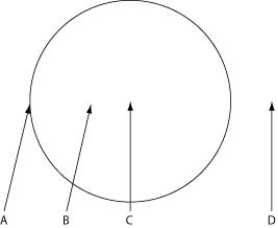 Assume that all four locations are 0.5 metres above the surface. On a breezy day with prevailing winds blowing from left to right, where should one expect to find the highest concentration of free basidiospores in an air sample?
 (Multiple Choice)
4.8/5 (78)
(78) At which stage of a basidiomycete's life cycle would reproduction be halted if an enzyme that prevented the fusion of hyphae was introduced?
(Multiple Choice)
4.9/5 (77)
(77) For several decades now, amphibian species worldwide have been in decline. A significant proportion of the decline seems to be due to the spread of the chytrid fungus, Batrachochytrium dendrobatidis (Bd). Chytrid sporangia reside within the epidermal cells of infected animals, animals that consequently show areas of sloughed skin. They can also be lethargic, which is expressed through failure to hide and failure to flee. The infection cycle typically takes four to five days, at the end of which zoospores are released from sporangia into the environment. In some amphibian species, mortality rates approach 100%; other species seem able to survive the infection.
Sexual reproduction has not been observed in Bd. If its morphology and genetics did not identify it as a chytridiomycete, then to which fungal group would Bd be assigned?
(Multiple Choice)
4.9/5 (81)
(81) The figure depicts the outline of a large fairy ring that has appeared overnight in an open paddock, as viewed from above. The fairy ring represents the furthest advance of this mycelium through the soil. Locations A-D are all 0.5 metres below the soil surface. 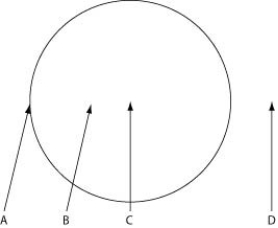 At which location is the mycelium currently absorbing the most nutrients per unit surface area, per unit time?
 (Multiple Choice)
4.8/5 (86)
(86) The adaptive advantage associated with the filamentous nature of fungal mycelia is primarily related to ________.
(Multiple Choice)
5.0/5 (67)
(67) The most important adaptive advantage associated with the filamentous nature of fungal mycelia is
(Multiple Choice)
4.9/5 (83)
(83) 
Filters
- Essay(0)
- Multiple Choice(0)
- Short Answer(0)
- True False(0)
- Matching(0)