



 Chat with AI
Exam 31: Fungi

Exam 1: Evolution, the Themes of Biology, and Scientific Inquiry51 Questions
Exam 2: The Chemical Context of Life61 Questions
Exam 3: Water and Life55 Questions
Exam 4: Carbon and the Molecular Diversity of Life58 Questions
Exam 5: The Structure and Function of Large Biological Molecules70 Questions
Exam 6: A Tour of the Cell66 Questions
Exam 7: Membrane Structure and Function68 Questions
Exam 8: An Introduction to Metabolism67 Questions
Exam 9: Cellular Respiration and Fermentation68 Questions
Exam 10: Photosynthesis65 Questions
Exam 11: Cell Communication65 Questions
Exam 12: The Cell Cycle66 Questions
Exam 13: Meiosis and Sexual Life Cycles64 Questions
Exam 14: Mendel and the Gene Idea62 Questions
Exam 15: The Chromosomal Basis of Inheritance58 Questions
Exam 16: The Molecular Basis of Inheritance65 Questions
Exam 17: Gene Expression: From Gene to Protein67 Questions
Exam 18: Regulation of Gene Expression66 Questions
Exam 19: Viruses54 Questions
Exam 20: Dna Tools and Biotechnology57 Questions
Exam 21: Genomes and Their Evolution44 Questions
Exam 22: Descent With Modification: a Darwinian View of Life60 Questions
Exam 23: The Evolution of Populations64 Questions
Exam 24: The Origin of Species67 Questions
Exam 25: The History of Life on Earth59 Questions
Exam 26: Phylogeny and the Tree of Life75 Questions
Exam 27: Bacteria and Archaea75 Questions
Exam 28: Protists79 Questions
Exam 29: Plant Diversity I: How Plants Colonised Land82 Questions
Exam 30: Plant Diversity Ii: the Evolution of Seed Plants80 Questions
Exam 31: Fungi70 Questions
Exam 32: An Overview of Animal Diversity67 Questions
Exam 33: An Introduction to Invertebrates83 Questions
Exam 34: The Origin and Evolution of Vertebrates82 Questions
Exam 35: Vascular Plant Structure, Growth, and Development65 Questions
Exam 36: Resource Acquisition and Transport in Vascular Plants74 Questions
Exam 37: Soil and Plant Nutrition52 Questions
Exam 38: Angiosperm Reproduction and Biotechnology60 Questions
Exam 39: Plant Responses to Internal and External Signals61 Questions
Exam 40: Basic Principles of Animal Form and Function68 Questions
Exam 41: Animal Nutrition64 Questions
Exam 42: Circulation and Gas Exchange67 Questions
Exam 43: The Immune System69 Questions
Exam 44: Osmoregulation and Excretion64 Questions
Exam 45: Hormones and the Endocrine System66 Questions
Exam 46: Animal Reproduction68 Questions
Exam 47: Animal Development70 Questions
Exam 48: Neurons, Synapses, and Signalling68 Questions
Exam 49: Nervous Systems65 Questions
Exam 50: Sensory and Motor Mechanisms67 Questions
Select questions type


It has been hypothesised that fungi and plants have a mutualistic relationship because plants make sugars available for the fungi's use. What is the best evidence in support of this hypothesis?
(Multiple Choice)
4.8/5  (85)
(85) For several decades now, amphibian species worldwide have been in decline. A significant proportion of the decline seems to be due to the spread of the chytrid fungus, Batrachochytrium dendrobatidis (Bd). Chytrid sporangia reside within the epidermal cells of infected animals, animals that consequently show areas of sloughed skin. They can also be lethargic, which is expressed through failure to hide and failure to flee. The infection cycle typically takes four to five days, at the end of which zoospores are released from sporangia into the environment. In some amphibian species, mortality rates approach 100%; other species seem able to survive the infection. However, when adult amphibian skin harbours populations of the bacterium Janthinobacterium lividum (Jl), chytrid infection seems to be inhibited.
A researcher took water in which a Jl population had been thriving, filtered the water to remove all bacterial cells, and then applied the water to the skins of adult amphibians to see if there would subsequently be a reduced infection rate by Bd when frog skins were inoculated with Bd. For which of the following hypotheses is the procedure described a potential test?
(Multiple Choice)
4.9/5 (81)
(81) Some fungal species live in plants and can kill herbivores that feed on the plant. What type of relationship does this fungus have with its host?
(Multiple Choice)
4.9/5 (94)
(94) If haustoria from the fungal partner were to appear within the photosynthetic partner of a lichen, and if the growth rate of the photosynthetic partner consequently slowed substantially, then this would support the claim that ________.
(Multiple Choice)
4.8/5 (85)
(85) Diploid nuclei of the ascomycete Neurospora crassa contain 14 chromosomes. A single diploid cell in an ascus will undergo one round of meiosis, followed in each of the daughter cells by one round of mitosis, producing a total of eight ascospores. If a single, diploid G2 nucleus in an ascus contains 400 nanograms (ng) of DNA, then a single ascospore nucleus of this species should contain how much DNA (ng), carried on how many chromosomes?
(Multiple Choice)
4.8/5 (71)
(71) When a mycelium infiltrates an unexploited source of dead organic matter, what are most likely to appear within the food source soon thereafter?
(Multiple Choice)
4.9/5 (83)
(83) Truffles are the fruiting bodies of certain fungi whose mycelium grows below ground. The truffle is also underground and can be detected by many mammals, which eat the truffle and expel the spores with their faeces. Which of the following statements is likely accurate with respect to this interaction?
(Multiple Choice)
4.9/5 (82)
(82) Which of the following best describes the physical relationship of the partners involved in lichens?
(Multiple Choice)
4.7/5 (77)
(77) Suzanne Simard and colleagues knew that the same mycorrhizal fungal species could colonise multiple types of trees. They wondered if the same fungal individual would colonise different trees, forming an underground network that potentially could transport carbon and nutrients from one tree to another (S. Simard et al. 1997. Net transfer of carbon between mycorrhizal tree species in the field. Nature 388:579-82).
Pots containing seedlings of three different tree species were set up and grown under natural conditions for three years (Fig.A). Two of the three species (Douglas fir, birch) could form ectomycorrhizal connections with the same fungal species, but the third species (cedar) could not form an ectomycorrhizal connection with the fungal species. In some of the pots, the researchers placed airtight bags over the Douglas fir and birch seedlings and injected carbon dioxide made from carbon-13 into the bags with the Douglas fir and carbon dioxide made from carbon-14 into the bags with the birch. (13C and 14C are different isotopes of carbon that can be detected and measured by researchers.) As the seedlings photosynthesised, the carbon dioxide was converted into sugars that could be tracked and measured by the researchers. The researchers measured whether the sugars in each plant contained only the carbon isotope that was in the air of their plastic bag or also the carbon isotope from the air around the other plant.
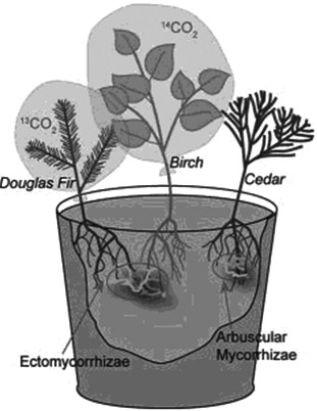 Figure A
-Which of the following results would support Simard et al.'s (1997) hypothesis that fungi can move carbon from one plant to another? [Hypothesis: Sugars made by one plant during photosynthesis can travel through a mycorrhizal fungus and be incorporated into the tissues of another plant.]
Figure A
-Which of the following results would support Simard et al.'s (1997) hypothesis that fungi can move carbon from one plant to another? [Hypothesis: Sugars made by one plant during photosynthesis can travel through a mycorrhizal fungus and be incorporated into the tissues of another plant.] (Multiple Choice)
4.8/5 (72)
(72) 
Filters
- Essay(0)
- Multiple Choice(0)
- Short Answer(0)
- True False(0)
- Matching(0)