Multiple Choice
Along with bacteria and protozoa, some chytrid fungi live in the digestive tracts of cattle and aid in the digestion of plant matter; thus, all three groups represent potential mutualists with cattle. In an experiment designed to test how much of a contribution to cell wall digestion was made by fungi in one part of the stomach (rumen) , Lee et al. fed grain to cattle and then removed samples of the rumen contents. They took these samples to the laboratory and experimentally treated them with various chemicals to produce fractions that contained (A) only fungi, (B) only bacteria, (C) only protozoa, and (D) all of the potential mutualists. They then measured the percent of the cell wall that was degraded (see the figure) . 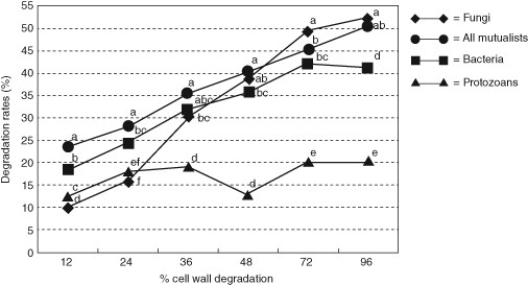
Degradation rates of cell walls extracted from Orchard grass by the monoculture system to assess the relative contributions of digestion by bacterial (square) , protozoan (triangle) , and fungal (diamond) systems, and all components (closed circle) as a control. The lowercase letters above the spots indicate statistical significance; mean values with different letters are significantly different (P < 0.05) .
-Which of the following reasons provides the best explanation for the use of a control that contained all potential mutualists? Comparison to a fraction that contained all potential mutualists allowed the researchers to ________.
A) demonstrate that their laboratory culture conditions allowed all potential mutualists to grow
B) determine how much each potential mutualist contributed to cell wall degradation
C) better mimic the conditions of the rumen
D) demonstrate that the various potential mutualists did not compete with each other
Correct Answer:

Verified
Correct Answer:
Verified
Q1: Suzanne Simard and colleagues knew that the
Q2: Rose-picker's disease is caused by the yeast
Q3: The closest relatives of fungi are thought
Q7: Heterobasidion is a basidiomycete that contributes
Q8: In most fungi, karyogamy does not immediately
Q10: The figure depicts the outline of a
Q11: The figure depicts the outline of a
Q42: Use the following information to answer the
Q46: The Neurospora genome is quite compact, lacking
Q57: Arrange the following in order from largest