



 Chat with AI
Exam 17: Gene Expression: From Gene to Protein

Exam 1: Evolution, the Themes of Biology, and Scientific Inquiry51 Questions
Exam 2: The Chemical Context of Life61 Questions
Exam 3: Water and Life55 Questions
Exam 4: Carbon and the Molecular Diversity of Life58 Questions
Exam 5: The Structure and Function of Large Biological Molecules70 Questions
Exam 6: A Tour of the Cell66 Questions
Exam 7: Membrane Structure and Function68 Questions
Exam 8: An Introduction to Metabolism67 Questions
Exam 9: Cellular Respiration and Fermentation68 Questions
Exam 10: Photosynthesis65 Questions
Exam 11: Cell Communication65 Questions
Exam 12: The Cell Cycle66 Questions
Exam 13: Meiosis and Sexual Life Cycles64 Questions
Exam 14: Mendel and the Gene Idea62 Questions
Exam 15: The Chromosomal Basis of Inheritance58 Questions
Exam 16: The Molecular Basis of Inheritance65 Questions
Exam 17: Gene Expression: From Gene to Protein67 Questions
Exam 18: Regulation of Gene Expression66 Questions
Exam 19: Viruses54 Questions
Exam 20: Dna Tools and Biotechnology57 Questions
Exam 21: Genomes and Their Evolution44 Questions
Exam 22: Descent With Modification: a Darwinian View of Life60 Questions
Exam 23: The Evolution of Populations64 Questions
Exam 24: The Origin of Species67 Questions
Exam 25: The History of Life on Earth59 Questions
Exam 26: Phylogeny and the Tree of Life75 Questions
Exam 27: Bacteria and Archaea75 Questions
Exam 28: Protists79 Questions
Exam 29: Plant Diversity I: How Plants Colonised Land82 Questions
Exam 30: Plant Diversity Ii: the Evolution of Seed Plants80 Questions
Exam 31: Fungi70 Questions
Exam 32: An Overview of Animal Diversity67 Questions
Exam 33: An Introduction to Invertebrates83 Questions
Exam 34: The Origin and Evolution of Vertebrates82 Questions
Exam 35: Vascular Plant Structure, Growth, and Development65 Questions
Exam 36: Resource Acquisition and Transport in Vascular Plants74 Questions
Exam 37: Soil and Plant Nutrition52 Questions
Exam 38: Angiosperm Reproduction and Biotechnology60 Questions
Exam 39: Plant Responses to Internal and External Signals61 Questions
Exam 40: Basic Principles of Animal Form and Function68 Questions
Exam 41: Animal Nutrition64 Questions
Exam 42: Circulation and Gas Exchange67 Questions
Exam 43: The Immune System69 Questions
Exam 44: Osmoregulation and Excretion64 Questions
Exam 45: Hormones and the Endocrine System66 Questions
Exam 46: Animal Reproduction68 Questions
Exam 47: Animal Development70 Questions
Exam 48: Neurons, Synapses, and Signalling68 Questions
Exam 49: Nervous Systems65 Questions
Exam 50: Sensory and Motor Mechanisms67 Questions
Select questions type


What would be the consequence of a mutation in a bacterial cell that produces a defective aminoacyl-tRNA synthetase that attaches a lysine instead of the normal phenylalanine to tRNAs with the anticodon AAA?
(Multiple Choice)
4.9/5  (74)
(74) Which of the following characteristics is directly related to the coding of a single amino acid during the process of translation?
(Multiple Choice)
4.9/5 (78)
(78) In eukaryotes, there are several different types of RNA polymerase. Which type is involved in transcription of mRNA for a globin protein?
(Multiple Choice)
4.9/5 (76)
(76) During the elongation phase of translation, which site in the ribosome represents the location where a codon is being read?
(Multiple Choice)
4.7/5 (80)
(80) Which of the following statements best describes the termination of transcription in prokaryotes?
(Multiple Choice)
4.9/5 (80)
(80) Once researchers identified DNA as the molecule responsible for transmitting heritable traits, they asked how information was transferred from the DNA in the nucleus to the site of protein synthesis in the cytoplasm. Which of the following statements correctly describes the mechanism of information transfer in eukaryotes that accomplishes this task?
(Multiple Choice)
4.8/5 (74)
(74)  The figure shows a simple metabolic pathway.
-According to Beadle and Tatum's (1930s) hypothesis, how many genes are necessary for this pathway?
The figure shows a simple metabolic pathway.
-According to Beadle and Tatum's (1930s) hypothesis, how many genes are necessary for this pathway? (Multiple Choice)
4.8/5 (73)
(73) 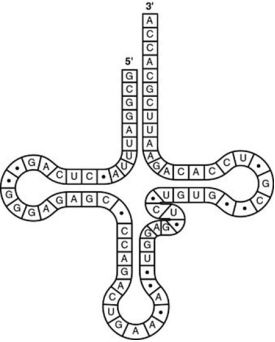 The tRNA shown in the figure has its 3′ end projecting beyond its 5′ end.
- Which of the following processes will occur at this 3′ end?
The tRNA shown in the figure has its 3′ end projecting beyond its 5′ end.
- Which of the following processes will occur at this 3′ end? (Multiple Choice)
4.9/5 (86)
(86) 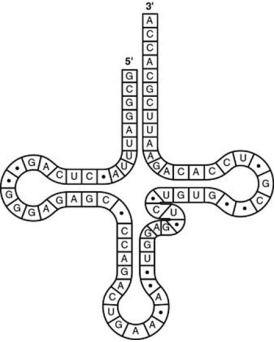 The figure represents tRNA that recognises and binds a particular amino acid (in this instance, phenylalanine).
- What type of bonding is responsible for maintaining the shape of the tRNA molecule shown in the figure?
The figure represents tRNA that recognises and binds a particular amino acid (in this instance, phenylalanine).
- What type of bonding is responsible for maintaining the shape of the tRNA molecule shown in the figure? (Multiple Choice)
4.9/5 (77)
(77) Which one of the following statements about RNA processing is correct?
(Multiple Choice)
4.8/5 (80)
(80) Which of the following processes correctly describes alternative RNA splicing?
(Multiple Choice)
4.8/5 (67)
(67) 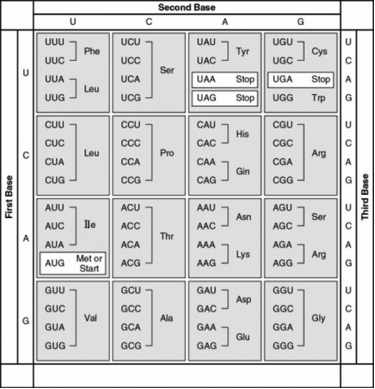 - What amino acid sequence will be generated, based on the following mRNA codon sequence?
5′-AUG-UCU-UCG-UUA-UCC-UUG-3′
- What amino acid sequence will be generated, based on the following mRNA codon sequence?
5′-AUG-UCU-UCG-UUA-UCC-UUG-3′ (Multiple Choice)
4.9/5 (89)
(89) Which of the following processes occurs in prokaryotes but not in eukaryotes?
(Multiple Choice)
4.7/5 (87)
(87) Accuracy in the translation of mRNA into the primary structure of a polypeptide depends on specificity in the ________.
(Multiple Choice)
4.9/5 (82)
(82) A particular triplet of bases in the template strand of DNA is 5′-AGT-3′. What would be the corresponding codon for the mRNA that is transcribed?
(Multiple Choice)
4.9/5 (73)
(73) The figure shows a simple metabolic pathway.
- If A, B, and C are all required for growth, a strain mutant for the gene encoding enzyme B would be able to grow on medium supplemented with which of the following nutrient(s)?
The figure shows a simple metabolic pathway.
- If A, B, and C are all required for growth, a strain mutant for the gene encoding enzyme B would be able to grow on medium supplemented with which of the following nutrient(s)? (Multiple Choice)
4.7/5 (68)
(68) A part of an mRNA molecule with the following sequence is being read by a ribosome: 5′-CCG-ACG-3′ (mRNA). The following charged transfer RNA molecules (with their anticodons shown in the 3′ to 5′ direction) are available. Two of them can correctly match the mRNA so that a dipeptide can form.
tRNA Anticodon Amino Acid GGC Proline CGU Alanine UGC Threonine CCG Glycine ACG Cysteine CGG Alanine
-
Which of the following anticodons in the first tRNA to bind will complement this mRNA?
(Multiple Choice)
4.9/5 (67)
(67) 
Filters
- Essay(0)
- Multiple Choice(0)
- Short Answer(0)
- True False(0)
- Matching(0)