



 Chat with AI
Exam 46: Animal Reproduction

Exam 1: Evolution, the Themes of Biology, and Scientific Inquiry51 Questions
Exam 2: The Chemical Context of Life61 Questions
Exam 3: Water and Life55 Questions
Exam 4: Carbon and the Molecular Diversity of Life58 Questions
Exam 5: The Structure and Function of Large Biological Molecules70 Questions
Exam 6: A Tour of the Cell66 Questions
Exam 7: Membrane Structure and Function68 Questions
Exam 8: An Introduction to Metabolism67 Questions
Exam 9: Cellular Respiration and Fermentation68 Questions
Exam 10: Photosynthesis65 Questions
Exam 11: Cell Communication65 Questions
Exam 12: The Cell Cycle66 Questions
Exam 13: Meiosis and Sexual Life Cycles64 Questions
Exam 14: Mendel and the Gene Idea62 Questions
Exam 15: The Chromosomal Basis of Inheritance58 Questions
Exam 16: The Molecular Basis of Inheritance65 Questions
Exam 17: Gene Expression: From Gene to Protein67 Questions
Exam 18: Regulation of Gene Expression66 Questions
Exam 19: Viruses54 Questions
Exam 20: Dna Tools and Biotechnology57 Questions
Exam 21: Genomes and Their Evolution44 Questions
Exam 22: Descent With Modification: a Darwinian View of Life60 Questions
Exam 23: The Evolution of Populations64 Questions
Exam 24: The Origin of Species67 Questions
Exam 25: The History of Life on Earth59 Questions
Exam 26: Phylogeny and the Tree of Life75 Questions
Exam 27: Bacteria and Archaea75 Questions
Exam 28: Protists79 Questions
Exam 29: Plant Diversity I: How Plants Colonised Land82 Questions
Exam 30: Plant Diversity Ii: the Evolution of Seed Plants80 Questions
Exam 31: Fungi70 Questions
Exam 32: An Overview of Animal Diversity67 Questions
Exam 33: An Introduction to Invertebrates83 Questions
Exam 34: The Origin and Evolution of Vertebrates82 Questions
Exam 35: Vascular Plant Structure, Growth, and Development65 Questions
Exam 36: Resource Acquisition and Transport in Vascular Plants74 Questions
Exam 37: Soil and Plant Nutrition52 Questions
Exam 38: Angiosperm Reproduction and Biotechnology60 Questions
Exam 39: Plant Responses to Internal and External Signals61 Questions
Exam 40: Basic Principles of Animal Form and Function68 Questions
Exam 41: Animal Nutrition64 Questions
Exam 42: Circulation and Gas Exchange67 Questions
Exam 43: The Immune System69 Questions
Exam 44: Osmoregulation and Excretion64 Questions
Exam 45: Hormones and the Endocrine System66 Questions
Exam 46: Animal Reproduction68 Questions
Exam 47: Animal Development70 Questions
Exam 48: Neurons, Synapses, and Signalling68 Questions
Exam 49: Nervous Systems65 Questions
Exam 50: Sensory and Motor Mechanisms67 Questions
Select questions type


Increasing the temperature of the human scrotum by 2°C (that is, near the normal body core temperature) and holding it there would most likely ________.
(Multiple Choice)
4.8/5  (81)
(81) An ectopic pregnancy occurs when a fertilised egg implants somewhere other than in the lining of the uterus. Usually it implants in the oviduct. Which of the following would be the most likely explanation for such a pregnancy being unsuccessful?
(Multiple Choice)
4.8/5 (72)
(72)
Oestrogens found in the environment have raised concerns about effects on reproductive health of animals. Researchers studied the effects that oestrogens in the water have on sexual differentiation in zebrafish. They exposed embryo-larval (0-21 days post-hatching), juvenile (21-42 days post-hatching), and adult (over 200 days post-hatching) fish to three concentrations of 17β-oestradiol (5, 25, and 100 nanograms/litre) that are within the range of concentrations found in water leaving sewage treatment plants in different countries. They then examined the proportion of males and females when the fish exposed at embryo-larval and juvenile stages reached adulthood. Embryo-larval stage fish that had been exposed to 100 ng/l 17β-oestradiol resulted in adult populations that had substantially more females than males compared to control groups. Embryo-larval fish that had been exposed to 5 and 25 ng/l of 17β-oestradiol did not show a statistically significant shift in the proportion of females. (Brion, F., C. R. Tyler, X. Palazzi, B. Laillet, J. M. Porcher, J. Garric, and P. Flammarion. 2004. Impacts of 17β-oestradiol, including environmentally relevant concentrations, on reproduction after exposure during embryo-larval-, juvenile-, and adult-life stages in zebrafish (Danio rerio). Aquatic Toxicology 68:193-217.)
-What is the significance of using the concentrations of 5, 25, and 100 ng/l of 17β-oestradiol in this experiment?
(Multiple Choice)
4.8/5 (77)
(77) Genetic mutations in asexually reproducing organisms lead to more evolutionary changes than do genetic mutations in sexually reproducing ones because ________.
(Multiple Choice)
4.9/5 (87)
(87) Refer to the following figure, which diagrams the reproductive anatomy of the human male, to answer the question. 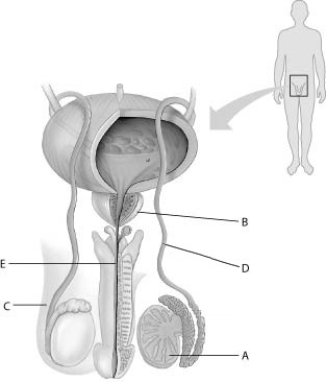 In the figure, which letter points to the vas deferens?
 (Multiple Choice)
4.9/5 (58)
(58) For which of the following is the number the same in spermatogenesis and oogenesis?
(Multiple Choice)
4.9/5 (78)
(78) Among non-mammalian vertebrates, the cloaca is an anatomical structure that functions as ________.
(Multiple Choice)
4.7/5 (84)
(84) In close comparisons, external fertilisation often yields more offspring than does internal fertilisation. However, internal fertilisation typically offers the advantage that ________.
(Multiple Choice)
4.9/5 (81)
(81) Refer to the following figure, which diagrams the reproductive anatomy of the human male, to answer the question. 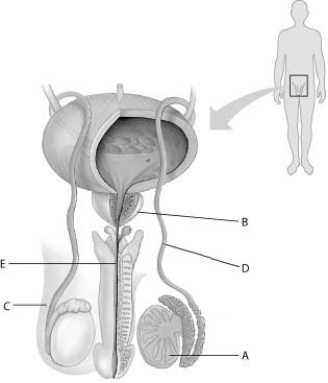 In the figure, which letter points to the prostate gland?
 (Multiple Choice)
5.0/5 (86)
(86) Evidence that parthenogenic whiptail lizards are derived from sexually reproducing ancestors includes ________.
(Multiple Choice)
4.7/5 (78)
(78) Refer to the following figure, which diagrams the reproductive anatomy of the human female, to answer the question. 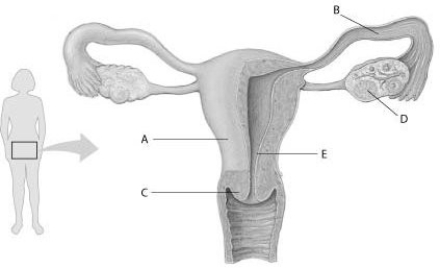 In the figure, which letter points to the corpus luteum?
 (Multiple Choice)
4.9/5 (87)
(87) For your internship at the local zoo, you have been assigned to help with the new orangutan-breeding program. Little is known about orangutan reproductive hormones, but hormone feedback cycles are often the same in closely related animals. You have been asked to use your knowledge of the interactions of human reproductive hormones to recommend injections to promote ovulation in a female orangutan when a visiting male arrives for a brief breeding visit.
-Which of the following hormones would you use if you want to induce ovulation right away?
(Multiple Choice)
4.9/5 (80)
(80) Refer to the following figure, which diagrams the reproductive anatomy of the human female, to answer the question. 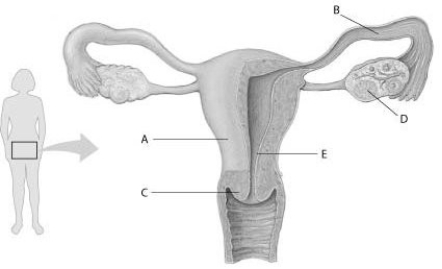 In the figure, which letter points to the cervix?
 (Multiple Choice)
4.8/5 (69)
(69) For water fleas of the genus Daphnia, switching from a pattern of asexual reproduction to sexual reproduction coincides with ________.
(Multiple Choice)
4.8/5 (77)
(77) A physician finds that a nine-year-old male patient is entering puberty much earlier than usual. Such a condition is most likely the result of a tumour in the ________.
(Multiple Choice)
4.9/5 (71)
(71) The primary difference between oestrous and menstrual cycles is that ________.
(Multiple Choice)
4.8/5 (76)
(76) On a submarine expedition to the ocean bottom, you discover a population of fish that are only female. What type of reproduction does this fish most likely use?
(Multiple Choice)
4.9/5 (73)
(73) 
Filters
- Essay(0)
- Multiple Choice(0)
- Short Answer(0)
- True False(0)
- Matching(0)