



 Chat with AI
Exam 23: The Evolution of Populations

Exam 1: Evolution, the Themes of Biology, and Scientific Inquiry51 Questions
Exam 2: The Chemical Context of Life61 Questions
Exam 3: Water and Life55 Questions
Exam 4: Carbon and the Molecular Diversity of Life58 Questions
Exam 5: The Structure and Function of Large Biological Molecules70 Questions
Exam 6: A Tour of the Cell66 Questions
Exam 7: Membrane Structure and Function68 Questions
Exam 8: An Introduction to Metabolism67 Questions
Exam 9: Cellular Respiration and Fermentation68 Questions
Exam 10: Photosynthesis65 Questions
Exam 11: Cell Communication65 Questions
Exam 12: The Cell Cycle66 Questions
Exam 13: Meiosis and Sexual Life Cycles64 Questions
Exam 14: Mendel and the Gene Idea62 Questions
Exam 15: The Chromosomal Basis of Inheritance58 Questions
Exam 16: The Molecular Basis of Inheritance65 Questions
Exam 17: Gene Expression: From Gene to Protein67 Questions
Exam 18: Regulation of Gene Expression66 Questions
Exam 19: Viruses54 Questions
Exam 20: Dna Tools and Biotechnology57 Questions
Exam 21: Genomes and Their Evolution44 Questions
Exam 22: Descent With Modification: a Darwinian View of Life60 Questions
Exam 23: The Evolution of Populations64 Questions
Exam 24: The Origin of Species67 Questions
Exam 25: The History of Life on Earth59 Questions
Exam 26: Phylogeny and the Tree of Life75 Questions
Exam 27: Bacteria and Archaea75 Questions
Exam 28: Protists79 Questions
Exam 29: Plant Diversity I: How Plants Colonised Land82 Questions
Exam 30: Plant Diversity Ii: the Evolution of Seed Plants80 Questions
Exam 31: Fungi70 Questions
Exam 32: An Overview of Animal Diversity67 Questions
Exam 33: An Introduction to Invertebrates83 Questions
Exam 34: The Origin and Evolution of Vertebrates82 Questions
Exam 35: Vascular Plant Structure, Growth, and Development65 Questions
Exam 36: Resource Acquisition and Transport in Vascular Plants74 Questions
Exam 37: Soil and Plant Nutrition52 Questions
Exam 38: Angiosperm Reproduction and Biotechnology60 Questions
Exam 39: Plant Responses to Internal and External Signals61 Questions
Exam 40: Basic Principles of Animal Form and Function68 Questions
Exam 41: Animal Nutrition64 Questions
Exam 42: Circulation and Gas Exchange67 Questions
Exam 43: The Immune System69 Questions
Exam 44: Osmoregulation and Excretion64 Questions
Exam 45: Hormones and the Endocrine System66 Questions
Exam 46: Animal Reproduction68 Questions
Exam 47: Animal Development70 Questions
Exam 48: Neurons, Synapses, and Signalling68 Questions
Exam 49: Nervous Systems65 Questions
Exam 50: Sensory and Motor Mechanisms67 Questions
Select questions type


You sample a population of butterflies and find that 56% are heterozygous at a particular locus. What should be the frequency of the homozygous individuals in this population?
(Multiple Choice)
4.9/5  (71)
(71) You are maintaining a small population of fruit flies in the laboratory by transferring the flies to a new culture bottle after each generation. After several generations, you notice that the viability of the flies has decreased greatly. Recognising that small population size is likely to be linked to decreased viability, the best way to reverse this trend is to ________.
(Multiple Choice)
5.0/5 (84)
(84) A fruit fly population has a gene with two alleles, A1 and A2. Tests show that 70% of the gametes produced in the population contain the A1 allele. If the population is in Hardy-Weinberg equilibrium, what proportion of the flies carry both A1 and A2?
(Multiple Choice)
4.8/5 (72)
(72) A biologist doing a long-term study on a wild spider population observes increased variation in silk thickness. Which of the following could the spider population be experiencing?
(Multiple Choice)
4.9/5 (75)
(75) Why does the fitness of a phenotype depend on frequency-dependent selection?
(Multiple Choice)
4.9/5 (82)
(82) A large population of laboratory animals has been allowed to breed randomly for a number of generations. After several generations, 25% of the animals display a recessive trait (aa), the same percentage as at the beginning of the breeding program. The rest of the animals show the dominant phenotype, with heterozygotes indistinguishable from the homozygous dominants.
What is the estimated frequency of allele A in the gene pool?
(Multiple Choice)
4.9/5 (79)
(79)
In those parts of equatorial Africa where the malaria parasite is most common, the sickle-cell allele constitutes 20% of the β haemoglobin alleles in the human gene pool.
In the United States, the parasite that causes malaria is not present, but it is present in African-Americans whose ancestors were from equatorial Africa. What should be happening to the sickle-cell allele in the United States, and what should be happening to it in equatorial Africa?
(Multiple Choice)
4.7/5 (88)
(88) The restriction enzymes of bacteria protect the bacteria from successful attack by bacteriophages, whose genomes can be degraded by the restriction enzymes. The bacterial genomes are not vulnerable to these restriction enzymes because bacterial DNA is methylated. This situation selects for bacteriophages whose genomes are also methylated. As new strains of resistant bacteriophages become more prevalent, this in turn selects for bacteria whose genomes are not methylated and whose restriction enzymes instead degrade methylated DNA. Over the course of evolutionary time, what should occur?
(Multiple Choice)
4.9/5 (77)
(77) Which one of the following conditions would allow gene frequencies to change by chance?
(Multiple Choice)
4.7/5 (79)
(79) Which of the following is the best modern definition of evolution?
(Multiple Choice)
4.8/5 (80)
(80) Which of the following descriptions illustrates phenotype variation caused by environment?
(Multiple Choice)
4.8/5 (84)
(84) In 1983, a population of dark-eyed junco birds became established on the campus of the University of California, San Diego (UCSD), which is located many miles from the junco's normal habitat in the mixed-coniferous temperate forests in the mountains. Juncos have white outer tail feathers that the males display during aggressive interactions and during courtship displays. Males with more white in their tail are more likely to win aggressive interactions, and females prefer to mate with males with more white in their tails. Females have less white in their tails than do males, and display it less often. (Pamela J. Yeh. 2004. Rapid evolution of a sexually selected trait following population establishment in a novel habitat. Evolution 58[1]:166-74.)
The UCSD campus male junco population tails are about 36% white, whereas the tails of males from nearby mountain populations are about 40-45% white. The founding stock of UCSD birds was likely from the nearby mountain populations because some of those birds overwinter on the UCSD campus each year. Population sizes on the UCSD campus have been reasonably large, and there are significant habitat differences between the UCSD campus and the mountain coniferous forests; UCSD campus has a more open environment (making birds more visible) and a lower junco density (decreasing intraspecific competition) than the mountain forests. Given this information, which of the following evolutionary mechanisms do you think is most likely responsible for the difference between the UCSD and mountain populations?
(Multiple Choice)
4.9/5 (84)
(84) Most starlings produce four to five eggs in each clutch. Starlings producing fewer or more than this have reduced fitness. Which of the following terms best describes this situation?
(Multiple Choice)
4.9/5 (73)
(73) 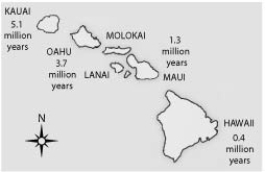 Soon after the island of Hawaii rose above the sea surface (somewhat less than one million years ago), the evolution of life on this new island should have been most strongly influenced by ________.
 (Multiple Choice)
5.0/5 (87)
(87) In peas, a gene controls flower colour such that R = purple and r = white. In an isolated pea patch, there are 36 purple-flowering plants and 64 white-flowering plants. Assuming Hardy-Weinberg equilibrium, what is the value of q for this population?
(Multiple Choice)
4.8/5 (80)
(80) There are 25 individuals in population 1, all with genotype AA, and there are 40 individuals in population 2, all with genotype aa. Assume that these populations are located far from each other and that their environmental conditions are very similar. Based on the information given here, the observed genetic variation most likely resulted from
(Multiple Choice)
4.9/5 (75)
(75) HIV's genome of RNA includes the code for reverse transcriptase (RT), an enzyme that acts early in infection to synthesise a DNA genome off of an RNA template. The HIV genome also codes for protease (PR), an enzyme that acts later in infection by cutting long viral polyproteins into smaller, functional proteins. Both RT and PR represent potential targets for antiretroviral drugs. Drugs called nucleoside analogues (NA) act against RT, whereas drugs called protease inhibitors (PI) act against PR.
Which of the following treatment options would most likely avoid the evolution of drug-resistant HIV (assuming no drug interactions or side effects)?
(Multiple Choice)
4.9/5 (68)
(68) Over time, the movement of people on Earth has steadily increased. This has altered the course of human evolution by increasing ________.
(Multiple Choice)
4.8/5 (89)
(89) 
Filters
- Essay(0)
- Multiple Choice(0)
- Short Answer(0)
- True False(0)
- Matching(0)