Multiple Choice
Along with bacteria and protozoa, some chytrid fungi live in the digestive tracts of cattle and aid in the digestion of plant matter; thus, all three groups represent potential mutualists with cattle. In an experiment designed to test how much of a contribution to cell wall digestion was made by fungi in one part of the stomach (rumen) , Lee et al. fed grain to cattle and then removed samples of the rumen contents. They took these samples to the laboratory and experimentally treated them with various chemicals to produce fractions that contained (A) only fungi, (B) only bacteria, (C) only protozoa, and (D) all of the potential mutualists. They then measured the percent of the cell wall that was degraded (see the figure) . 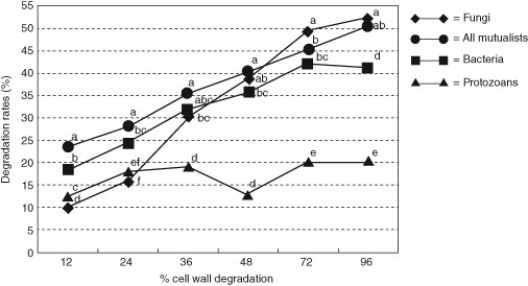
Degradation rates of cell walls extracted from Orchard grass by the monoculture system to assess the relative contributions of digestion by bacterial (square) , protozoan (triangle) , and fungal (diamond) systems, and all components (closed circle) as a control. The lowercase letters above the spots indicate statistical significance; mean values with different letters are significantly different (P < 0.05) .
Which of the following conclusions can be drawn correctly from the data?
A) Of all three potential mutualists, protozoa contribute the most to cell wall digestion.
B) Of all three potential mutualists, fungi contribute the least to cell wall digestion.
C) Fungi contribute as much to cell wall degradation as all the potential mutualists together.
D) The cattle did not benefit from the presence of fungi; therefore, the fungi are not mutualistic with the cattle.
Correct Answer:

Verified
Correct Answer:
Verified
Q6: Which feature seen in chytrids supports the
Q28: Some nematode worms suck plant juices from
Q29: Suzanne Simard and colleagues knew that the
Q30: There is much discussion in the media
Q31: Fungi have an extremely high surface-to-volume ratio.
Q32: Along with bacteria and protozoa, some chytrid
Q34: Asexual reproduction in yeasts occurs by budding.
Q38: You observe the gametes of a fungal
Q53: Mycorrhizae are to the roots of vascular
Q55: When pathogenic fungi are found growing on