



 Chat with AI
Exam 15: Gene Mutation and Molecular Medicine

Exam 1: Studying Life 97 Questions
Exam 2: Small Molecules and the Chemistry of Life145 Questions
Exam 3: Proteins, Carbohydrates, and Lipids145 Questions
Exam 4: Nucleic Acids and the Origin of Life117 Questions
Exam 5: Cells: the Working Units of Life153 Questions
Exam 6: Cell Membranes136 Questions
Exam 7: Cell Signaling and Communication150 Questions
Exam 8: Energy, Enzymes, and Metabolism153 Questions
Exam 9: Pathways That Harvest Chemical Energy154 Questions
Exam 10: Photosynthesis: Energy From Sunlight158 Questions
Exam 11: The Cell Cycle and Cell Division176 Questions
Exam 12: Inheritance, Genes, and Chromosomes150 Questions
Exam 13: Dna and Its Role in Heredity155 Questions
Exam 14: From Dna to Protein: Gene Expression151 Questions
Exam 15: Gene Mutation and Molecular Medicine141 Questions
Exam 16: Regulation of Gene Expression151 Questions
Exam 17: Genomes145 Questions
Exam 18: Recombinent Dna and Biotechnology141 Questions
Exam 19: Differential Gene Expression in Development147 Questions
Exam 20: Development and Evolutionary Change120 Questions
Exam 21: Evidence and Mechanisms of Evolution151 Questions
Exam 22: Reconstructing and Using Phylogenies137 Questions
Exam 23: Species and Their Formation140 Questions
Exam 24: Evolution of Genes and Genomes141 Questions
Exam 25: The History of Life on Earth145 Questions
Exam 26: Bacteria and Archaea: the Prokaryotic Domains156 Questions
Exam 27: The Origin and Diversification of Eukaryotes148 Questions
Exam 28: Plants Without Seeds: From Water to Land144 Questions
Exam 29: The Evolution of Seed Plants141 Questions
Exam 30: Fungi: Recyclers, Pathogens, Parasites, and Plant Partners144 Questions
Exam 31: Animal Origins and the Evolution of Body Plans122 Questions
Exam 32: Protostome Animals146 Questions
Exam 33: Deuterostome Animals150 Questions
Exam 34: The Plant Body132 Questions
Exam 35: Transport in Plants133 Questions
Exam 36: Plant Nutrition134 Questions
Exam 37: Regulation of Plant Growth137 Questions
Exam 38: Reproduction in Flowering Plants140 Questions
Exam 39: Plant Responses to Environmental Challenges131 Questions
Exam 40: Physiology, Homeostasis, and Temperature Regulation146 Questions
Exam 41: Animal Hormones147 Questions
Exam 42: Immunology: Animal Defense Systems150 Questions
Exam 43: Animal Reproduction150 Questions
Exam 44: Animal Development147 Questions
Exam 45: Neurons and Nervous Systems145 Questions
Exam 46: Sensory Systems150 Questions
Exam 47: The Mammalian Nervous System: Structure and Higher Function150 Questions
Exam 48: Musculoskeletal Systems150 Questions
Exam 49: Gas Exchange in Animals149 Questions
Exam 50: Circulatory Systems150 Questions
Exam 51: Nutrition, Digestion, and Absorption149 Questions
Exam 52: Salt and Water Balance and Nitrogen145 Questions
Exam 53: Animal Behavior149 Questions
Exam 54: Ecology and the Distribution of Life150 Questions
Exam 55: Population Ecology123 Questions
Exam 56: Species Interaction and Coevolution131 Questions
Exam 57: Community Ecology133 Questions
Exam 58: Ecosystems and Global Ecology142 Questions
Exam 59: Conservation Biology116 Questions
Select questions type


The goal of _______ is to insert a gene that will be expressed in the host.
(Short Answer)
4.7/5  (77)
(77) Which of the following enzymes are used by bacteria to defend themselves against bacteriophage?
(Multiple Choice)
4.8/5 (70)
(70) When a gene that has been mutated is expressed, the resulting protein may misfold and be nonfunctional. How is a misfolded protein (due to a mutation) different from a misfolded prion protein?
(Essay)
4.9/5 (76)
(76) Mutational "hot spots" often occur when a methyl group has been added to
(Multiple Choice)
4.9/5 (93)
(93) Phenylketonuria (PKU) and Duchenne muscular dystrophy (MD) are both molecular diseases that are caused by mutations in particular genes, yet PKU is easier to treat than MD. Why?
(Essay)
4.9/5 (93)
(93) Which of the following statements about DNA fingerprinting is true?
(Multiple Choice)
4.8/5 (89)
(89) What is the most likely explanation for the light skin and hair of people with PKU?
(Multiple Choice)
4.7/5 (78)
(78) The TP53 gene normally functions to inhibit the cell cycle. If a gain of function missense mutation occurs in the TP53 gene, the mutated TP53 gene will _______ (inhibit or promote) the cell cycle.
(Short Answer)
4.8/5 (75)
(75) Bacterial restriction endonucleases provide a type or "immunity" to viral infections. Describe how these endonucleases protect the bacterial cell from viral infections.
(Essay)
4.9/5 (67)
(67) People with sickle-cell disease have a(n) _______ abnormality.
(Multiple Choice)
4.9/5 (82)
(82) Mutations that exhibit the altered phenotype under certain restrictive conditions are referred to as _______ mutations
(Short Answer)
4.8/5 (78)
(78) Paul Hebert proposed using cytochrome oxidase in the DNA barcode project because it
(Multiple Choice)
4.9/5 (93)
(93) Refer to the diagram below showing the RFLP patterns at a hypothetical locus in a family wherein some individuals develop high cholesterol. Immediately below the RFLP patterns are the cholesterol levels of each corresponding individual. What inferences can we draw from these results? 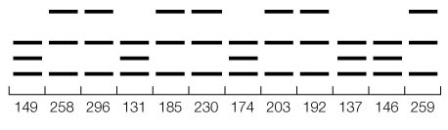
(Essay)
4.9/5 (82)
(82) Individuals with the disease PKU cannot break down the amino acid _______.
(Short Answer)
4.7/5 (84)
(84) Some bacteria use _______ enzymes as a defense mechanism; these enzymes cut up foreign _______.
(Short Answer)
4.8/5 (75)
(75) 
Filters
- Essay(0)
- Multiple Choice(0)
- Short Answer(0)
- True False(0)
- Matching(0)