



 Chat with AI
Exam 56: Species Interaction and Coevolution

Exam 1: Studying Life 97 Questions
Exam 2: Small Molecules and the Chemistry of Life145 Questions
Exam 3: Proteins, Carbohydrates, and Lipids145 Questions
Exam 4: Nucleic Acids and the Origin of Life117 Questions
Exam 5: Cells: the Working Units of Life153 Questions
Exam 6: Cell Membranes136 Questions
Exam 7: Cell Signaling and Communication150 Questions
Exam 8: Energy, Enzymes, and Metabolism153 Questions
Exam 9: Pathways That Harvest Chemical Energy154 Questions
Exam 10: Photosynthesis: Energy From Sunlight158 Questions
Exam 11: The Cell Cycle and Cell Division176 Questions
Exam 12: Inheritance, Genes, and Chromosomes150 Questions
Exam 13: Dna and Its Role in Heredity155 Questions
Exam 14: From Dna to Protein: Gene Expression151 Questions
Exam 15: Gene Mutation and Molecular Medicine141 Questions
Exam 16: Regulation of Gene Expression151 Questions
Exam 17: Genomes145 Questions
Exam 18: Recombinent Dna and Biotechnology141 Questions
Exam 19: Differential Gene Expression in Development147 Questions
Exam 20: Development and Evolutionary Change120 Questions
Exam 21: Evidence and Mechanisms of Evolution151 Questions
Exam 22: Reconstructing and Using Phylogenies137 Questions
Exam 23: Species and Their Formation140 Questions
Exam 24: Evolution of Genes and Genomes141 Questions
Exam 25: The History of Life on Earth145 Questions
Exam 26: Bacteria and Archaea: the Prokaryotic Domains156 Questions
Exam 27: The Origin and Diversification of Eukaryotes148 Questions
Exam 28: Plants Without Seeds: From Water to Land144 Questions
Exam 29: The Evolution of Seed Plants141 Questions
Exam 30: Fungi: Recyclers, Pathogens, Parasites, and Plant Partners144 Questions
Exam 31: Animal Origins and the Evolution of Body Plans122 Questions
Exam 32: Protostome Animals146 Questions
Exam 33: Deuterostome Animals150 Questions
Exam 34: The Plant Body132 Questions
Exam 35: Transport in Plants133 Questions
Exam 36: Plant Nutrition134 Questions
Exam 37: Regulation of Plant Growth137 Questions
Exam 38: Reproduction in Flowering Plants140 Questions
Exam 39: Plant Responses to Environmental Challenges131 Questions
Exam 40: Physiology, Homeostasis, and Temperature Regulation146 Questions
Exam 41: Animal Hormones147 Questions
Exam 42: Immunology: Animal Defense Systems150 Questions
Exam 43: Animal Reproduction150 Questions
Exam 44: Animal Development147 Questions
Exam 45: Neurons and Nervous Systems145 Questions
Exam 46: Sensory Systems150 Questions
Exam 47: The Mammalian Nervous System: Structure and Higher Function150 Questions
Exam 48: Musculoskeletal Systems150 Questions
Exam 49: Gas Exchange in Animals149 Questions
Exam 50: Circulatory Systems150 Questions
Exam 51: Nutrition, Digestion, and Absorption149 Questions
Exam 52: Salt and Water Balance and Nitrogen145 Questions
Exam 53: Animal Behavior149 Questions
Exam 54: Ecology and the Distribution of Life150 Questions
Exam 55: Population Ecology123 Questions
Exam 56: Species Interaction and Coevolution131 Questions
Exam 57: Community Ecology133 Questions
Exam 58: Ecosystems and Global Ecology142 Questions
Exam 59: Conservation Biology116 Questions
Select questions type


Certain birds follow swarms of foraging army ants and prey upon the insects that the ants flush out. The relationship between these birds and the ants is an example of
(Multiple Choice)
4.9/5  (86)
(86) Which of the following statements about herbivory is false?
(Multiple Choice)
4.8/5 (88)
(88) Robert Denno's studies on sap-sucking planthoppers showed that these species engage in _______ as a response to competition.
(Multiple Choice)
4.8/5 (82)
(82) Review the description of Connell's classic experiment on competition between Semibalanus and Chthamalus barnacle populations (see Figure 56.16). Do you think that the interaction between these species is an example of interference competition or exploitation competition? Why?
(Essay)
4.9/5 (73)
(73) The type of mimicry in which a palatable species resembles a toxic species is called
(Multiple Choice)
4.7/5 (81)
(81) Describe an experiment that would enable you to assess the degree of interspecific competition that exists between two rodent species living in the same habitat. How would you interpret the results?
(Essay)
4.8/5 (79)
(79) The most likely pollinator of a plant species with orange, sweet-smelling flowers that provide both nectar and pollen would be
(Multiple Choice)
4.9/5 (79)
(79) Hosts of pathogens can be classified as _______, infected, or recovered.
(Short Answer)
4.9/5 (93)
(93) Two species of beetles are both herbivores on the same host plant, and the presence of either species reduces the population growth of the other. The relationship between the beetles is best described as
(Multiple Choice)
4.8/5 (75)
(75) If the removal of a predator results in expansion of a spider's range, it is likely that the spider's _______ niche is larger than its _______ niche in the presence of predators.
(Short Answer)
4.7/5 (77)
(77) What would be the best explanation for the observation that the range of a species of lacewings has expanded following the removal of a competitor?
(Multiple Choice)
4.8/5 (81)
(81) The interaction between some plants and the ants that protect them is best described as
(Multiple Choice)
4.8/5 (81)
(81) The sharp contrast of black and white on a skunk warns other animals to stay away, lest they face a noxious spray. This defense is an example of
(Multiple Choice)
4.8/5 (92)
(92) Drosophila sechellia, which is native to the Seychelles Islands, feeds only from the Indian mulberry shrub. This species would therefore be called
(Multiple Choice)
4.9/5 (83)
(83) Which of the following types of interaction would be least likely to lead to coevolution of the interacting species?
(Multiple Choice)
4.8/5 (75)
(75) Figure 56.14 details an experiment designed to understand the relationship between Acacia cornigera trees and Pseudomyrmex ants. What can you conclude from the data in the bar graphs?
(Multiple Choice)
4.8/5 (78)
(78) Two species of woody shrubs are in close proximity and in competition for limited resources. One species produces chemicals through its roots that limit the growth of the other. The production of these chemicals is a form of
(Multiple Choice)
4.8/5 (81)
(81) Use the following to answer questions :
A hypothetical group of researchers is conducting a study to investigate whether character displacement is occurring in grasshopper species. This species has a range in which it shares some area with a competitor, while in other areas the competitor is missing. The diagram below shows the results for the three traits that were measured: tibia length, femur length, and mouthpart size. The measurements for the focal species in the absence of the competitor and the focal species in the presence of the competitor are designated A and A´, respectively. Panel B shows the measurements of the competitor. 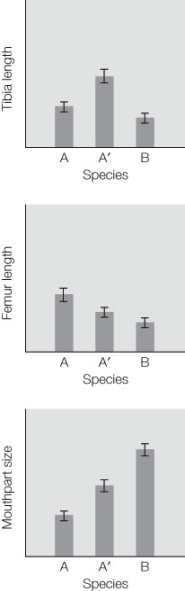 -Which traits show evidence of character displacement in species A?
 (Multiple Choice)
5.0/5 (71)
(71) 
Filters
- Essay(0)
- Multiple Choice(0)
- Short Answer(0)
- True False(0)
- Matching(0)