



 Chat with AI
Exam 58: Ecosystems and Global Ecology

Exam 1: Studying Life 97 Questions
Exam 2: Small Molecules and the Chemistry of Life145 Questions
Exam 3: Proteins, Carbohydrates, and Lipids145 Questions
Exam 4: Nucleic Acids and the Origin of Life117 Questions
Exam 5: Cells: the Working Units of Life153 Questions
Exam 6: Cell Membranes136 Questions
Exam 7: Cell Signaling and Communication150 Questions
Exam 8: Energy, Enzymes, and Metabolism153 Questions
Exam 9: Pathways That Harvest Chemical Energy154 Questions
Exam 10: Photosynthesis: Energy From Sunlight158 Questions
Exam 11: The Cell Cycle and Cell Division176 Questions
Exam 12: Inheritance, Genes, and Chromosomes150 Questions
Exam 13: Dna and Its Role in Heredity155 Questions
Exam 14: From Dna to Protein: Gene Expression151 Questions
Exam 15: Gene Mutation and Molecular Medicine141 Questions
Exam 16: Regulation of Gene Expression151 Questions
Exam 17: Genomes145 Questions
Exam 18: Recombinent Dna and Biotechnology141 Questions
Exam 19: Differential Gene Expression in Development147 Questions
Exam 20: Development and Evolutionary Change120 Questions
Exam 21: Evidence and Mechanisms of Evolution151 Questions
Exam 22: Reconstructing and Using Phylogenies137 Questions
Exam 23: Species and Their Formation140 Questions
Exam 24: Evolution of Genes and Genomes141 Questions
Exam 25: The History of Life on Earth145 Questions
Exam 26: Bacteria and Archaea: the Prokaryotic Domains156 Questions
Exam 27: The Origin and Diversification of Eukaryotes148 Questions
Exam 28: Plants Without Seeds: From Water to Land144 Questions
Exam 29: The Evolution of Seed Plants141 Questions
Exam 30: Fungi: Recyclers, Pathogens, Parasites, and Plant Partners144 Questions
Exam 31: Animal Origins and the Evolution of Body Plans122 Questions
Exam 32: Protostome Animals146 Questions
Exam 33: Deuterostome Animals150 Questions
Exam 34: The Plant Body132 Questions
Exam 35: Transport in Plants133 Questions
Exam 36: Plant Nutrition134 Questions
Exam 37: Regulation of Plant Growth137 Questions
Exam 38: Reproduction in Flowering Plants140 Questions
Exam 39: Plant Responses to Environmental Challenges131 Questions
Exam 40: Physiology, Homeostasis, and Temperature Regulation146 Questions
Exam 41: Animal Hormones147 Questions
Exam 42: Immunology: Animal Defense Systems150 Questions
Exam 43: Animal Reproduction150 Questions
Exam 44: Animal Development147 Questions
Exam 45: Neurons and Nervous Systems145 Questions
Exam 46: Sensory Systems150 Questions
Exam 47: The Mammalian Nervous System: Structure and Higher Function150 Questions
Exam 48: Musculoskeletal Systems150 Questions
Exam 49: Gas Exchange in Animals149 Questions
Exam 50: Circulatory Systems150 Questions
Exam 51: Nutrition, Digestion, and Absorption149 Questions
Exam 52: Salt and Water Balance and Nitrogen145 Questions
Exam 53: Animal Behavior149 Questions
Exam 54: Ecology and the Distribution of Life150 Questions
Exam 55: Population Ecology123 Questions
Exam 56: Species Interaction and Coevolution131 Questions
Exam 57: Community Ecology133 Questions
Exam 58: Ecosystems and Global Ecology142 Questions
Exam 59: Conservation Biology116 Questions
Select questions type


Approximately 80 percent of the mass of the atmosphere lies in its lowest layer the
(Multiple Choice)
4.9/5  (86)
(86) Despite having a relatively low rate of primary production per given area, the _______ ecosystem is a major contributor to the global primary productivity due to its vast area.
(Short Answer)
4.9/5 (92)
(92) Which of the following best describes the relationships among the following four factors: the relative amount of evaporation of water from the oceans, the amount of precipitation into the oceans, the evaporation of water from the land, and the precipitation onto the land?
(Multiple Choice)
4.9/5 (80)
(80) Oxygen makes up approximately _______ percent of Earth's atmosphere.
(Multiple Choice)
4.8/5 (88)
(88) According to studies by Swiss ecologists, the most important factor mitigating the effects of increased carbon dioxide will likely be
(Multiple Choice)
4.9/5 (91)
(91) In the following graph, the temperature of a freshwater lake is plotted against its depth. This temperature profile of the graph would be most characteristic of the lake during the 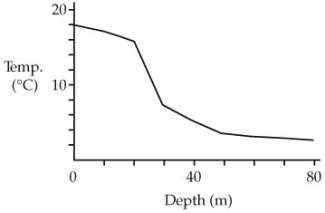
(Multiple Choice)
4.8/5 (78)
(78) Which of the following statements about biogeochemical cycles is false?
(Multiple Choice)
4.9/5 (85)
(85) Imagine an experiment in which the nitrogen-fixing capacity of a nitrogen-fixing bacterium is selectively knocked out (all other functions remain intact). This knockout strain is then placed in competition with an unaltered bacterium (the control) under two circumstances: one in which ammonia and other sources of fixed nitrogen are abundant, and one in which these sources are limiting (only N2 is readily available). Assume that the nitrogen-fixing capacity in the control is present all the time (not regulated). Which of the following would be the most likely result?
(Multiple Choice)
5.0/5 (81)
(81) In areas of the ocean called _______ zones, offshore winds move surface waters, and these waters are replaced by nutrient-rich waters from below.
(Short Answer)
4.7/5 (83)
(83) The phosphorous and carbon cycles are substantially different in that
(Multiple Choice)
4.9/5 (69)
(69) Most of the atmosphere's mass is located in the _______, which extends 10 to 17 kilometers above Earth's surface.
(Short Answer)
4.9/5 (69)
(69) Which of the following statements about the stratosphere is correct?
(Multiple Choice)
4.7/5 (79)
(79) Which of the following is part of the positive feedback loop between greenhouse gas emissions and climate change in which each is accelerating the other?
(Multiple Choice)
4.9/5 (75)
(75) Which of the following statements about material cycling is true?
(Multiple Choice)
4.7/5 (87)
(87) Which of the following human activities increases net global primary productivity?
(Multiple Choice)
4.9/5 (78)
(78) Carbon dioxide makes up approximately _______ percent of Earth's atmosphere.
(Multiple Choice)
4.8/5 (86)
(86) According to studies by Swiss ecologists, increasing atmospheric carbon dioxide will likely
(Multiple Choice)
4.8/5 (89)
(89) 
Filters
- Essay(0)
- Multiple Choice(0)
- Short Answer(0)
- True False(0)
- Matching(0)