



 Chat with AI
Exam 7: Cell Signaling and Communication

Exam 1: Studying Life 97 Questions
Exam 2: Small Molecules and the Chemistry of Life145 Questions
Exam 3: Proteins, Carbohydrates, and Lipids145 Questions
Exam 4: Nucleic Acids and the Origin of Life117 Questions
Exam 5: Cells: the Working Units of Life153 Questions
Exam 6: Cell Membranes136 Questions
Exam 7: Cell Signaling and Communication150 Questions
Exam 8: Energy, Enzymes, and Metabolism153 Questions
Exam 9: Pathways That Harvest Chemical Energy154 Questions
Exam 10: Photosynthesis: Energy From Sunlight158 Questions
Exam 11: The Cell Cycle and Cell Division176 Questions
Exam 12: Inheritance, Genes, and Chromosomes150 Questions
Exam 13: Dna and Its Role in Heredity155 Questions
Exam 14: From Dna to Protein: Gene Expression151 Questions
Exam 15: Gene Mutation and Molecular Medicine141 Questions
Exam 16: Regulation of Gene Expression151 Questions
Exam 17: Genomes145 Questions
Exam 18: Recombinent Dna and Biotechnology141 Questions
Exam 19: Differential Gene Expression in Development147 Questions
Exam 20: Development and Evolutionary Change120 Questions
Exam 21: Evidence and Mechanisms of Evolution151 Questions
Exam 22: Reconstructing and Using Phylogenies137 Questions
Exam 23: Species and Their Formation140 Questions
Exam 24: Evolution of Genes and Genomes141 Questions
Exam 25: The History of Life on Earth145 Questions
Exam 26: Bacteria and Archaea: the Prokaryotic Domains156 Questions
Exam 27: The Origin and Diversification of Eukaryotes148 Questions
Exam 28: Plants Without Seeds: From Water to Land144 Questions
Exam 29: The Evolution of Seed Plants141 Questions
Exam 30: Fungi: Recyclers, Pathogens, Parasites, and Plant Partners144 Questions
Exam 31: Animal Origins and the Evolution of Body Plans122 Questions
Exam 32: Protostome Animals146 Questions
Exam 33: Deuterostome Animals150 Questions
Exam 34: The Plant Body132 Questions
Exam 35: Transport in Plants133 Questions
Exam 36: Plant Nutrition134 Questions
Exam 37: Regulation of Plant Growth137 Questions
Exam 38: Reproduction in Flowering Plants140 Questions
Exam 39: Plant Responses to Environmental Challenges131 Questions
Exam 40: Physiology, Homeostasis, and Temperature Regulation146 Questions
Exam 41: Animal Hormones147 Questions
Exam 42: Immunology: Animal Defense Systems150 Questions
Exam 43: Animal Reproduction150 Questions
Exam 44: Animal Development147 Questions
Exam 45: Neurons and Nervous Systems145 Questions
Exam 46: Sensory Systems150 Questions
Exam 47: The Mammalian Nervous System: Structure and Higher Function150 Questions
Exam 48: Musculoskeletal Systems150 Questions
Exam 49: Gas Exchange in Animals149 Questions
Exam 50: Circulatory Systems150 Questions
Exam 51: Nutrition, Digestion, and Absorption149 Questions
Exam 52: Salt and Water Balance and Nitrogen145 Questions
Exam 53: Animal Behavior149 Questions
Exam 54: Ecology and the Distribution of Life150 Questions
Exam 55: Population Ecology123 Questions
Exam 56: Species Interaction and Coevolution131 Questions
Exam 57: Community Ecology133 Questions
Exam 58: Ecosystems and Global Ecology142 Questions
Exam 59: Conservation Biology116 Questions
Select questions type


A molecule that binds to a receptor site in another molecule is known as a(n) _______.
(Short Answer)
4.7/5  (86)
(86) For a G protein to play its part in moving events forward in a signal pathway,
(Multiple Choice)
5.0/5 (71)
(71) What do G protein-linked receptors and protein kinases have in common?
(Multiple Choice)
4.9/5 (73)
(73) Viagra, used to treat erectile dysfunction, acts by means of the release of the second messenger
(Multiple Choice)
5.0/5 (81)
(81) Which of the following statements about the insulin receptor is false?
(Multiple Choice)
4.8/5 (76)
(76) A benefit of the many steps involved in protein kinase cascades is that they allow for
(Multiple Choice)
4.9/5 (72)
(72) In _______ transduction, the more common mode of transduction, another molecule, known as a(n) _______ mediates further interaction between the receptor and the response of the cell.
(Short Answer)
4.8/5 (91)
(91) Which of the following represents the correct order of signal transduction?
(Multiple Choice)
4.8/5 (77)
(77) Draw what would happen when a hormone binds to a receptor, as shown in the diagram below. 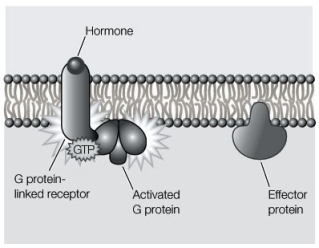
(Essay)
4.8/5 (68)
(68) The membrane-lined bridges spanning the cell walls between plant cells are known as
(Multiple Choice)
4.9/5 (84)
(84) Signals reach target cells in multicellular organisms via _______ and _______.
(Multiple Choice)
4.9/5 (76)
(76) A protein found in abnormal form in many human bladder cancer cells, _______, is a G protein.
(Short Answer)
4.8/5 (80)
(80) Which of the following statements about cell signaling in voles is false?
(Multiple Choice)
4.7/5 (67)
(67) Which of the following represents the correct ordering of the molecules that are activated by a single molecule of epinephrine, from highest number of molecules to lowest number of molecules?
(Multiple Choice)
4.9/5 (67)
(67) A molecule that binds to the particular three-dimensional structure of another molecule's receptor site is known as a(n)
(Multiple Choice)
4.9/5 (78)
(78) 
Filters
- Essay(0)
- Multiple Choice(0)
- Short Answer(0)
- True False(0)
- Matching(0)