



 Chat with AI
Exam 22: Descent With Modification: a Darwinian View of Life

Exam 1: Introduction: Themes in the Study of Life66 Questions
Exam 2: The Chemical Context of Life83 Questions
Exam 3: Water and the Fitness of the Environment66 Questions
Exam 4: Carbon and the Molecular Diversity of Life68 Questions
Exam 5: The Structure and Function of Large Biological Molecules109 Questions
Exam 6: A Tour of the Cell75 Questions
Exam 7: Membrane Structure and Function75 Questions
Exam 8: An Introduction to Metabolism79 Questions
Exam 9: Cellular Respiration: Harvesting Chemical Energy103 Questions
Exam 10: Photosynthesis74 Questions
Exam 11: Cell Communication62 Questions
Exam 12: The Cell Cycle80 Questions
Exam 13: Meiosis and Sexual Life Cycles68 Questions
Exam 14: Mendel and the Gene Idea90 Questions
Exam 15: The Chromosomal Basis of Inheritance75 Questions
Exam 16: The Molecular Basis of Inheritance72 Questions
Exam 17: From Gene to Protein84 Questions
Exam 18: Control of Gene Expression101 Questions
Exam 19: Viruses38 Questions
Exam 20: Biotechnology70 Questions
Exam 21: Genomes and Their Evolution37 Questions
Exam 22: Descent With Modification: a Darwinian View of Life57 Questions
Exam 23: The Evolution of Populations84 Questions
Exam 24: The Origin of Species60 Questions
Exam 25: The History of Life on Earth85 Questions
Exam 26: Phylogeny and the Tree of Life90 Questions
Exam 27: Bacteria and Archaea78 Questions
Exam 28: Protists79 Questions
Exam 29: Plant Diversity I: How Plants Colonized Land74 Questions
Exam 30: Plant Diversity Ii: the Evolution of Seed Plants101 Questions
Exam 31: Fungi87 Questions
Exam 32: An Introduction to Animal Diversity82 Questions
Exam 33: Invertebrates98 Questions
Exam 34: Vertebrates112 Questions
Exam 35: Plant Structure, Growth, and Development77 Questions
Exam 36: Transport in Vascular Plants84 Questions
Exam 37: Soil and Plant Nutrition85 Questions
Exam 38: Angiosperm Reproduction and Biotechnology86 Questions
Exam 39: Plant Responses to Internal and External Signals111 Questions
Exam 40: Basic Principles of Animal Form and Function74 Questions
Exam 41: Animal Nutrition68 Questions
Exam 42: Circulation and Gas Exchange78 Questions
Exam 43: The Immune System85 Questions
Exam 44: Osmoregulation and Excretion49 Questions
Exam 45: Hormones and the Endocrine System71 Questions
Exam 46: Animal Reproduction85 Questions
Exam 47: Animal Development75 Questions
Exam 48: Neurons, Synapses, and Signaling52 Questions
Exam 49: Nervous Systems48 Questions
Exam 50: Sensory and Motor Mechanisms59 Questions
Exam 51: Animal Behavior74 Questions
Exam 52: An Introduction to Ecology and the Biosphere71 Questions
Exam 53: Population Ecology80 Questions
Exam 54: Community Ecology74 Questions
Exam 55: Ecosystems79 Questions
Exam 56: Conservation Biology and Restoration Ecology65 Questions
Select questions type


During drought years on the Galapagos, small, easily eaten seeds become rare, leaving mostly large, hard-cased seeds that only birds with large beaks can eat. If a drought persists for several years, what should one expect to result from natural selection?
(Multiple Choice)
4.8/5  (67)
(67) Which of the following must exist in a population before natural selection can act upon that population?
(Multiple Choice)
4.9/5 (71)
(71) What was the prevailing notion prior to the time of Lyell and Darwin?
(Multiple Choice)
4.8/5 (86)
(86) Over evolutionary time, many cave-dwelling organisms have lost their eyes. Tapeworms have lost their digestive systems. Whales have lost their hind limbs. How can natural selection account for these losses?
(Multiple Choice)
4.7/5 (94)
(94) Within a few weeks of treatment with the drug 3TC, a patient's HIV population consists entirely of 3TC-resistant viruses. How can this result best be explained?
(Multiple Choice)
4.8/5 (74)
(74) Darwin's mechanism of natural selection required long time spans in order to modify species. From whom did Darwin get the concept of Earth's ancient age?
(Multiple Choice)
5.0/5 (83)
(83) The following questions refer to Figure 22.1, which shows an outcrop of sedimentary rock whose strata are labeled A-D.
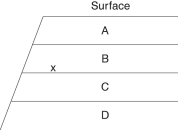 -If "x" indicates the location of fossils of two closely related species, then fossils of their most-recent common ancestor are most likely to occur in which stratum?
 (Short Answer)
4.7/5 (72)
(72) DNA sequences in many human genes are very similar to the sequences of corresponding genes in chimpanzees. The most likely explanation for this result is that
(Multiple Choice)
4.7/5 (79)
(79) If two modern organisms are distantly related in an evolutionary sense, then one should expect that
(Multiple Choice)
4.9/5 (77)
(77) The following questions refer to the evolutionary tree in Figure 22.2.
The tree's horizontal axis is a timeline that extends from 100,000 years ago to the present; the vertical axis represents nothing in particular. The labeled branch points on the tree (V-Z) represent various common ancestors. Let's say that only since 50,000 years ago has there been enough variation between the lineages depicted here to separate them into distinct species, and only the tips of the lineages on this tree represent distinct species.
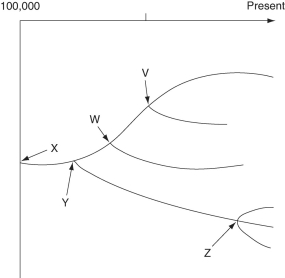 -Evolutionary trees such as this are properly understood by scientists to be
 (Multiple Choice)
4.8/5 (104)
(104) To observe natural selection's effects on a population, which of these must be True?
(Multiple Choice)
4.8/5 (81)
(81) During a study session about evolution, one of your fellow students remarks, "The giraffe stretched its neck while reaching for higher leaves; its offspring inherited longer necks as a result." Which statement is most likely to be helpful in correcting this student's misconception?
(Multiple Choice)
5.0/5 (82)
(82) Which of the following pairs of structures is least likely to represent homology?
(Multiple Choice)
4.8/5 (90)
(90) Which of the following statements is an inference of natural selection?
(Multiple Choice)
4.9/5 (73)
(73) Members of two different species possess a similar-looking structure that they use in a similar fashion to perform the same function. Which information would best help distinguish between an explanation based on homology versus one based on convergent evolution?
(Multiple Choice)
4.8/5 (85)
(85) 
Filters
- Essay(0)
- Multiple Choice(0)
- Short Answer(0)
- True False(0)
- Matching(0)