



 Chat with AI
Exam 15: The Chromosomal Basis of Inheritance

Exam 1: Introduction: Themes in the Study of Life66 Questions
Exam 2: The Chemical Context of Life83 Questions
Exam 3: Water and the Fitness of the Environment66 Questions
Exam 4: Carbon and the Molecular Diversity of Life68 Questions
Exam 5: The Structure and Function of Large Biological Molecules109 Questions
Exam 6: A Tour of the Cell75 Questions
Exam 7: Membrane Structure and Function75 Questions
Exam 8: An Introduction to Metabolism79 Questions
Exam 9: Cellular Respiration: Harvesting Chemical Energy103 Questions
Exam 10: Photosynthesis74 Questions
Exam 11: Cell Communication62 Questions
Exam 12: The Cell Cycle80 Questions
Exam 13: Meiosis and Sexual Life Cycles68 Questions
Exam 14: Mendel and the Gene Idea90 Questions
Exam 15: The Chromosomal Basis of Inheritance75 Questions
Exam 16: The Molecular Basis of Inheritance72 Questions
Exam 17: From Gene to Protein84 Questions
Exam 18: Control of Gene Expression101 Questions
Exam 19: Viruses38 Questions
Exam 20: Biotechnology70 Questions
Exam 21: Genomes and Their Evolution37 Questions
Exam 22: Descent With Modification: a Darwinian View of Life57 Questions
Exam 23: The Evolution of Populations84 Questions
Exam 24: The Origin of Species60 Questions
Exam 25: The History of Life on Earth85 Questions
Exam 26: Phylogeny and the Tree of Life90 Questions
Exam 27: Bacteria and Archaea78 Questions
Exam 28: Protists79 Questions
Exam 29: Plant Diversity I: How Plants Colonized Land74 Questions
Exam 30: Plant Diversity Ii: the Evolution of Seed Plants101 Questions
Exam 31: Fungi87 Questions
Exam 32: An Introduction to Animal Diversity82 Questions
Exam 33: Invertebrates98 Questions
Exam 34: Vertebrates112 Questions
Exam 35: Plant Structure, Growth, and Development77 Questions
Exam 36: Transport in Vascular Plants84 Questions
Exam 37: Soil and Plant Nutrition85 Questions
Exam 38: Angiosperm Reproduction and Biotechnology86 Questions
Exam 39: Plant Responses to Internal and External Signals111 Questions
Exam 40: Basic Principles of Animal Form and Function74 Questions
Exam 41: Animal Nutrition68 Questions
Exam 42: Circulation and Gas Exchange78 Questions
Exam 43: The Immune System85 Questions
Exam 44: Osmoregulation and Excretion49 Questions
Exam 45: Hormones and the Endocrine System71 Questions
Exam 46: Animal Reproduction85 Questions
Exam 47: Animal Development75 Questions
Exam 48: Neurons, Synapses, and Signaling52 Questions
Exam 49: Nervous Systems48 Questions
Exam 50: Sensory and Motor Mechanisms59 Questions
Exam 51: Animal Behavior74 Questions
Exam 52: An Introduction to Ecology and the Biosphere71 Questions
Exam 53: Population Ecology80 Questions
Exam 54: Community Ecology74 Questions
Exam 55: Ecosystems79 Questions
Exam 56: Conservation Biology and Restoration Ecology65 Questions
Select questions type


Red-green color blindness is a sex-linked recessive trait in humans. Two people with normal color vision have a color-blind son. What are the genotypes of the parents?
(Multiple Choice)
4.7/5  (79)
(79) A space probe discovers a planet inhabited by creatures that reproduce with the same hereditary patterns seen in humans. Three phenotypic characters are height (T = tall, t = dwarf), head appendages (A = antennae, a = no antennae), and nose morphology (S = upturned snout, s = downturned snout). Since the creatures are not "intelligent," Earth scientists are able to do some controlled breeding experiments, using various heterozygotes in testcrosses. For tall heterozygotes with antennae, the offspring are: tall-antennae, 46; dwarf-antennae, 7; dwarf-no antennae, 42; tall-no antennae, 5. For heterozygotes with antennae and an upturned snout, the offspring are: antennae-upturned snout, 47; antennae-downturned snout, 2; no antennae-downturned snout, 48; no antennae-upturned snout, 3. Calculate the recombination frequencies for both experiments.
(Essay)
4.9/5 (98)
(98) Which of the following is a map of a chromosome that includes the positions of genes relative to visible chromosomal features, such as stained bands?
(Multiple Choice)
4.9/5 (76)
(76) They have a daughter who is a dwarf with normal color vision. What is the probability that she is heterozygous for both genes?
(Multiple Choice)
4.9/5 (78)
(78) Two genes of a flower, one controlling blue (B)versus white (b)petals and the other controlling round (R)versus oval (r)stamens, are linked and are 10 map units apart. You cross a homozygous blue-oval plant with a homozygous white-round plant. The resulting F1 progeny are crossed with homozygous white-oval plants, and 1,000 F2 progeny are obtained. How many F2 plants of each of the four phenotypes do you expect?
(Essay)
4.9/5 (63)
(63) D, F, and J are three genes in Drosophila. The recombination frequencies for two of the three genes are shown in Figure 15.3.
Gene Pair Recombination Frequency D-F 50\% D-J 25\% F-J ?
-Genes D and F could be
(Multiple Choice)
4.9/5 (95)
(95) Figure 15.4 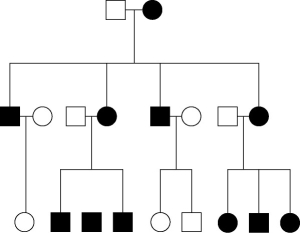 -The pedigree in Figure 15.4 shows the transmission of a trait in a particular family. Based on this pattern of transmission, the trait is most likely
 (Multiple Choice)
4.9/5 (78)
(78) Down syndrome has a frequency in the U.S. population of ~ 1/700 live births. In which of the following groups would you expect this to be significantly higher?
(Multiple Choice)
4.8/5 (67)
(67) If a human interphase nucleus contains three Barr bodies, it can be assumed that the person
(Multiple Choice)
4.8/5 (80)
(80) At which phase(s)is it preferable to obtain chromosomes to prepare a karyotype?
(Multiple Choice)
4.7/5 (74)
(74) A woman is found to have 47 chromosomes, including 3 X chromosomes. Which of the following describes her expected phenotype?
(Multiple Choice)
4.9/5 (88)
(88) 
Filters
- Essay(0)
- Multiple Choice(0)
- Short Answer(0)
- True False(0)
- Matching(0)