



 Chat with AI
Exam 2: The Chemical Context of Life

Exam 1: Introduction: Themes in the Study of Life66 Questions
Exam 2: The Chemical Context of Life83 Questions
Exam 3: Water and the Fitness of the Environment66 Questions
Exam 4: Carbon and the Molecular Diversity of Life68 Questions
Exam 5: The Structure and Function of Large Biological Molecules109 Questions
Exam 6: A Tour of the Cell75 Questions
Exam 7: Membrane Structure and Function75 Questions
Exam 8: An Introduction to Metabolism79 Questions
Exam 9: Cellular Respiration: Harvesting Chemical Energy103 Questions
Exam 10: Photosynthesis74 Questions
Exam 11: Cell Communication62 Questions
Exam 12: The Cell Cycle80 Questions
Exam 13: Meiosis and Sexual Life Cycles68 Questions
Exam 14: Mendel and the Gene Idea90 Questions
Exam 15: The Chromosomal Basis of Inheritance75 Questions
Exam 16: The Molecular Basis of Inheritance72 Questions
Exam 17: From Gene to Protein84 Questions
Exam 18: Control of Gene Expression101 Questions
Exam 19: Viruses38 Questions
Exam 20: Biotechnology70 Questions
Exam 21: Genomes and Their Evolution37 Questions
Exam 22: Descent With Modification: a Darwinian View of Life57 Questions
Exam 23: The Evolution of Populations84 Questions
Exam 24: The Origin of Species60 Questions
Exam 25: The History of Life on Earth85 Questions
Exam 26: Phylogeny and the Tree of Life90 Questions
Exam 27: Bacteria and Archaea78 Questions
Exam 28: Protists79 Questions
Exam 29: Plant Diversity I: How Plants Colonized Land74 Questions
Exam 30: Plant Diversity Ii: the Evolution of Seed Plants101 Questions
Exam 31: Fungi87 Questions
Exam 32: An Introduction to Animal Diversity82 Questions
Exam 33: Invertebrates98 Questions
Exam 34: Vertebrates112 Questions
Exam 35: Plant Structure, Growth, and Development77 Questions
Exam 36: Transport in Vascular Plants84 Questions
Exam 37: Soil and Plant Nutrition85 Questions
Exam 38: Angiosperm Reproduction and Biotechnology86 Questions
Exam 39: Plant Responses to Internal and External Signals111 Questions
Exam 40: Basic Principles of Animal Form and Function74 Questions
Exam 41: Animal Nutrition68 Questions
Exam 42: Circulation and Gas Exchange78 Questions
Exam 43: The Immune System85 Questions
Exam 44: Osmoregulation and Excretion49 Questions
Exam 45: Hormones and the Endocrine System71 Questions
Exam 46: Animal Reproduction85 Questions
Exam 47: Animal Development75 Questions
Exam 48: Neurons, Synapses, and Signaling52 Questions
Exam 49: Nervous Systems48 Questions
Exam 50: Sensory and Motor Mechanisms59 Questions
Exam 51: Animal Behavior74 Questions
Exam 52: An Introduction to Ecology and the Biosphere71 Questions
Exam 53: Population Ecology80 Questions
Exam 54: Community Ecology74 Questions
Exam 55: Ecosystems79 Questions
Exam 56: Conservation Biology and Restoration Ecology65 Questions
Select questions type


Refer to the following figure to answer the following questions.
 -The molecule shown here could be described in chemical symbols as
 (Multiple Choice)
4.8/5  (75)
(75) Different atomic forms of an element contain the same number of protons but a different number of neutrons. What are these different atomic forms called?
(Multiple Choice)
4.8/5 (85)
(85) The atomic number of chlorine is 17. The atomic number of magnesium is 12. What is the formula for magnesium chloride?
(Multiple Choice)
4.9/5 (76)
(76) Refer to the following figure to answer the following questions.
 -Which of the following pairs of atoms would be most likely to form a covalent bond?
 (Multiple Choice)
4.8/5 (78)
(78) A molecule of carbon dioxide (CO₂)is formed when one atom of carbon (atomic number 6)is covalently bonded with two atoms of oxygen (atomic number 8). What is the total number of electrons that must be shared between the carbon atom and the oxygen atoms in order to complete the outer electron shell of all three atoms?
(Multiple Choice)
4.7/5 (78)
(78) Which of the following statements correctly describes any chemical reaction that has reached equilibrium?
(Multiple Choice)
4.9/5 (90)
(90) From its atomic number of 15, it is possible to predict that the phosphorus atom has
(Multiple Choice)
4.8/5 (90)
(90) Use the information extracted from the periodic table in Figure 2.2 to answer the following questions.
 -How many electrons does phosphorus have in its valence shell?
 (Multiple Choice)
4.8/5 (90)
(90) Sometimes atoms form molecules by sharing two pairs of valence electrons. When this occurs, the atoms are said to be joined by
(Multiple Choice)
4.8/5 (87)
(87) What is the difference between covalent bonds and ionic bonds?
(Multiple Choice)
4.9/5 (74)
(74) Calcium has an atomic number of 20 and an atomic mass of 40. Therefore, a calcium atom must have
(Multiple Choice)
4.8/5 (79)
(79) Please refer to Figure 2.1 to answer the following questions.
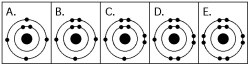 -Which drawing depicts the electron configuration of neon ( )?
 (Short Answer)
4.8/5 (82)
(82) Please refer to Figure 2.1 to answer the following questions.
-Which drawing depicts the electron configuration of nitrogen ( 14 7 N)?
-Which drawing depicts the electron configuration of nitrogen ( 14 7 N)? (Short Answer)
4.8/5 (68)
(68) Refer to the following figure to answer the following questions.
-In the methane molecule shown here, bonds have formed that include both the s orbital valence electrons of the hydrogen atoms and the p orbital valence electrons of the carbon. The electrons in these bonds are said to have
-In the methane molecule shown here, bonds have formed that include both the s orbital valence electrons of the hydrogen atoms and the p orbital valence electrons of the carbon. The electrons in these bonds are said to have (Multiple Choice)
5.0/5 (89)
(89) The nucleus of a nitrogen atom contains 7 neutrons and 7 protons. Which of the following is a correct statement concerning nitrogen?
(Multiple Choice)
4.8/5 (74)
(74) Use the information extracted from the periodic table in Figure 2.2 to answer the following questions.
-The atomic number of each atom is given to the left of each of the elements below. Which of the atoms has the same valence as carbon ( 12 6 C)?
-The atomic number of each atom is given to the left of each of the elements below. Which of the atoms has the same valence as carbon ( 12 6 C)? (Multiple Choice)
4.8/5 (86)
(86) 
Filters
- Essay(0)
- Multiple Choice(0)
- Short Answer(0)
- True False(0)
- Matching(0)