



 Chat with AI
Exam 37: Soil and Plant Nutrition

Exam 1: Introduction: Evolution and Themes of Biology77 Questions
Exam 2: The Chemical Context of Life98 Questions
Exam 3: Water and Life92 Questions
Exam 4: Carbon and the Molecular Diversity of Life86 Questions
Exam 5: The Structure and Function of Large Biological Molecules131 Questions
Exam 6: A Tour of the Cell111 Questions
Exam 7: Membrane Structure and Function88 Questions
Exam 8: An Introduction to Metabolism92 Questions
Exam 9: Cellular Respiration and Fermentation128 Questions
Exam 10: Photosynthesis103 Questions
Exam 11: Cell Communication85 Questions
Exam 12: The Cell Cycle98 Questions
Exam 13: Meiosis and Sexual Life Cycles90 Questions
Exam 14: Mendel and the Gene Idea92 Questions
Exam 15: The Chromosomal Basis of Inheritance75 Questions
Exam 16: The Molecular Basis of Inheritance84 Questions
Exam 17: From Gene to Protein106 Questions
Exam 18: Regulation of Gene Expression116 Questions
Exam 19: Viruses71 Questions
Exam 20: DNA Tools and Biotechnology78 Questions
Exam 21: Genomes and Their Evolution64 Questions
Exam 22: Descent with Modification: A Darwinian View of Life68 Questions
Exam 23: The Evolution of Populations92 Questions
Exam 24: The Origin of Species76 Questions
Exam 25: The History of Life on Earth89 Questions
Exam 26: Phylogeny and the Tree of Life91 Questions
Exam 27: Bacteria and Archaea96 Questions
Exam 28: Protists82 Questions
Exam 29: Plant Diversity I: How Plants Colonized Land93 Questions
Exam 30: Plant Diversity II: The Evolution of Seed Plants119 Questions
Exam 31: Fungi105 Questions
Exam 32: An Overview of Animal Diversity93 Questions
Exam 33: An Introduction to Invertebrates111 Questions
Exam 34: The Origin and Evolution of Vertebrates126 Questions
Exam 35: Plant Structure,Growth,and Development82 Questions
Exam 36: Resource Acquisition and Transport in Vascular Plants100 Questions
Exam 37: Soil and Plant Nutrition99 Questions
Exam 38: Angiosperm Reproduction and Biotechnology107 Questions
Exam 39: Plant Responses to Internal and External Signals137 Questions
Exam 40: Basic Principles of Animal Form and Function98 Questions
Exam 41: Animal Nutrition87 Questions
Exam 42: Circulation and Gas Exchange112 Questions
Exam 43: The Immune System123 Questions
Exam 44: Osmoregulation and Excretion91 Questions
Exam 45: Hormones and the Endocrine System92 Questions
Exam 46: Animal Reproduction104 Questions
Exam 47: Animal Development106 Questions
Exam 48: Neurons,Synapses,and Signalling93 Questions
Exam 49: Nervous Systems85 Questions
Exam 50: Sensory and Motor Mechanisms106 Questions
Exam 51: Animal Behaviour91 Questions
Exam 52: An Introduction to Ecology and the Biosphere90 Questions
Exam 53: Population Ecology89 Questions
Exam 54: Community Ecology97 Questions
Exam 55: Ecosystems and Restoration Ecology98 Questions
Exam 56: Conservation Biology and Global Change90 Questions
Select questions type


How would you determine if certain minerals are essential for plant growth?
(Multiple Choice)
4.9/5  (74)
(74) The following statements are true about carnivorous plants,with the exception of
(Multiple Choice)
4.9/5 (75)
(75) If you wanted to increase the cation exchange and water retention capacity of loamy soil,what should you do?
(Multiple Choice)
4.9/5 (84)
(84) The figure below shows the results of a study to determine the effect of soil air spaces on plant growth.
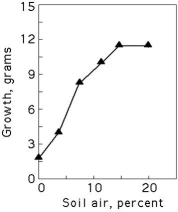 -The best explanation for the shape of the growth response curve in the above figure is that
 (Multiple Choice)
5.0/5 (83)
(83) Synthesis of which of the following compounds in a mature leaf would be least impacted by a temporary soil nitrogen deficiency?
(Multiple Choice)
4.9/5 (89)
(89) When comparing a developing leaf with a fully mature leaf,the developing leaf will have
(Multiple Choice)
4.8/5 (72)
(72) Which of the following best describes the general role of micronutrients in plants?
(Multiple Choice)
4.7/5 (86)
(86) Rhizobacteria aid plant growth in all the following ways,except
(Multiple Choice)
4.9/5 (83)
(83) When performing a mineral nutrition experiment,researchers use water from a glass still.Why is it not a good idea to use regular distilled water from a stainless steel still?
(Multiple Choice)
4.8/5 (85)
(85) The following questions refer to the description below.
Soil can be considered a complex ecosystem because it contains inorganic particles,minerals,water,and a large diversity of living organisms that all interact with one another.Plants need soil to grow and humans depend on plants for food,building supplies,a source of heat,etc.
-Since soil provides plants with a substrate for support and water,minerals,and oxygen,what is a plausible hypothesis to explain the evolution of carnivorous plants?
(Multiple Choice)
4.9/5 (76)
(76) Which of the following plant structures shares the most common features and functions with a fungal hyphae?
(Multiple Choice)
4.8/5 (71)
(71) Clay in soils represents a trade-off in nutrient availability,such that
(Multiple Choice)
4.7/5 (81)
(81) The most efficient way to increase essential amino acids in crop plants for human consumption would be to
(Multiple Choice)
4.8/5 (85)
(85) A farmer noted that many of his tomato fruits turned brown at the base as they ripened.The following spring when he replanted,seedlings only grew for a few weeks before the apical tips of many of the plants turned brown and the plants ultimately died.The most likely explanation for this observation is a soil deficiency in
(Multiple Choice)
4.9/5 (74)
(74) What major benefits do plants and mycorrhizal fungi receive from their symbiotic relationship?
(Multiple Choice)
4.9/5 (77)
(77) 
Filters
- Essay(0)
- Multiple Choice(0)
- Short Answer(0)
- True False(0)
- Matching(0)