



 Chat with AI
Exam 25: The History of Life on Earth

Exam 1: Introduction: Evolution and Themes of Biology77 Questions
Exam 2: The Chemical Context of Life98 Questions
Exam 3: Water and Life92 Questions
Exam 4: Carbon and the Molecular Diversity of Life86 Questions
Exam 5: The Structure and Function of Large Biological Molecules131 Questions
Exam 6: A Tour of the Cell111 Questions
Exam 7: Membrane Structure and Function88 Questions
Exam 8: An Introduction to Metabolism92 Questions
Exam 9: Cellular Respiration and Fermentation128 Questions
Exam 10: Photosynthesis103 Questions
Exam 11: Cell Communication85 Questions
Exam 12: The Cell Cycle98 Questions
Exam 13: Meiosis and Sexual Life Cycles90 Questions
Exam 14: Mendel and the Gene Idea92 Questions
Exam 15: The Chromosomal Basis of Inheritance75 Questions
Exam 16: The Molecular Basis of Inheritance84 Questions
Exam 17: From Gene to Protein106 Questions
Exam 18: Regulation of Gene Expression116 Questions
Exam 19: Viruses71 Questions
Exam 20: DNA Tools and Biotechnology78 Questions
Exam 21: Genomes and Their Evolution64 Questions
Exam 22: Descent with Modification: A Darwinian View of Life68 Questions
Exam 23: The Evolution of Populations92 Questions
Exam 24: The Origin of Species76 Questions
Exam 25: The History of Life on Earth89 Questions
Exam 26: Phylogeny and the Tree of Life91 Questions
Exam 27: Bacteria and Archaea96 Questions
Exam 28: Protists82 Questions
Exam 29: Plant Diversity I: How Plants Colonized Land93 Questions
Exam 30: Plant Diversity II: The Evolution of Seed Plants119 Questions
Exam 31: Fungi105 Questions
Exam 32: An Overview of Animal Diversity93 Questions
Exam 33: An Introduction to Invertebrates111 Questions
Exam 34: The Origin and Evolution of Vertebrates126 Questions
Exam 35: Plant Structure,Growth,and Development82 Questions
Exam 36: Resource Acquisition and Transport in Vascular Plants100 Questions
Exam 37: Soil and Plant Nutrition99 Questions
Exam 38: Angiosperm Reproduction and Biotechnology107 Questions
Exam 39: Plant Responses to Internal and External Signals137 Questions
Exam 40: Basic Principles of Animal Form and Function98 Questions
Exam 41: Animal Nutrition87 Questions
Exam 42: Circulation and Gas Exchange112 Questions
Exam 43: The Immune System123 Questions
Exam 44: Osmoregulation and Excretion91 Questions
Exam 45: Hormones and the Endocrine System92 Questions
Exam 46: Animal Reproduction104 Questions
Exam 47: Animal Development106 Questions
Exam 48: Neurons,Synapses,and Signalling93 Questions
Exam 49: Nervous Systems85 Questions
Exam 50: Sensory and Motor Mechanisms106 Questions
Exam 51: Animal Behaviour91 Questions
Exam 52: An Introduction to Ecology and the Biosphere90 Questions
Exam 53: Population Ecology89 Questions
Exam 54: Community Ecology97 Questions
Exam 55: Ecosystems and Restoration Ecology98 Questions
Exam 56: Conservation Biology and Global Change90 Questions
Select questions type


The following questions refer to the description below.
All animals with eyes or eyespots that have been studied so far share a gene in common.When mutated,the gene Pax-6 causes lack of eyes in fruit flies,tiny eyes in mice,and missing irises (and other eye parts)in humans.The sequence of Pax-6 in humans and mice is identical.There are so few sequence differences with fruit fly Pax-6 that the human/mouse version can cause eye formation in eyeless fruit flies,even though vertebrates and invertebrates last shared a common ancestor more than 500 million years ago.
-Fruit fly eyes are of the compound type,which is structurally very different from the camera-type eyes of mammals.Even the camera-type eyes of molluscs,such as octopi,are structurally quite different from those of mammals.Yet,fruit flies,octopi,and mammals possess very similar versions of Pax-6.The fact that the same gene helps produce very different types of eyes is most likely due to
(Multiple Choice)
4.8/5  (76)
(76) A genetic change that caused a certain Hox gene to be expressed along the tip of a vertebrate limb bud instead of farther back helped make possible the evolution of the tetrapod limb.This type of change is illustrative of
(Multiple Choice)
4.8/5 (95)
(95) The following questions refer to the description below.
You were asked to give a presentation about fossils to a group of young students.You tell the students that the fossil record shows how organisms can change over time,but unfortunately the fossil record is incomplete.After your talk a student tells you that his pet salamander has died and he wants his salamander to be fossilized.The boy plans to lay his salamander on the grass and cover the salamander's body with leaves and twigs.You had told the class that a critical step in the fossilization process is the burial of an organism.
-Which of the statement(s)below lends support to your claim about the fossilization process?
(Multiple Choice)
4.7/5 (79)
(79) The following questions refer to the description and figure below.
The figure represents a cross section of the sea floor through a mid-ocean rift valley,with alternating patches of black and white indicating sea floor with reversed magnetic polarities.At the arrow labelled "I" (the rift valley),the igneous rock of the sea floor is so young that it can be accurately dated using carbon-14 dating.At the arrow labeled "III," however,the igneous rock is about 1 million years old,and potassium-40 dating is typically used to date such rocks.Note: The horizontal arrows indicate the direction of sea-floor spreading,away from the rift valley.
 -Assuming that the rate of sea-floor spreading was constant during the 1-million-year period depicted above,what should be the approximate age of marine fossils found in undisturbed sedimentary rock immediately overlying the igneous rock at the arrow labelled "II"?
 (Multiple Choice)
4.9/5 (83)
(83) The oxygen revolution changed Earth's environment dramatically.Which of the following took advantage of the presence of free oxygen in the oceans and atmosphere?
(Multiple Choice)
4.8/5 (72)
(72) The following questions refer to the description and figure below.
The figure represents a cross section of the sea floor through a mid-ocean rift valley,with alternating patches of black and white indicating sea floor with reversed magnetic polarities.At the arrow labelled "I" (the rift valley),the igneous rock of the sea floor is so young that it can be accurately dated using carbon-14 dating.At the arrow labeled "III," however,the igneous rock is about 1 million years old,and potassium-40 dating is typically used to date such rocks.Note: The horizontal arrows indicate the direction of sea-floor spreading,away from the rift valley.
-Assuming that the rate of sea-floor spreading was constant during the 1-million-year period depicted above,Earth's magnetic field has undergone reversal at an average rate of once every
-Assuming that the rate of sea-floor spreading was constant during the 1-million-year period depicted above,Earth's magnetic field has undergone reversal at an average rate of once every (Multiple Choice)
4.7/5 (73)
(73) 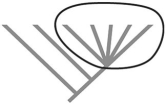 What does the circled part of the phylogenetic tree above indicate?
 (Multiple Choice)
4.9/5 (79)
(79) What is true of the amino acids that might have been delivered to Earth within carbonaceous chondrites?
(Multiple Choice)
4.8/5 (90)
(90) Refer to the following information to answer the questions below.
Fossils of Lystrosaurus,a dicynodont therapsid,are most common in parts of modern-day South America,South Africa,Madagascar,India,South Australia,and Antarctica.It apparently lived in arid regions,and was mostly herbivorous.It originated during the mid-Permian period,survived the Permian extinction,and dwindled by the late Triassic,though there is evidence of a relict population in Australia during the Cretaceous period.The dicynodonts had two large tusks,extending down from their upper jaws.The tusks were not used for food gathering,and in some species were limited to males.Food was gathered using an otherwise toothless beak.Judging from the fossil record in sedimentary rocks,these pig-sized organisms were the most common mammal-like reptiles of the Permian period.
-Which of the following is the most likely explanation for the modern-day distribution of dicynodont fossils?
(Multiple Choice)
4.8/5 (78)
(78) Which organisms would you expect to be most poorly represented in the fossil record?
(Multiple Choice)
4.8/5 (67)
(67) On the basis of their morphologies,how might Linnaeus have classified the Hawaiian silverswords?
(Multiple Choice)
4.8/5 (77)
(77) Which of the following statements does not apply to Hox genes?
(Multiple Choice)
4.7/5 (77)
(77) Which event is nearest in time to the end of the period known as snowball Earth?
(Multiple Choice)
4.8/5 (87)
(87) Several scientific laboratories across the globe are involved in research concerning the origin of life on Earth.Which graph below,if the results were produced abiotically,would have the greatest promise for revealing important information about the origin of Earth's first genetic system?
(Multiple Choice)
4.8/5 (74)
(74) Refer to the following information to answer the questions below.
Fossils of Lystrosaurus,a dicynodont therapsid,are most common in parts of modern-day South America,South Africa,Madagascar,India,South Australia,and Antarctica.It apparently lived in arid regions,and was mostly herbivorous.It originated during the mid-Permian period,survived the Permian extinction,and dwindled by the late Triassic,though there is evidence of a relict population in Australia during the Cretaceous period.The dicynodonts had two large tusks,extending down from their upper jaws.The tusks were not used for food gathering,and in some species were limited to males.Food was gathered using an otherwise toothless beak.Judging from the fossil record in sedimentary rocks,these pig-sized organisms were the most common mammal-like reptiles of the Permian period.
-If an increase in dicynodont species diversity (in other words,number of species)occurred soon after the Permian extinction,and if it occurred for the same general reason usually given for the increase in mammalian diversity following the Cretaceous extinction,then it should be attributed to
(Multiple Choice)
4.9/5 (81)
(81) The following questions refer to this hypothetical situation.
A female fly,full of fertilized eggs,is swept by high winds to an island far out to sea.She is the first fly to arrive on this island,and the only fly to arrive in this way.Thousands of years later,her numerous offspring occupy the island,but none of them resembles her.There are,instead,several species,each of which eats only a certain type of food.None of the species can fly,for their flight wings are absent,and their balancing organs (in other words,halteres)are now used in courtship displays.The male members of each species bear modified halteres that are unique in appearance to their species.Females bear vestigial halteres.The ranges of all of the daughter species overlap.
-In each fly species,the entire body segment that gave rise to the original flight wings is missing.The mutation(s)that led to the flightless condition could have
(Multiple Choice)
4.9/5 (85)
(85) Which of the following characteristics should have been possessed by the first animals to colonize land?
1)were probably herbivores (ate photosynthesizers)
2)had four appendages
3)had the ability to resist dehydration
4)had lobe-finned fishes as ancestors
5)were invertebrates
(Multiple Choice)
4.9/5 (67)
(67) Bagworm moth caterpillars feed on evergreens and carry a silken case or bag around with them in which they eventually pupate.Adult female bagworm moths are larval in appearance; they lack the wings and other structures of the adult male and instead retain the appearance of a caterpillar even though they are sexually mature and can lay eggs within the bag.This is a good example of
(Multiple Choice)
4.8/5 (82)
(82) Which factor most likely caused animals and plants in India to differ greatly from species in nearby southeast Asia?
(Multiple Choice)
5.0/5 (72)
(72) 
Filters
- Essay(0)
- Multiple Choice(0)
- Short Answer(0)
- True False(0)
- Matching(0)