



 Chat with AI
Exam 11: Cell Communication

Exam 1: Introduction: Evolution and Themes of Biology77 Questions
Exam 2: The Chemical Context of Life98 Questions
Exam 3: Water and Life92 Questions
Exam 4: Carbon and the Molecular Diversity of Life86 Questions
Exam 5: The Structure and Function of Large Biological Molecules131 Questions
Exam 6: A Tour of the Cell111 Questions
Exam 7: Membrane Structure and Function88 Questions
Exam 8: An Introduction to Metabolism92 Questions
Exam 9: Cellular Respiration and Fermentation128 Questions
Exam 10: Photosynthesis103 Questions
Exam 11: Cell Communication85 Questions
Exam 12: The Cell Cycle98 Questions
Exam 13: Meiosis and Sexual Life Cycles90 Questions
Exam 14: Mendel and the Gene Idea92 Questions
Exam 15: The Chromosomal Basis of Inheritance75 Questions
Exam 16: The Molecular Basis of Inheritance84 Questions
Exam 17: From Gene to Protein106 Questions
Exam 18: Regulation of Gene Expression116 Questions
Exam 19: Viruses71 Questions
Exam 20: DNA Tools and Biotechnology78 Questions
Exam 21: Genomes and Their Evolution64 Questions
Exam 22: Descent with Modification: A Darwinian View of Life68 Questions
Exam 23: The Evolution of Populations92 Questions
Exam 24: The Origin of Species76 Questions
Exam 25: The History of Life on Earth89 Questions
Exam 26: Phylogeny and the Tree of Life91 Questions
Exam 27: Bacteria and Archaea96 Questions
Exam 28: Protists82 Questions
Exam 29: Plant Diversity I: How Plants Colonized Land93 Questions
Exam 30: Plant Diversity II: The Evolution of Seed Plants119 Questions
Exam 31: Fungi105 Questions
Exam 32: An Overview of Animal Diversity93 Questions
Exam 33: An Introduction to Invertebrates111 Questions
Exam 34: The Origin and Evolution of Vertebrates126 Questions
Exam 35: Plant Structure,Growth,and Development82 Questions
Exam 36: Resource Acquisition and Transport in Vascular Plants100 Questions
Exam 37: Soil and Plant Nutrition99 Questions
Exam 38: Angiosperm Reproduction and Biotechnology107 Questions
Exam 39: Plant Responses to Internal and External Signals137 Questions
Exam 40: Basic Principles of Animal Form and Function98 Questions
Exam 41: Animal Nutrition87 Questions
Exam 42: Circulation and Gas Exchange112 Questions
Exam 43: The Immune System123 Questions
Exam 44: Osmoregulation and Excretion91 Questions
Exam 45: Hormones and the Endocrine System92 Questions
Exam 46: Animal Reproduction104 Questions
Exam 47: Animal Development106 Questions
Exam 48: Neurons,Synapses,and Signalling93 Questions
Exam 49: Nervous Systems85 Questions
Exam 50: Sensory and Motor Mechanisms106 Questions
Exam 51: Animal Behaviour91 Questions
Exam 52: An Introduction to Ecology and the Biosphere90 Questions
Exam 53: Population Ecology89 Questions
Exam 54: Community Ecology97 Questions
Exam 55: Ecosystems and Restoration Ecology98 Questions
Exam 56: Conservation Biology and Global Change90 Questions
Select questions type


Which of the following is true during a typical cAMP-type signal transduction event?
(Multiple Choice)
4.9/5  (71)
(71) Use the following figure to answer the questions below.
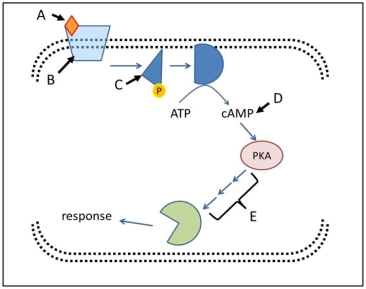 -In the above diagram,the structure labelled B is a(n)
 (Multiple Choice)
4.9/5 (78)
(78) Which of the following amino acids are most frequently phosphorylated by protein kinases in the cytoplasm during signal transduction?
(Multiple Choice)
4.8/5 (78)
(78) If an adult person has a faulty version of the human analogue to ced-4 of the nematode,which of the following is most likely to result?
(Multiple Choice)
4.9/5 (77)
(77) Use the following figure to answer the questions below.
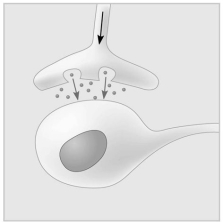 -In the figure,the dots in the space between the two structures represent which of the following?
 (Multiple Choice)
4.9/5 (80)
(80) Use the following figure to answer the questions below.
-In the above diagram,the structure labelled C is a(n)
-In the above diagram,the structure labelled C is a(n) (Multiple Choice)
5.0/5 (91)
(91) Use the following figure to answer the questions below.
-Which of the following types of signalling is represented in the figure?
-Which of the following types of signalling is represented in the figure? (Multiple Choice)
4.9/5 (82)
(82) Use this information to answer the following questions.
Affinity chromatography is a method that can be used to purify cell-surface receptors,while they retain their hormone-binding ability.A ligand (hormone)for a receptor of interest is chemically linked to polystyrene beads.A solubilized preparation of membrane proteins is passed over a column containing these beads.Only the receptor binds to the beads.
-This method of affinity chromatography would be expected to collect which of the following?
(Multiple Choice)
4.8/5 (82)
(82) Use this information to answer the following questions.
A major group of G protein-coupled receptors contains seven transmembrane α helices.The amino end of the protein lies at the exterior of the plasma membrane.Loops of amino acids connect the helices either at the exterior face or on the cytosol face of the membrane.The loop on the cytosol side between helices 5 and 6 is usually substantially longer than the others.
-The coupled G protein most likely interacts with this receptor
(Multiple Choice)
4.8/5 (90)
(90) Which of the following is characterized by hydrophobic molecules passing through the plasma membrane and interacting with cytosolic receptors?
(Multiple Choice)
4.7/5 (72)
(72) What is most likely to happen to an animal's target cells that lack receptors for local regulators?
(Multiple Choice)
4.9/5 (71)
(71) Of the following,a receptor protein in a membrane that recognizes a chemical signal is most similar to
(Multiple Choice)
4.8/5 (76)
(76) Put the steps of the process of signal transduction in the order they occur:
1)A conformational change in the signal-receptor complex activates an enzyme.
2)Protein kinases are activated.
3)A signal molecule binds to a receptor.
4)Target proteins are phosphorylated.
5)Second messenger molecules are released.
(Multiple Choice)
4.8/5 (85)
(85) Which type of receptor in the plasma membrane reacts by forming dimers,adding phosphate groups,and then activating relay proteins?
(Multiple Choice)
4.9/5 (100)
(100) Caffeine is an inhibitor of phosphodiesterase.Therefore,the cells of a person who has recently consumed coffee would have increased levels of
(Multiple Choice)
5.0/5 (82)
(82) Use the following figure to answer the questions below.
-In the above diagram,the structure labelled D is a(n)
-In the above diagram,the structure labelled D is a(n) (Multiple Choice)
4.8/5 (78)
(78) 
Filters
- Essay(0)
- Multiple Choice(0)
- Short Answer(0)
- True False(0)
- Matching(0)