



 Chat with AI
Exam 23: Evolutionary Processes

Exam 1: Biology and the Tree of Life35 Questions
Exam 2: Water and Carbon: the Chemical Basis of Life53 Questions
Exam 3: Protein Structure and Function40 Questions
Exam 4: Nucleic Acids and the Rna World40 Questions
Exam 5: An Introduction to Carbohydrates42 Questions
Exam 6: Lipids, Membranes, and the First Cells53 Questions
Exam 7: Inside the Cell41 Questions
Exam 8: Energy and Enzymes59 Questions
Exam 9: Cellular Respiration and Fermentation43 Questions
Exam 10: Photosynthesis41 Questions
Exam 11: Cellcell Interactions38 Questions
Exam 12: The Cell Cycle39 Questions
Exam 13: Meiosis40 Questions
Exam 14: Mendel and the Gene47 Questions
Exam 15: Dna and the Gene: Synthesis and Repair39 Questions
Exam 16: How Genes Work39 Questions
Exam 17: Transcription, Rna Processing, and Translation37 Questions
Exam 18: Control of Gene Expression in Bacteria38 Questions
Exam 19: Control of Gene Expression in Eukaryotes40 Questions
Exam 20: The Molecular Revolution: Biotechnology and Beyond39 Questions
Exam 21: Gene Structure and Development39 Questions
Exam 22: Evolution by Natural Selection42 Questions
Exam 23: Evolutionary Processes48 Questions
Exam 24: Speciation40 Questions
Exam 25: Phylogenies and the History of Life37 Questions
Exam 26: Bacteria and Archaea38 Questions
Exam 27: Protists36 Questions
Exam 28: Green Algae and Land Plants54 Questions
Exam 29: Fungi40 Questions
Exam 30: An Introduction to Animals42 Questions
Exam 31: Protostome Animals38 Questions
Exam 32: Deuterostome Animals43 Questions
Exam 33: Viruses35 Questions
Exam 34: Plant Form and Function39 Questions
Exam 35: Water and Sugar Transport in Plants42 Questions
Exam 36: Plant Nutrition37 Questions
Exam 37: Plant Sensory Systems, Signals, and Responses64 Questions
Exam 38: Plant Reproduction and Development44 Questions
Exam 39: Animal Form and Function37 Questions
Exam 40: Water and Electrolyte Balance in Animals41 Questions
Exam 41: Animal Nutrition43 Questions
Exam 42: Gas Exchange and Circulation46 Questions
Exam 43: Animal Nervous Systems40 Questions
Exam 44: Animal Sensory Systems43 Questions
Exam 45: Animal Movement42 Questions
Exam 46: Chemical Signals in Animals38 Questions
Exam 47: Animal Reproduction and Development39 Questions
Exam 48: The Immune System in Animals38 Questions
Exam 49: An Introduction to Ecology40 Questions
Exam 50: Behavioural Ecology39 Questions
Exam 51: Population Ecology49 Questions
Exam 52: Community Ecology38 Questions
Exam 53: Ecosystems and Global Ecology41 Questions
Exam 54: Biodiversity and Conservation Biology38 Questions
Select questions type


Cystic fibrosis is a genetic disorder in homozygous recessives ff) that typically causes death in the early 30s. Over time, we would expect the f allele frequency to for this trait.
(Multiple Choice)
4.9/5  (63)
(63) Aendtype \#individuals 50 50 400 Use the information in the table above for the next questions).
-Given the information above, what is the frequency of individuals with the A1A1 genotype?
(Multiple Choice)
4.8/5 (91)
(91) In 1986, a nuclear power accident in Chernobyl, USSR now the Ukraine), led to high radiation levels for miles surrounding the plant. The high levels of radiation caused elevated mutation rates in the surviving organisms, and evolutionary biologists have been studying rodent populations in the Chernobyl area ever since. Based on your understanding of evolutionary mechanisms, which of the following most likely occurred in the rodent populations following the accident?
(Multiple Choice)
4.8/5 (66)
(66) 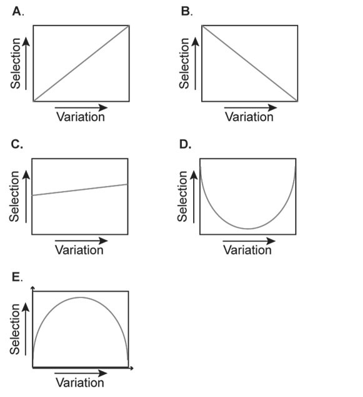 -Which of the graphs above best represents the relationship between the intensity of directional selection and the genetic variation present within a population?
 (Short Answer)
4.8/5 (69)
(69) Which of the following describes what we should expect when a population is in Hardy- Weinberg genetic equilibrium?
(Multiple Choice)
4.9/5 (81)
(81) Aendtype \#individuals 50 50 400 Use the information in the table above for the next questions).
-Given the information above, what is the frequency of the A2 allele in this population?
(Multiple Choice)
4.8/5 (83)
(83) Which sex typically has more extreme sex- selected characteristics: males or females? Why? Give an example.
(Essay)
5.0/5 (69)
(69) Wikelski and Romero 2003) found that large marine iguanas had higher reproductive success than smaller iguanas did. However, the large iguanas were generally in poor body condition because they could not eat enough; at higher temperatures their foraging efficiency improved, allowing them to eat more. Thus, Wikelski and Romero hypothesize that iguana size will as global warming gradually increases air and water temperatures in the Galápagos Islands.
(Multiple Choice)
4.8/5 (77)
(77) 
Filters
- Essay(0)
- Multiple Choice(0)
- Short Answer(0)
- True False(0)
- Matching(0)