



 Chat with AI
Exam 15: Dna and the Gene: Synthesis and Repair

Exam 1: Biology and the Tree of Life35 Questions
Exam 2: Water and Carbon: the Chemical Basis of Life53 Questions
Exam 3: Protein Structure and Function40 Questions
Exam 4: Nucleic Acids and the Rna World40 Questions
Exam 5: An Introduction to Carbohydrates42 Questions
Exam 6: Lipids, Membranes, and the First Cells53 Questions
Exam 7: Inside the Cell41 Questions
Exam 8: Energy and Enzymes59 Questions
Exam 9: Cellular Respiration and Fermentation43 Questions
Exam 10: Photosynthesis41 Questions
Exam 11: Cellcell Interactions38 Questions
Exam 12: The Cell Cycle39 Questions
Exam 13: Meiosis40 Questions
Exam 14: Mendel and the Gene47 Questions
Exam 15: Dna and the Gene: Synthesis and Repair39 Questions
Exam 16: How Genes Work39 Questions
Exam 17: Transcription, Rna Processing, and Translation37 Questions
Exam 18: Control of Gene Expression in Bacteria38 Questions
Exam 19: Control of Gene Expression in Eukaryotes40 Questions
Exam 20: The Molecular Revolution: Biotechnology and Beyond39 Questions
Exam 21: Gene Structure and Development39 Questions
Exam 22: Evolution by Natural Selection42 Questions
Exam 23: Evolutionary Processes48 Questions
Exam 24: Speciation40 Questions
Exam 25: Phylogenies and the History of Life37 Questions
Exam 26: Bacteria and Archaea38 Questions
Exam 27: Protists36 Questions
Exam 28: Green Algae and Land Plants54 Questions
Exam 29: Fungi40 Questions
Exam 30: An Introduction to Animals42 Questions
Exam 31: Protostome Animals38 Questions
Exam 32: Deuterostome Animals43 Questions
Exam 33: Viruses35 Questions
Exam 34: Plant Form and Function39 Questions
Exam 35: Water and Sugar Transport in Plants42 Questions
Exam 36: Plant Nutrition37 Questions
Exam 37: Plant Sensory Systems, Signals, and Responses64 Questions
Exam 38: Plant Reproduction and Development44 Questions
Exam 39: Animal Form and Function37 Questions
Exam 40: Water and Electrolyte Balance in Animals41 Questions
Exam 41: Animal Nutrition43 Questions
Exam 42: Gas Exchange and Circulation46 Questions
Exam 43: Animal Nervous Systems40 Questions
Exam 44: Animal Sensory Systems43 Questions
Exam 45: Animal Movement42 Questions
Exam 46: Chemical Signals in Animals38 Questions
Exam 47: Animal Reproduction and Development39 Questions
Exam 48: The Immune System in Animals38 Questions
Exam 49: An Introduction to Ecology40 Questions
Exam 50: Behavioural Ecology39 Questions
Exam 51: Population Ecology49 Questions
Exam 52: Community Ecology38 Questions
Exam 53: Ecosystems and Global Ecology41 Questions
Exam 54: Biodiversity and Conservation Biology38 Questions
Select questions type


Which one of the following is least likely to cause mutations in DNA?

Free
(Multiple Choice)
4.8/5  (78)
(78) Correct Answer: Verified
E
The epsilon s) subunit of DNA polymerase III of E. coli has exonuclease activity. How does it function in the proofreading process?
Free
(Multiple Choice)
4.9/5 (90)
(90) Correct Answer:Verified
VerifiedB
What appears to be a dark side to telomerase activity with regard to human health?
Free
(Multiple Choice)
4.7/5 (88)
(88) Correct Answer:Verified
VerifiedA
\text {Single strand as a template plus 3 ^ { \prime } end to }
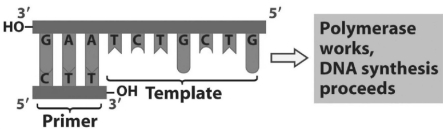 Figure 15.1
-Refer to Figure 15.1. What bases will be added to the primer as DNA replication proceeds? The bases should appear in the order that they will be added.
Figure 15.1
-Refer to Figure 15.1. What bases will be added to the primer as DNA replication proceeds? The bases should appear in the order that they will be added. (Multiple Choice)
4.9/5 (84)
(84) How does the simple primary and secondary structure of DNA hold the information needed to code for the many features of multicellular organisms?
(Multiple Choice)
4.7/5 (84)
(84) Semiconservative replication involves a template. What is the template?
(Multiple Choice)
4.9/5 (85)
(85) If during the process of DNA replication, the enzyme topoisomerase was not functioning i.e. it was mutated) what do you expect will happen to the replication process?
(Multiple Choice)
4.8/5 (82)
(82) In the mismatch repair process, enzyme complexes replace bases that were incorrectly inserted into the newly synthesized DNA strand. To function, they must be able to distinguish between the parent DNA strand and the new strand. How is this accomplished?
(Multiple Choice)
4.8/5 (82)
(82) Hereditary nonpolyposis colorectal cancer HNPCC) is an inherited disorder. The genetic defect identified is an error in the mismatch repair mechanism. Which of the following would be an expected result of this mutation?
(Multiple Choice)
4.9/5 (88)
(88) What can you infer from the information presented in this table? 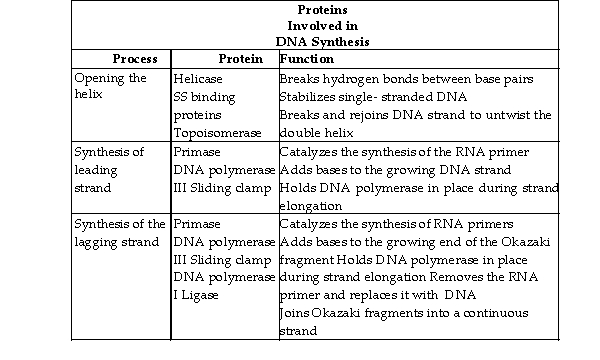
(Multiple Choice)
4.9/5 (79)
(79) Who performed the classic experiments that proved DNA was copied by semiconservative replication?
(Multiple Choice)
4.9/5 (75)
(75) The transduction experiments done by Hershey and Chase, and the transformation experiments done by Griffith, supported the same conclusion, which was that
(Multiple Choice)
4.8/5 (83)
(83) Which of the following would you expect of a eukaryote lacking telomerase?
(Multiple Choice)
4.9/5 (88)
(88) DNA replication is highly accurate. It results in about one mistake per billion nucleotides. For the human genome, how often would errors occur?
(Multiple Choice)
4.7/5 (67)
(67) Put the following steps of DNA replication in chronological order.
1) Single- stranded binding proteins attach to DNA strands.
2) Hydrogen bonds between base pairs of antiparallel strands are broken.
3) Primase binds to the site of origin.
4) DNA polymerase binds to the template strand.
5) An RNA primer is created.
(Multiple Choice)
4.8/5 (77)
(77) The fact that within a double- stranded DNA molecule, adenine forms two hydrogen bonds with thymine and cytosine forms three hydrogen bonds with guanine is known as
(Multiple Choice)
4.9/5 (83)
(83) 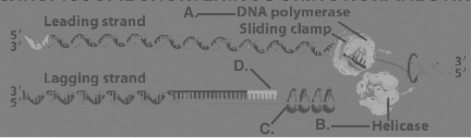 Figure 15.3
-Refer to Figure 15.3. Which of the structures in the figure breaks hydrogen bonds between complementary bases?
Figure 15.3
-Refer to Figure 15.3. Which of the structures in the figure breaks hydrogen bonds between complementary bases? (Short Answer)
4.8/5 (71)
(71) 
Filters
- Essay(0)
- Multiple Choice(0)
- Short Answer(0)
- True False(0)
- Matching(0)