



 Chat with AI
Exam 38: Plant Reproduction and Development

Exam 1: Biology and the Tree of Life35 Questions
Exam 2: Water and Carbon: the Chemical Basis of Life53 Questions
Exam 3: Protein Structure and Function40 Questions
Exam 4: Nucleic Acids and the Rna World40 Questions
Exam 5: An Introduction to Carbohydrates42 Questions
Exam 6: Lipids, Membranes, and the First Cells53 Questions
Exam 7: Inside the Cell41 Questions
Exam 8: Energy and Enzymes59 Questions
Exam 9: Cellular Respiration and Fermentation43 Questions
Exam 10: Photosynthesis41 Questions
Exam 11: Cellcell Interactions38 Questions
Exam 12: The Cell Cycle39 Questions
Exam 13: Meiosis40 Questions
Exam 14: Mendel and the Gene47 Questions
Exam 15: Dna and the Gene: Synthesis and Repair39 Questions
Exam 16: How Genes Work39 Questions
Exam 17: Transcription, Rna Processing, and Translation37 Questions
Exam 18: Control of Gene Expression in Bacteria38 Questions
Exam 19: Control of Gene Expression in Eukaryotes40 Questions
Exam 20: The Molecular Revolution: Biotechnology and Beyond39 Questions
Exam 21: Gene Structure and Development39 Questions
Exam 22: Evolution by Natural Selection42 Questions
Exam 23: Evolutionary Processes48 Questions
Exam 24: Speciation40 Questions
Exam 25: Phylogenies and the History of Life37 Questions
Exam 26: Bacteria and Archaea38 Questions
Exam 27: Protists36 Questions
Exam 28: Green Algae and Land Plants54 Questions
Exam 29: Fungi40 Questions
Exam 30: An Introduction to Animals42 Questions
Exam 31: Protostome Animals38 Questions
Exam 32: Deuterostome Animals43 Questions
Exam 33: Viruses35 Questions
Exam 34: Plant Form and Function39 Questions
Exam 35: Water and Sugar Transport in Plants42 Questions
Exam 36: Plant Nutrition37 Questions
Exam 37: Plant Sensory Systems, Signals, and Responses64 Questions
Exam 38: Plant Reproduction and Development44 Questions
Exam 39: Animal Form and Function37 Questions
Exam 40: Water and Electrolyte Balance in Animals41 Questions
Exam 41: Animal Nutrition43 Questions
Exam 42: Gas Exchange and Circulation46 Questions
Exam 43: Animal Nervous Systems40 Questions
Exam 44: Animal Sensory Systems43 Questions
Exam 45: Animal Movement42 Questions
Exam 46: Chemical Signals in Animals38 Questions
Exam 47: Animal Reproduction and Development39 Questions
Exam 48: The Immune System in Animals38 Questions
Exam 49: An Introduction to Ecology40 Questions
Exam 50: Behavioural Ecology39 Questions
Exam 51: Population Ecology49 Questions
Exam 52: Community Ecology38 Questions
Exam 53: Ecosystems and Global Ecology41 Questions
Exam 54: Biodiversity and Conservation Biology38 Questions
Select questions type


What is an essential part of alternation of generations in plants?

Free
(Multiple Choice)
5.0/5  (91)
(91) Correct Answer: Verified
A
If the expression of the PHAN gene is blocked in plants, what will be the likely result?
Free
(Multiple Choice)
4.8/5 (69)
(69) Correct Answer:Verified
VerifiedE
Endosperm is a major part of monocot seeds. In most dicots,
Free
(Multiple Choice)
4.7/5 (86)
(86) Correct Answer:Verified
VerifiedB
Hammer orchids resemble female thyranide wasps and release a chemical signal called pheromone to deceive male thyranide wasps and accomplish pollination. Compared to food- deceiving orchids, is it more or less likely that pollen of the hammer orchid will be transferred to the flower of the same species than to the flower of a different species?
(Multiple Choice)
4.8/5 (85)
(85) Most plants are adept at asexual reproduction. What is the probable explanation for the energy spent for sexual reproduction?
(Multiple Choice)
4.9/5 (75)
(75) 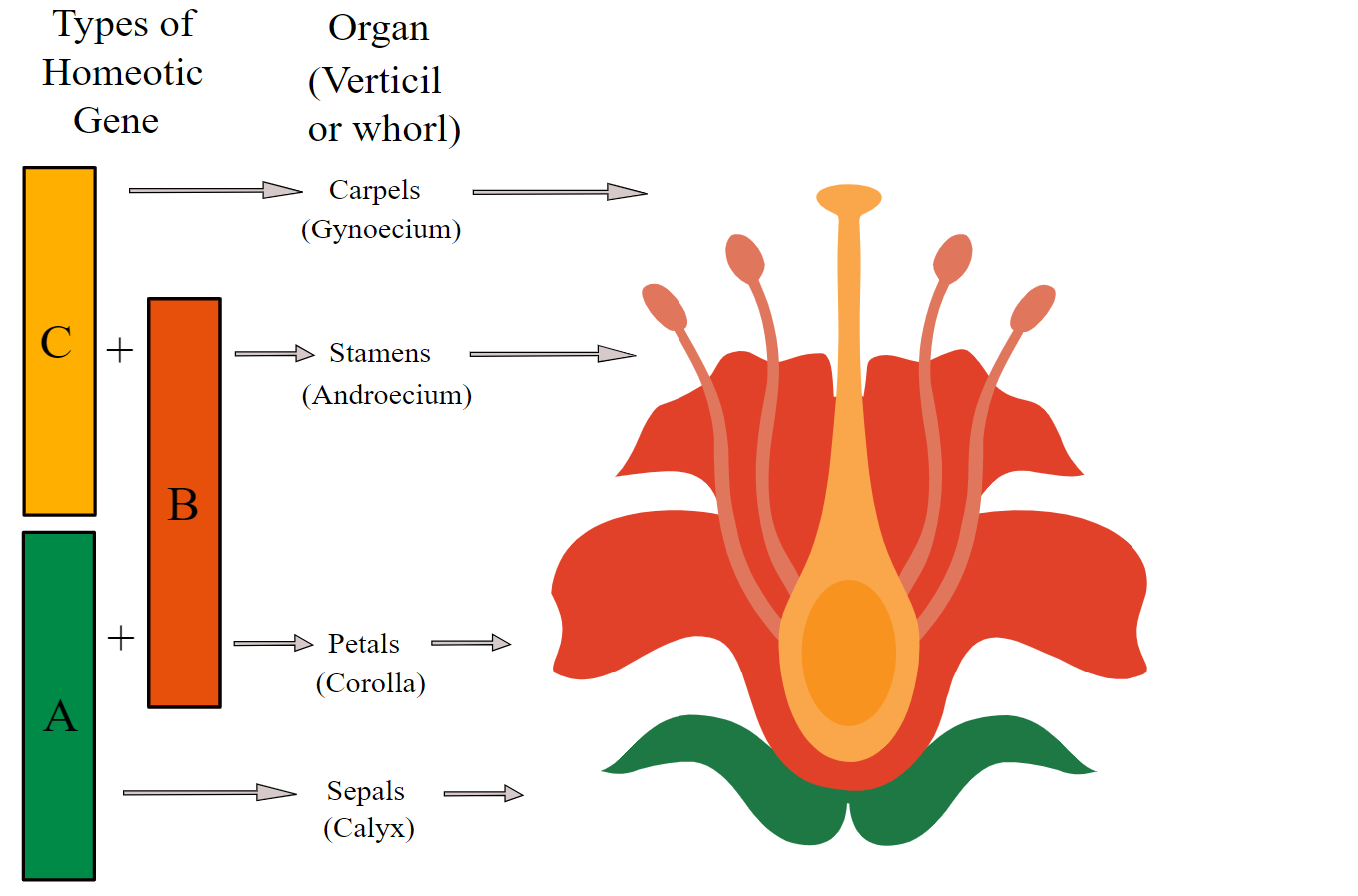 ABC model of flower development
-The ABC genes ,in Arabidopsis are considered homeotic genes. What could be a reason for this classification?
ABC model of flower development
-The ABC genes ,in Arabidopsis are considered homeotic genes. What could be a reason for this classification? (Multiple Choice)
5.0/5 (74)
(74) If a hypocotyl does not elongate during seed germination and early seedling growth, where will the cotyledons be?
(Multiple Choice)
4.8/5 (87)
(87) The MONOPTEROS gene in Arabidopsis encodes a protein that is similar in its function to which animal protein?
(Multiple Choice)
4.8/5 (79)
(79) If an ovary contains 50 ovules, what is the minimum number of pollen grains that must land in order to form 50 mature seeds?
(Multiple Choice)
4.8/5 (66)
(66) Charles Darwin experimented with reactions of grass seedlings monocots) relative to applied auxin a plant hormone) and light. He used the youngest seedlings with a structure that dicots do not have. What is the name of that structure?
(Multiple Choice)
4.8/5 (71)
(71) Gardeners purchase packets of seeds that are put in the ground and germinate. Native plant seeds usually need a scarification treatment or a real or simulated winter stratification), some seeds need light, and others need a smoke treatment. What do these adaptations to the environmental conditions reveal about where the plants grow?
(Essay)
4.8/5 (89)
(89) Which of the following correctly identifies the function of the flower part named?
(Multiple Choice)
4.8/5 (92)
(92) Suppose that 100 pollen grains land on a stigma, and 50 mature seeds are formed in the fruit. What does this indicate about the pollination process and success?
(Multiple Choice)
4.7/5 (82)
(82) After double fertilization in angiosperms, what development sequence is correct?
(Multiple Choice)
4.8/5 (89)
(89) Within which structure does meiosis and spore production occur?
(Multiple Choice)
4.8/5 (78)
(78) During self- fertilization, which of the following is absent?
(Multiple Choice)
4.9/5 (76)
(76) The sperm and egg each contribute 50% of the nuclear genetic material to the zygote that becomes the embryo and the new plant. Mitochondria and plastids that become chloroplasts are passed primarily from the female parent. What feature of the male or female gametophytes accounts for this?
(Multiple Choice)
4.7/5 (78)
(78) How are the life cycles of liverworts and angiosperms alike?
(Multiple Choice)
4.9/5 (67)
(67) Male gametophytes are derived from which of the following via mitosis?
(Multiple Choice)
4.8/5 (73)
(73) 
Filters
- Essay(0)
- Multiple Choice(0)
- Short Answer(0)
- True False(0)
- Matching(0)