



 Chat with AI
Exam 26: Bacteria and Archaea

Exam 1: Biology and the Tree of Life35 Questions
Exam 2: Water and Carbon: the Chemical Basis of Life53 Questions
Exam 3: Protein Structure and Function40 Questions
Exam 4: Nucleic Acids and the Rna World40 Questions
Exam 5: An Introduction to Carbohydrates42 Questions
Exam 6: Lipids, Membranes, and the First Cells53 Questions
Exam 7: Inside the Cell41 Questions
Exam 8: Energy and Enzymes59 Questions
Exam 9: Cellular Respiration and Fermentation43 Questions
Exam 10: Photosynthesis41 Questions
Exam 11: Cellcell Interactions38 Questions
Exam 12: The Cell Cycle39 Questions
Exam 13: Meiosis40 Questions
Exam 14: Mendel and the Gene47 Questions
Exam 15: Dna and the Gene: Synthesis and Repair39 Questions
Exam 16: How Genes Work39 Questions
Exam 17: Transcription, Rna Processing, and Translation37 Questions
Exam 18: Control of Gene Expression in Bacteria38 Questions
Exam 19: Control of Gene Expression in Eukaryotes40 Questions
Exam 20: The Molecular Revolution: Biotechnology and Beyond39 Questions
Exam 21: Gene Structure and Development39 Questions
Exam 22: Evolution by Natural Selection42 Questions
Exam 23: Evolutionary Processes48 Questions
Exam 24: Speciation40 Questions
Exam 25: Phylogenies and the History of Life37 Questions
Exam 26: Bacteria and Archaea38 Questions
Exam 27: Protists36 Questions
Exam 28: Green Algae and Land Plants54 Questions
Exam 29: Fungi40 Questions
Exam 30: An Introduction to Animals42 Questions
Exam 31: Protostome Animals38 Questions
Exam 32: Deuterostome Animals43 Questions
Exam 33: Viruses35 Questions
Exam 34: Plant Form and Function39 Questions
Exam 35: Water and Sugar Transport in Plants42 Questions
Exam 36: Plant Nutrition37 Questions
Exam 37: Plant Sensory Systems, Signals, and Responses64 Questions
Exam 38: Plant Reproduction and Development44 Questions
Exam 39: Animal Form and Function37 Questions
Exam 40: Water and Electrolyte Balance in Animals41 Questions
Exam 41: Animal Nutrition43 Questions
Exam 42: Gas Exchange and Circulation46 Questions
Exam 43: Animal Nervous Systems40 Questions
Exam 44: Animal Sensory Systems43 Questions
Exam 45: Animal Movement42 Questions
Exam 46: Chemical Signals in Animals38 Questions
Exam 47: Animal Reproduction and Development39 Questions
Exam 48: The Immune System in Animals38 Questions
Exam 49: An Introduction to Ecology40 Questions
Exam 50: Behavioural Ecology39 Questions
Exam 51: Population Ecology49 Questions
Exam 52: Community Ecology38 Questions
Exam 53: Ecosystems and Global Ecology41 Questions
Exam 54: Biodiversity and Conservation Biology38 Questions
Select questions type


What is the major goal of cellular respiration?

Free
(Multiple Choice)
4.8/5  (71)
(71) Correct Answer: Verified
A
While examining a rock surface, you have discovered an interesting new organism. Which of the following criteria will allow you to classify the organism as belonging to Bacteria, but not Archaea or Eukarya?
Free
(Multiple Choice)
4.9/5 (81)
(81) Correct Answer:Verified
VerifiedC
Bacteria participate in the nitrogen cycle through which mechanism?
Free
(Multiple Choice)
4.9/5 (80)
(80) Correct Answer:Verified
VerifiedE
What are the chemicals secreted by soil fungi that inhibit the growth of bacteria known as?
(Multiple Choice)
4.8/5 (90)
(90) An organic solvent widely used in industrial processes-1,1,1- trichloroethane TCA)-is a major environmental pollutant affecting human health and damaging the ozone layer. Recently, researchers isolated the first bacteria able to degrade TCA. They found that the bacteria use hydrogen as an electron donor, TCA as electron acceptor, and acetate as a carbon source. Based on the preceding information, deduce the method used to isolate these bacteria.
(Multiple Choice)
4.9/5 (74)
(74) Which of the following can a chemolithotrophic bacteria use as a source of energy?
(Multiple Choice)
4.7/5 (69)
(69) Which of the following groups is characterized by unusual flagella contained within a structure called the outer sheath?
(Multiple Choice)
5.0/5 (84)
(84) What is the characteristic feature of the Chlamydiales phylum?
(Multiple Choice)
4.8/5 (100)
(100) To establish a link between a specific bacterium and a skin disease, researchers have shown that bacterium was present in sick persons but not in healthy individuals. They isolated the bacterium in a pure culture and demonstrated that experimental healthy animals injected with this culture became sick. What other experiment do researchers need to perform to be absolutely sure that the bacterium is responsible for the disease?
(Multiple Choice)
4.9/5 (81)
(81) Which of the following lineages do not contain bacteria that are photosynthetic?
(Multiple Choice)
4.9/5 (69)
(69) What do nitrogen fixation genes and antibiotic resistance genes have in common?
(Multiple Choice)
4.7/5 (80)
(80) What do Bacteria have in common with Archaea but not with Eukarya?
(Multiple Choice)
4.9/5 (82)
(82) 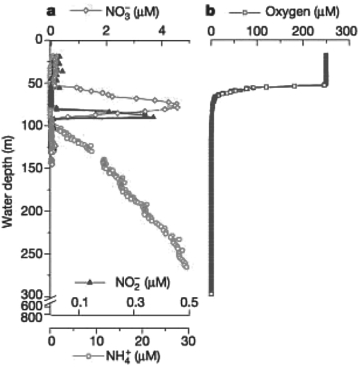 Figure 26.1
-Bacteria able to perform the NH4+ + NO2- -N2 + 2H2O reaction have been discovered in laboratory bioreactors and wastewater treatment systems. Researchers predicted that these bacteria should exist in oceans. They measured the concentration of NH4+, NO2- , NO3- , and O2 in the Black Sea as a function of water depth M. Kuypers et al. 2003 Anaerobic ammonium oxidation by anammox bacteria in the Black Sea. Nature
422:608- 11) to determine where in the sea the bacteria might live. Analyzing data presented in Figure 26.1 above, at what depth would you expect to find the bacteria? Note: In the figure, different scales are used to show concentrations of NH4+, NO2- , NO3- , and O2.)
Figure 26.1
-Bacteria able to perform the NH4+ + NO2- -N2 + 2H2O reaction have been discovered in laboratory bioreactors and wastewater treatment systems. Researchers predicted that these bacteria should exist in oceans. They measured the concentration of NH4+, NO2- , NO3- , and O2 in the Black Sea as a function of water depth M. Kuypers et al. 2003 Anaerobic ammonium oxidation by anammox bacteria in the Black Sea. Nature
422:608- 11) to determine where in the sea the bacteria might live. Analyzing data presented in Figure 26.1 above, at what depth would you expect to find the bacteria? Note: In the figure, different scales are used to show concentrations of NH4+, NO2- , NO3- , and O2.) (Multiple Choice)
4.9/5 (81)
(81) You have decided to grow E. coli to isolate a specific enzyme. For your experiment, which of the following conditions would enable you to grow a maximum amount of bacteria in the shortest time possible?
(Multiple Choice)
4.8/5 (82)
(82) While examining soil from a cornfield, you found a new type of bacteria that turns purple when treated with Gram stain. What lineage might it belong to?
(Multiple Choice)
4.8/5 (63)
(63) A newly discovered organism is found to use hydrogen sulfide H2S) for aerobic respiration and carbon dioxide CO2) from the air as a source of carbon, much like a plant. This organism must be a
(Multiple Choice)
4.8/5 (82)
(82) Imagine that you are given some chemoorganotrophic bacteria to grow. What should you use as a source of energy for this type of bacteria?
(Multiple Choice)
4.8/5 (72)
(72) Microbiologists use the Gram stain to aid in identification of bacteria. What is the major difference between Gram- positive and Gram- negative bacteria?
(Multiple Choice)
4.9/5 (74)
(74) 
Filters
- Essay(0)
- Multiple Choice(0)
- Short Answer(0)
- True False(0)
- Matching(0)