



 Chat with AI
Exam 10: Photosynthesis

Exam 1: Biology and the Tree of Life35 Questions
Exam 2: Water and Carbon: the Chemical Basis of Life53 Questions
Exam 3: Protein Structure and Function40 Questions
Exam 4: Nucleic Acids and the Rna World40 Questions
Exam 5: An Introduction to Carbohydrates42 Questions
Exam 6: Lipids, Membranes, and the First Cells53 Questions
Exam 7: Inside the Cell41 Questions
Exam 8: Energy and Enzymes59 Questions
Exam 9: Cellular Respiration and Fermentation43 Questions
Exam 10: Photosynthesis41 Questions
Exam 11: Cellcell Interactions38 Questions
Exam 12: The Cell Cycle39 Questions
Exam 13: Meiosis40 Questions
Exam 14: Mendel and the Gene47 Questions
Exam 15: Dna and the Gene: Synthesis and Repair39 Questions
Exam 16: How Genes Work39 Questions
Exam 17: Transcription, Rna Processing, and Translation37 Questions
Exam 18: Control of Gene Expression in Bacteria38 Questions
Exam 19: Control of Gene Expression in Eukaryotes40 Questions
Exam 20: The Molecular Revolution: Biotechnology and Beyond39 Questions
Exam 21: Gene Structure and Development39 Questions
Exam 22: Evolution by Natural Selection42 Questions
Exam 23: Evolutionary Processes48 Questions
Exam 24: Speciation40 Questions
Exam 25: Phylogenies and the History of Life37 Questions
Exam 26: Bacteria and Archaea38 Questions
Exam 27: Protists36 Questions
Exam 28: Green Algae and Land Plants54 Questions
Exam 29: Fungi40 Questions
Exam 30: An Introduction to Animals42 Questions
Exam 31: Protostome Animals38 Questions
Exam 32: Deuterostome Animals43 Questions
Exam 33: Viruses35 Questions
Exam 34: Plant Form and Function39 Questions
Exam 35: Water and Sugar Transport in Plants42 Questions
Exam 36: Plant Nutrition37 Questions
Exam 37: Plant Sensory Systems, Signals, and Responses64 Questions
Exam 38: Plant Reproduction and Development44 Questions
Exam 39: Animal Form and Function37 Questions
Exam 40: Water and Electrolyte Balance in Animals41 Questions
Exam 41: Animal Nutrition43 Questions
Exam 42: Gas Exchange and Circulation46 Questions
Exam 43: Animal Nervous Systems40 Questions
Exam 44: Animal Sensory Systems43 Questions
Exam 45: Animal Movement42 Questions
Exam 46: Chemical Signals in Animals38 Questions
Exam 47: Animal Reproduction and Development39 Questions
Exam 48: The Immune System in Animals38 Questions
Exam 49: An Introduction to Ecology40 Questions
Exam 50: Behavioural Ecology39 Questions
Exam 51: Population Ecology49 Questions
Exam 52: Community Ecology38 Questions
Exam 53: Ecosystems and Global Ecology41 Questions
Exam 54: Biodiversity and Conservation Biology38 Questions
Select questions type


What is the difference between NAD+ and NADP+?

Free
(Multiple Choice)
4.8/5  (78)
(78) Correct Answer: Verified
B
How does carbon fixation differ between C3 and C4 plants?
Free
(Multiple Choice)
4.7/5 (71)
(71) Correct Answer:Verified
VerifiedD
What event accompanies energy absorption by chlorophyll or other pigment molecules of the antenna complex)?
(Multiple Choice)
4.9/5 (79)
(79) During a discussion of photosynthesis, you are given the following series of facts:
1) Photosystem P700 alone is involved.
2) Water- splitting is not occurring.
3) A proton gradient is created in the Thylakoid lumen.
To which of the following processes do these statements collectively refer?
(Multiple Choice)
4.8/5 (89)
(89) The figure provided shows the absorption spectrum for chlorophyll a and the action spectrum for photosynthesis. Why are they different?
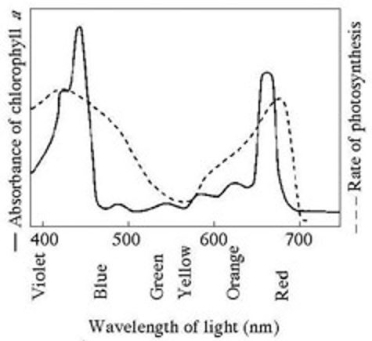
(Multiple Choice)
4.8/5 (92)
(92) In the carbon fixation step of the Calvin cycle, ribulose- 1,5- bisphosphate a five- carbon compound) is carboxylated to produce
(Multiple Choice)
4.8/5 (83)
(83) How are the light- dependent and light- independent reactions of photosynthesis related?
(Multiple Choice)
4.8/5 (87)
(87) Why are there several structurally different pigments in the reaction centers of photosystems?
(Multiple Choice)
4.7/5 (81)
(81) The absorption spectrum of a plant shows what wavelengths of light the plant absorbs. The absorption spectrum depends on
(Multiple Choice)
4.9/5 (93)
(93) As electrons are passed through the system of electron carriers associated with photosystem II, they lose energy. What happens to this energy?
(Multiple Choice)
4.7/5 (76)
(76) Melvin Calvin introduced radiolabeled carbon dioxide into plants. Which of the following molecules should he have expected to see radiolabeled first?
(Multiple Choice)
4.9/5 (83)
(83) The proteins of the electron transport chain active in the light- dependent reactions
(Multiple Choice)
4.7/5 (90)
(90) Both C3 and C4 plants have the enzymes of the Calvin cycle. How are C4 plants more efficient than C3 plants at fixing carbon?
(Multiple Choice)
4.9/5 (77)
(77) In the light dependent reactions of photosynthesis, the plant cell will conduct both linear and cyclic electron transport. This is needed because
(Multiple Choice)
4.9/5 (69)
(69) Which of the following sequences correctly represents the flow of electrons during photosynthesis?
(Multiple Choice)
4.9/5 (91)
(91) Which of the following statements concerning chloroplasts is FALSE?
(Multiple Choice)
4.9/5 (90)
(90) The final electron acceptors) associated with photosystem I is
(Multiple Choice)
4.9/5 (78)
(78) Chlorophylls absorb light in which colours of the visible range?
(Multiple Choice)
5.0/5 (102)
(102) 
Filters
- Essay(0)
- Multiple Choice(0)
- Short Answer(0)
- True False(0)
- Matching(0)