



 Chat with AI
Exam 9: Cellular Respiration and Fermentation

Exam 1: Biology and the Tree of Life35 Questions
Exam 2: Water and Carbon: the Chemical Basis of Life53 Questions
Exam 3: Protein Structure and Function40 Questions
Exam 4: Nucleic Acids and the Rna World40 Questions
Exam 5: An Introduction to Carbohydrates42 Questions
Exam 6: Lipids, Membranes, and the First Cells53 Questions
Exam 7: Inside the Cell41 Questions
Exam 8: Energy and Enzymes59 Questions
Exam 9: Cellular Respiration and Fermentation43 Questions
Exam 10: Photosynthesis41 Questions
Exam 11: Cellcell Interactions38 Questions
Exam 12: The Cell Cycle39 Questions
Exam 13: Meiosis40 Questions
Exam 14: Mendel and the Gene47 Questions
Exam 15: Dna and the Gene: Synthesis and Repair39 Questions
Exam 16: How Genes Work39 Questions
Exam 17: Transcription, Rna Processing, and Translation37 Questions
Exam 18: Control of Gene Expression in Bacteria38 Questions
Exam 19: Control of Gene Expression in Eukaryotes40 Questions
Exam 20: The Molecular Revolution: Biotechnology and Beyond39 Questions
Exam 21: Gene Structure and Development39 Questions
Exam 22: Evolution by Natural Selection42 Questions
Exam 23: Evolutionary Processes48 Questions
Exam 24: Speciation40 Questions
Exam 25: Phylogenies and the History of Life37 Questions
Exam 26: Bacteria and Archaea38 Questions
Exam 27: Protists36 Questions
Exam 28: Green Algae and Land Plants54 Questions
Exam 29: Fungi40 Questions
Exam 30: An Introduction to Animals42 Questions
Exam 31: Protostome Animals38 Questions
Exam 32: Deuterostome Animals43 Questions
Exam 33: Viruses35 Questions
Exam 34: Plant Form and Function39 Questions
Exam 35: Water and Sugar Transport in Plants42 Questions
Exam 36: Plant Nutrition37 Questions
Exam 37: Plant Sensory Systems, Signals, and Responses64 Questions
Exam 38: Plant Reproduction and Development44 Questions
Exam 39: Animal Form and Function37 Questions
Exam 40: Water and Electrolyte Balance in Animals41 Questions
Exam 41: Animal Nutrition43 Questions
Exam 42: Gas Exchange and Circulation46 Questions
Exam 43: Animal Nervous Systems40 Questions
Exam 44: Animal Sensory Systems43 Questions
Exam 45: Animal Movement42 Questions
Exam 46: Chemical Signals in Animals38 Questions
Exam 47: Animal Reproduction and Development39 Questions
Exam 48: The Immune System in Animals38 Questions
Exam 49: An Introduction to Ecology40 Questions
Exam 50: Behavioural Ecology39 Questions
Exam 51: Population Ecology49 Questions
Exam 52: Community Ecology38 Questions
Exam 53: Ecosystems and Global Ecology41 Questions
Exam 54: Biodiversity and Conservation Biology38 Questions
Select questions type


Fatty acids typically have an even number of carbons. They are catabolized by a process called beta- oxidation. The end- products of the metabolic pathway are acetyl groups of acetyl CoA molecules. What is the most likely fate of the acetyl groups?

Free
(Multiple Choice)
4.9/5  (70)
(70) Correct Answer: Verified
D
The chemiosmotic hypothesis is an important key to understanding general metabolism because
Free
(Multiple Choice)
4.8/5 (80)
(80) Correct Answer:Verified
VerifiedA
The inner mitochondrial membrane normally
Free
(Multiple Choice)
4.9/5 (78)
(78) Correct Answer:Verified
VerifiedA
Which metabolic pathway is common to both cellular respiration and fermentation?
(Multiple Choice)
4.8/5 (74)
(74) Which of the following events takes place in the electron transport chain?
(Multiple Choice)
4.8/5 (77)
(77) In the energy- yielding phase of glycolysis, energy is extracted in the form of
(Multiple Choice)
4.8/5 (82)
(82) When one of the eight Krebs cycle intermediates is added to the respiration medium of living cells, like yeast, what happens to the rates of ATP and carbon dioxide production?
(Multiple Choice)
4.9/5 (89)
(89) Following glycolysis and the Krebs cycle and before the electron transport chain and oxidative phosphorylation, the carbon skeleton of glucose has been broken down to CO2. Most of the energy from the original glucose at that point is still in the form of
(Multiple Choice)
4.9/5 (63)
(63) The energy of electron transport serves to move translocate) protons to the outer mitochondrial compartment. How does this help the mitochondrion to produce energy?
(Multiple Choice)
4.7/5 (85)
(85) A metabolic pathway, glycolysis, is active when cellular energy levels are___________; the regulatory enzyme, phosphofructokinase, is _______by ATP.
(Multiple Choice)
4.8/5 (73)
(73) Why might adding inorganic phosphate to a reaction mixture where glycolysis was rapidly proceeding help sustain the metabolic pathway?
(Multiple Choice)
4.8/5 (77)
(77) C6H12O6 + 6 O2 -6 CO2 + 6 H2O + Energy
-Which of the following statements describes the pathway shown above?
(Multiple Choice)
5.0/5 (76)
(76) Substrate- level phosphorylation occurs within a metabolic pathway where sufficient energy is released by a given chemical reaction to drive the synthesis of ATP from ADP and phosphate. Substrate- level phosphorylation is seen in which metabolic pathways)?
(Multiple Choice)
4.9/5 (76)
(76) Canine phosphofructokinase PFK) deficiency afflicts springer spaniels, affecting an estimated 10% of the breed. PFK is the glycolytic enzyme that phosphorylates fructose- 1- phosphate and catalyzes the committed step in glycolysis. Given its critical role in glycolysis, one implication of the genetic defect resulting in PFK deficiency in dogs is
(Multiple Choice)
4.9/5 (81)
(81) 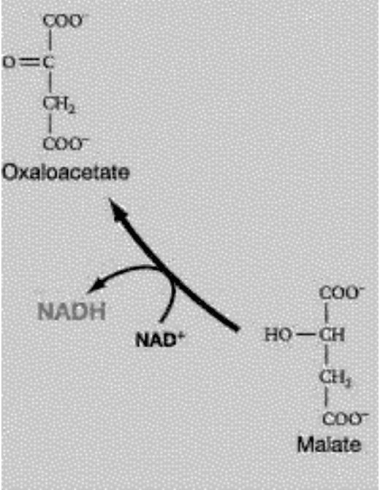 Figure 9.3
-Refer to Figure 9.3. Which of these statements concerning the following reaction is true?
Malate + NAD+ -oxaloacetate + NADH + H+
Figure 9.3
-Refer to Figure 9.3. Which of these statements concerning the following reaction is true?
Malate + NAD+ -oxaloacetate + NADH + H+ (Multiple Choice)
4.9/5 (79)
(79) A cell has enough available ATP to meet its needs for about 30 seconds. What is likely to happen when an athlete exhausts his or her ATP supply?
(Multiple Choice)
4.8/5 (74)
(74) 
Filters
- Essay(0)
- Multiple Choice(0)
- Short Answer(0)
- True False(0)
- Matching(0)