



 Chat with AI
Exam 9: Cellular Respiration and Fermentation

Exam 1: Biology and the Tree of Life35 Questions
Exam 2: Water and Carbon: the Chemical Basis of Life53 Questions
Exam 3: Protein Structure and Function40 Questions
Exam 4: Nucleic Acids and the Rna World40 Questions
Exam 5: An Introduction to Carbohydrates42 Questions
Exam 6: Lipids, Membranes, and the First Cells53 Questions
Exam 7: Inside the Cell41 Questions
Exam 8: Energy and Enzymes59 Questions
Exam 9: Cellular Respiration and Fermentation43 Questions
Exam 10: Photosynthesis41 Questions
Exam 11: Cellcell Interactions38 Questions
Exam 12: The Cell Cycle39 Questions
Exam 13: Meiosis40 Questions
Exam 14: Mendel and the Gene47 Questions
Exam 15: Dna and the Gene: Synthesis and Repair39 Questions
Exam 16: How Genes Work39 Questions
Exam 17: Transcription, Rna Processing, and Translation37 Questions
Exam 18: Control of Gene Expression in Bacteria38 Questions
Exam 19: Control of Gene Expression in Eukaryotes40 Questions
Exam 20: The Molecular Revolution: Biotechnology and Beyond39 Questions
Exam 21: Gene Structure and Development39 Questions
Exam 22: Evolution by Natural Selection42 Questions
Exam 23: Evolutionary Processes48 Questions
Exam 24: Speciation40 Questions
Exam 25: Phylogenies and the History of Life37 Questions
Exam 26: Bacteria and Archaea38 Questions
Exam 27: Protists36 Questions
Exam 28: Green Algae and Land Plants54 Questions
Exam 29: Fungi40 Questions
Exam 30: An Introduction to Animals42 Questions
Exam 31: Protostome Animals38 Questions
Exam 32: Deuterostome Animals43 Questions
Exam 33: Viruses35 Questions
Exam 34: Plant Form and Function39 Questions
Exam 35: Water and Sugar Transport in Plants42 Questions
Exam 36: Plant Nutrition37 Questions
Exam 37: Plant Sensory Systems, Signals, and Responses64 Questions
Exam 38: Plant Reproduction and Development44 Questions
Exam 39: Animal Form and Function37 Questions
Exam 40: Water and Electrolyte Balance in Animals41 Questions
Exam 41: Animal Nutrition43 Questions
Exam 42: Gas Exchange and Circulation46 Questions
Exam 43: Animal Nervous Systems40 Questions
Exam 44: Animal Sensory Systems43 Questions
Exam 45: Animal Movement42 Questions
Exam 46: Chemical Signals in Animals38 Questions
Exam 47: Animal Reproduction and Development39 Questions
Exam 48: The Immune System in Animals38 Questions
Exam 49: An Introduction to Ecology40 Questions
Exam 50: Behavioural Ecology39 Questions
Exam 51: Population Ecology49 Questions
Exam 52: Community Ecology38 Questions
Exam 53: Ecosystems and Global Ecology41 Questions
Exam 54: Biodiversity and Conservation Biology38 Questions
Select questions type


Which of the following is true of oxidation- reduction redox) reactions?
(Multiple Choice)
4.8/5  (73)
(73) The constituents of the electron transport chain have similar capabilities, with the exception of ubiquinone coenzyme Q). What is different about ubiquinone?
(Multiple Choice)
4.9/5 (85)
(85) After glycolysis, but before the Krebs cycle and electron transport chain/oxidative phosphorylation, most of the energy from the original glucose is in the form of which molecule?
(Multiple Choice)
4.8/5 (64)
(64) A substrate- level phosphorylation occurs in the Krebs cycle where
(Multiple Choice)
4.9/5 (82)
(82) Substrate level phosphorylation occurs in the citric acid cycle when Succinyl CoA is converted to Succinate. Which of the following statements about this event is true?
(Multiple Choice)
4.9/5 (74)
(74) C6H12O6 glucose) + 6O2 -6 CO2 + 6H2O
Where is most of the water in this reaction produced?
(Multiple Choice)
4.8/5 (101)
(101) Which of the following occurs in the cytosol of a eukaryotic cell?
(Multiple Choice)
4.7/5 (79)
(79) In the absence of oxygen, yeast cells can obtain energy by fermentation, resulting in the production of
(Multiple Choice)
4.7/5 (83)
(83) In cellular respiration, electrons are moved along a series of membrane proteins during the electron transport chain. If there was a mutation in the DNA coding for each of the proton pumps of the electron transport chain such that these proteins became non- functional, what would you predict to occur?
(Multiple Choice)
4.9/5 (75)
(75) ATP production by ATP synthase, requiring a proton gradient across a membrane, occurs in which of the following?
(Multiple Choice)
4.9/5 (80)
(80) Two ATP molecules are expended in the energy investment phase of glycolysis. Why is this energy necessary to begin the process of glucose catabolism?
(Multiple Choice)
4.8/5 (66)
(66) 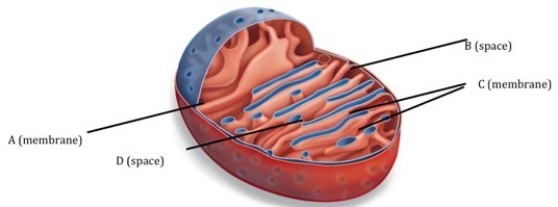 -In the figure above, where are the enzymes of the Krebs citric acid) cycle located? Choose the arrow that corresponds.
 (Multiple Choice)
4.7/5 (88)
(88) A mutation in yeast makes it unable to convert pyruvate to ethanol. How will this mutation affect these yeast cells? The mutant yeast cells will
(Multiple Choice)
4.9/5 (90)
(90) 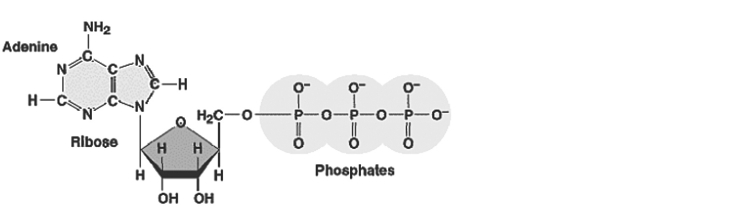 Figure 9.1
-Refer to Figure 9.1. What characteristic of this molecule ATP) is responsible for its high energy level compared to AMP?
Figure 9.1
-Refer to Figure 9.1. What characteristic of this molecule ATP) is responsible for its high energy level compared to AMP? (Multiple Choice)
5.0/5 (77)
(77) The enzyme phosphofructokinase is the major regulatory enzyme of glycolysis. It catalyzes
(Multiple Choice)
4.8/5 (78)
(78) 
Filters
- Essay(0)
- Multiple Choice(0)
- Short Answer(0)
- True False(0)
- Matching(0)