



 Chat with AI
Exam 25: Phylogenies and the History of Life

Exam 1: Biology and the Tree of Life35 Questions
Exam 2: Water and Carbon: the Chemical Basis of Life53 Questions
Exam 3: Protein Structure and Function40 Questions
Exam 4: Nucleic Acids and the Rna World40 Questions
Exam 5: An Introduction to Carbohydrates42 Questions
Exam 6: Lipids, Membranes, and the First Cells53 Questions
Exam 7: Inside the Cell41 Questions
Exam 8: Energy and Enzymes59 Questions
Exam 9: Cellular Respiration and Fermentation43 Questions
Exam 10: Photosynthesis41 Questions
Exam 11: Cellcell Interactions38 Questions
Exam 12: The Cell Cycle39 Questions
Exam 13: Meiosis40 Questions
Exam 14: Mendel and the Gene47 Questions
Exam 15: Dna and the Gene: Synthesis and Repair39 Questions
Exam 16: How Genes Work39 Questions
Exam 17: Transcription, Rna Processing, and Translation37 Questions
Exam 18: Control of Gene Expression in Bacteria38 Questions
Exam 19: Control of Gene Expression in Eukaryotes40 Questions
Exam 20: The Molecular Revolution: Biotechnology and Beyond39 Questions
Exam 21: Gene Structure and Development39 Questions
Exam 22: Evolution by Natural Selection42 Questions
Exam 23: Evolutionary Processes48 Questions
Exam 24: Speciation40 Questions
Exam 25: Phylogenies and the History of Life37 Questions
Exam 26: Bacteria and Archaea38 Questions
Exam 27: Protists36 Questions
Exam 28: Green Algae and Land Plants54 Questions
Exam 29: Fungi40 Questions
Exam 30: An Introduction to Animals42 Questions
Exam 31: Protostome Animals38 Questions
Exam 32: Deuterostome Animals43 Questions
Exam 33: Viruses35 Questions
Exam 34: Plant Form and Function39 Questions
Exam 35: Water and Sugar Transport in Plants42 Questions
Exam 36: Plant Nutrition37 Questions
Exam 37: Plant Sensory Systems, Signals, and Responses64 Questions
Exam 38: Plant Reproduction and Development44 Questions
Exam 39: Animal Form and Function37 Questions
Exam 40: Water and Electrolyte Balance in Animals41 Questions
Exam 41: Animal Nutrition43 Questions
Exam 42: Gas Exchange and Circulation46 Questions
Exam 43: Animal Nervous Systems40 Questions
Exam 44: Animal Sensory Systems43 Questions
Exam 45: Animal Movement42 Questions
Exam 46: Chemical Signals in Animals38 Questions
Exam 47: Animal Reproduction and Development39 Questions
Exam 48: The Immune System in Animals38 Questions
Exam 49: An Introduction to Ecology40 Questions
Exam 50: Behavioural Ecology39 Questions
Exam 51: Population Ecology49 Questions
Exam 52: Community Ecology38 Questions
Exam 53: Ecosystems and Global Ecology41 Questions
Exam 54: Biodiversity and Conservation Biology38 Questions
Select questions type


 Figure 25.1
-Which of the following trees depicts the same relationship among species as shown in Figure 25.1?
Figure 25.1
-Which of the following trees depicts the same relationship among species as shown in Figure 25.1?
Free
(Multiple Choice)
4.9/5  (85)
(85) Correct Answer: Verified
A
Which of the following likely has the most Hox genes?
Free
(Multiple Choice)
4.9/5 (65)
(65) Correct Answer:Verified
VerifiedA
Trait 1 Trait 2 Trait 3 Species W 1 0 0 Species X 1 1 0 Species Y 1 1 0 Species Z 1 0 1 Based on the table provided, which of the following traits is/are useful in generating a phylogeny for species W, Z?
Free
(Multiple Choice)
5.0/5 (86)
(86) Correct Answer:Verified
VerifiedB
The Mesozoic era is nicknamed the Age of Reptiles and the Cenozoic era is nicknamed the Age of Mammals. What do these nicknames mean?
(Multiple Choice)
4.8/5 (66)
(66) Some beetles and flies have antler-like structures on their heads, much like male deer do. The existence of antlers in beetle, fly, and deer species with strong male-male competition is an example of
(Multiple Choice)
5.0/5 (74)
(74) Which of the following statements is true about a phylogeny, as represented by a phylogenetic tree?
(Multiple Choice)
4.9/5 (80)
(80) 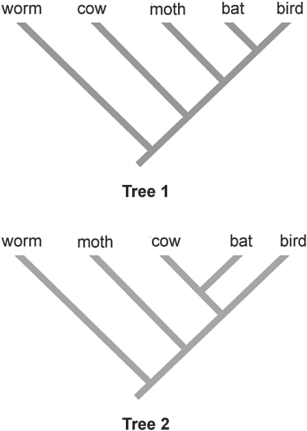 Figure 25.3
-Applying the principle of parsimony to the trait "ability to fly," which of the two phylogenetic trees above is most parsimonious?
Figure 25.3
-Applying the principle of parsimony to the trait "ability to fly," which of the two phylogenetic trees above is most parsimonious? (Multiple Choice)
4.8/5 (84)
(84) Your professor wants you to construct a phylogenetic tree of orchids. She gives you tissue from seven orchid species and one lily. What is the most likely reason she gave you the lily?
(Multiple Choice)
4.8/5 (68)
(68) Which of the following organisms would be most likely to fossilize?
(Multiple Choice)
4.8/5 (95)
(95) Proposed number of Hox genes in some extant and extinct animal groups Last Common Ancestor of Bilateria Last Common Ancesto of Insects and Vertebrates Ancestral Verte brates Mammals 4 7 14 38 Which of the following is the most parsimonious explanation for the change in the number of Hox genes from the last common ancestor of insects and vertebrates to ancestral vertebrates, as shown in the table provided?
(Multiple Choice)
4.7/5 (74)
(74) All of the following events can trigger an adaptive radiation EXCEPT
(Multiple Choice)
4.9/5 (86)
(86) Islands are well known for having many endemic species-species that are unique to that location. What isa likely explanation for this pattern?
(Multiple Choice)
4.9/5 (77)
(77) Which statement best describes why the Cambrian explosion was important?
(Multiple Choice)
4.8/5 (76)
(76) 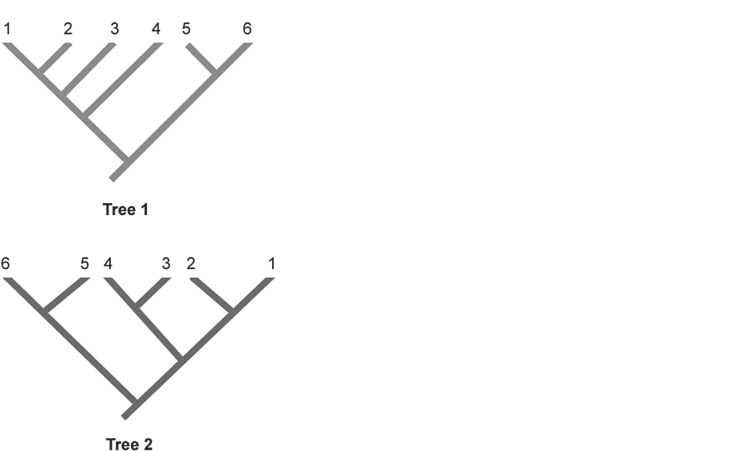 Figure 25.2
-In the phylogenetic trees above, numbers represent species and the same species are shown in both trees. Which two species are represented as sister species in Tree 2 but are not shown as sister species in Tree 1?
Figure 25.2
-In the phylogenetic trees above, numbers represent species and the same species are shown in both trees. Which two species are represented as sister species in Tree 2 but are not shown as sister species in Tree 1? (Multiple Choice)
4.8/5 (76)
(76) Which of the following organisms would be most likely to fossilize?
(Multiple Choice)
4.7/5 (88)
(88) Which of the following catastrophes is linked to the end-Permian mass extinction?
(Multiple Choice)
4.7/5 (76)
(76) 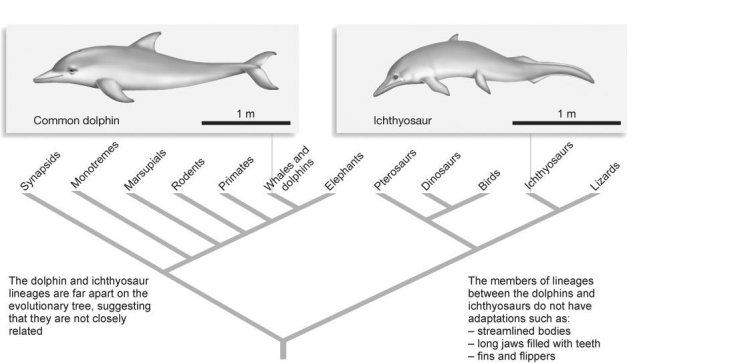 Figure 25.4
-For the streamlined bodies shown in Figure 25.4 above to be homologous instead of homoplasious, which of the following groups would you expect to also have streamlined bodies? Assume the trait was not lost in any of the lineages on the phylogenetic tree in Figure 25.4.
Figure 25.4
-For the streamlined bodies shown in Figure 25.4 above to be homologous instead of homoplasious, which of the following groups would you expect to also have streamlined bodies? Assume the trait was not lost in any of the lineages on the phylogenetic tree in Figure 25.4. (Multiple Choice)
4.8/5 (84)
(84) Which of the following would be least likely in the fossil record?
(Multiple Choice)
4.9/5 (74)
(74) Which of the following statements best describes the rationale for applying the principle of parsimony in constructing phylogenetic trees?
(Multiple Choice)
4.8/5 (67)
(67) 
Filters
- Essay(0)
- Multiple Choice(0)
- Short Answer(0)
- True False(0)
- Matching(0)