



 Chat with AI
Exam 40: Water and Electrolyte Balance in Animals

Exam 1: Biology and the Tree of Life35 Questions
Exam 2: Water and Carbon: the Chemical Basis of Life53 Questions
Exam 3: Protein Structure and Function40 Questions
Exam 4: Nucleic Acids and the Rna World40 Questions
Exam 5: An Introduction to Carbohydrates42 Questions
Exam 6: Lipids, Membranes, and the First Cells53 Questions
Exam 7: Inside the Cell41 Questions
Exam 8: Energy and Enzymes59 Questions
Exam 9: Cellular Respiration and Fermentation43 Questions
Exam 10: Photosynthesis41 Questions
Exam 11: Cellcell Interactions38 Questions
Exam 12: The Cell Cycle39 Questions
Exam 13: Meiosis40 Questions
Exam 14: Mendel and the Gene47 Questions
Exam 15: Dna and the Gene: Synthesis and Repair39 Questions
Exam 16: How Genes Work39 Questions
Exam 17: Transcription, Rna Processing, and Translation37 Questions
Exam 18: Control of Gene Expression in Bacteria38 Questions
Exam 19: Control of Gene Expression in Eukaryotes40 Questions
Exam 20: The Molecular Revolution: Biotechnology and Beyond39 Questions
Exam 21: Gene Structure and Development39 Questions
Exam 22: Evolution by Natural Selection42 Questions
Exam 23: Evolutionary Processes48 Questions
Exam 24: Speciation40 Questions
Exam 25: Phylogenies and the History of Life37 Questions
Exam 26: Bacteria and Archaea38 Questions
Exam 27: Protists36 Questions
Exam 28: Green Algae and Land Plants54 Questions
Exam 29: Fungi40 Questions
Exam 30: An Introduction to Animals42 Questions
Exam 31: Protostome Animals38 Questions
Exam 32: Deuterostome Animals43 Questions
Exam 33: Viruses35 Questions
Exam 34: Plant Form and Function39 Questions
Exam 35: Water and Sugar Transport in Plants42 Questions
Exam 36: Plant Nutrition37 Questions
Exam 37: Plant Sensory Systems, Signals, and Responses64 Questions
Exam 38: Plant Reproduction and Development44 Questions
Exam 39: Animal Form and Function37 Questions
Exam 40: Water and Electrolyte Balance in Animals41 Questions
Exam 41: Animal Nutrition43 Questions
Exam 42: Gas Exchange and Circulation46 Questions
Exam 43: Animal Nervous Systems40 Questions
Exam 44: Animal Sensory Systems43 Questions
Exam 45: Animal Movement42 Questions
Exam 46: Chemical Signals in Animals38 Questions
Exam 47: Animal Reproduction and Development39 Questions
Exam 48: The Immune System in Animals38 Questions
Exam 49: An Introduction to Ecology40 Questions
Exam 50: Behavioural Ecology39 Questions
Exam 51: Population Ecology49 Questions
Exam 52: Community Ecology38 Questions
Exam 53: Ecosystems and Global Ecology41 Questions
Exam 54: Biodiversity and Conservation Biology38 Questions
Select questions type


 Table 40.1
-Refer to Table 40.1: Because the shark rectal gland functions only when ATP molecules are present, what can you infer about the movement of Na+, K+, and Cl- ?
Table 40.1
-Refer to Table 40.1: Because the shark rectal gland functions only when ATP molecules are present, what can you infer about the movement of Na+, K+, and Cl- ?
Free
(Multiple Choice)
4.8/5  (80)
(80) Correct Answer: Verified
A
Different habitats pose certain challenges to animal survival. For instance, terrestrial insects must maintain water balance by minimizing evaporation. How do insects minimize water loss?
Free
(Multiple Choice)
4.8/5 (81)
(81) Correct Answer:Verified
VerifiedC
The products of filtration in the renal corpuscle enter the renal tubule through which of the following structures?
Free
(Multiple Choice)
4.8/5 (77)
(77) Correct Answer:Verified
VerifiedA
Water loss from insect surface is minimal due to which of the following structures?
(Multiple Choice)
4.8/5 (75)
(75) 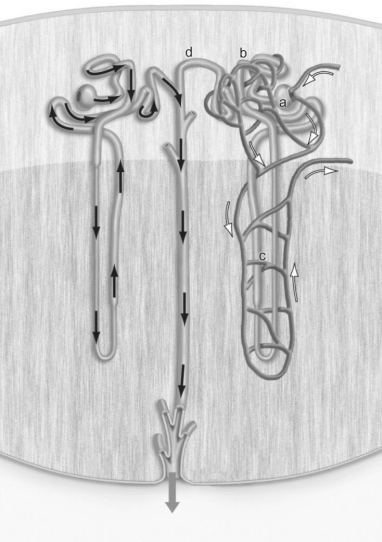 Figure 40.1
-Where does filtration take place in the figure above?
Figure 40.1
-Where does filtration take place in the figure above? (Short Answer)
4.8/5 (69)
(69) Reabsorption of water in the hindgut of insects is controlled by which of the following?
(Multiple Choice)
4.8/5 (93)
(93) Freshwater fish live in a hypotonic environment. To maintain homeostasis in this environment, they must
(Multiple Choice)
4.8/5 (76)
(76) A potassium ion gradient is set up in the Malpighian tubules through an active transport process. As a result, potassium concentration is higher in the lumen of the tubules than in hemolymph. How would the potassium gradient affect water movement?
(Multiple Choice)
4.8/5 (85)
(85) Salmon eggs hatch in freshwater. The fish then migrate to the ocean a hypertonic solution) and, after several years of feeding and growing, return to freshwater to breed. How can these organisms make the transition from freshwater to ocean water and back to freshwater?
(Multiple Choice)
4.8/5 (82)
(82) For filtration to take place through the fenestrated capillaries of the renal corpuscle,
(Multiple Choice)
4.9/5 (76)
(76) Why do birds secrete uric acid as their nitrogenous waste? Because uric acid
(Multiple Choice)
4.7/5 (79)
(79) African lungfish, which are often found in small, stagnant pools of freshwater, produce urea as a nitrogenous waste. What is the advantage of this adaptation?
(Multiple Choice)
4.8/5 (62)
(62) There are microvilli on the luminal apical) surface of the epithelium that lines the lumen of the proximal tubule. Microvilli are structural features designed to
(Multiple Choice)
5.0/5 (89)
(89) Freshwater fish reside in hypotonic environments. They do not drink water, and they excrete large volumes of hypotonic urine in an effort to osmoregulate. How do they obtain an adequate supply of electrolytes?
(Multiple Choice)
4.9/5 (69)
(69) The loop of Henle dips into the renal cortex. This is an important feature of osmoregulation in terrestrial vertebrates because
(Multiple Choice)
4.9/5 (81)
(81) How does ion composition of pre- urine differ from hemolymph?
(Multiple Choice)
4.9/5 (77)
(77) Proper functioning of body cells and processes requires solute concentrations to be maintained within a narrow range. Which of the following solutes would be absorbed by the proximal tubule of the kidney nephron?
(Multiple Choice)
4.7/5 (79)
(79) 
Filters
- Essay(0)
- Multiple Choice(0)
- Short Answer(0)
- True False(0)
- Matching(0)