



 Chat with AI
Exam 43: Animal Nervous Systems

Exam 1: Biology and the Tree of Life35 Questions
Exam 2: Water and Carbon: the Chemical Basis of Life53 Questions
Exam 3: Protein Structure and Function40 Questions
Exam 4: Nucleic Acids and the Rna World40 Questions
Exam 5: An Introduction to Carbohydrates42 Questions
Exam 6: Lipids, Membranes, and the First Cells53 Questions
Exam 7: Inside the Cell41 Questions
Exam 8: Energy and Enzymes59 Questions
Exam 9: Cellular Respiration and Fermentation43 Questions
Exam 10: Photosynthesis41 Questions
Exam 11: Cellcell Interactions38 Questions
Exam 12: The Cell Cycle39 Questions
Exam 13: Meiosis40 Questions
Exam 14: Mendel and the Gene47 Questions
Exam 15: Dna and the Gene: Synthesis and Repair39 Questions
Exam 16: How Genes Work39 Questions
Exam 17: Transcription, Rna Processing, and Translation37 Questions
Exam 18: Control of Gene Expression in Bacteria38 Questions
Exam 19: Control of Gene Expression in Eukaryotes40 Questions
Exam 20: The Molecular Revolution: Biotechnology and Beyond39 Questions
Exam 21: Gene Structure and Development39 Questions
Exam 22: Evolution by Natural Selection42 Questions
Exam 23: Evolutionary Processes48 Questions
Exam 24: Speciation40 Questions
Exam 25: Phylogenies and the History of Life37 Questions
Exam 26: Bacteria and Archaea38 Questions
Exam 27: Protists36 Questions
Exam 28: Green Algae and Land Plants54 Questions
Exam 29: Fungi40 Questions
Exam 30: An Introduction to Animals42 Questions
Exam 31: Protostome Animals38 Questions
Exam 32: Deuterostome Animals43 Questions
Exam 33: Viruses35 Questions
Exam 34: Plant Form and Function39 Questions
Exam 35: Water and Sugar Transport in Plants42 Questions
Exam 36: Plant Nutrition37 Questions
Exam 37: Plant Sensory Systems, Signals, and Responses64 Questions
Exam 38: Plant Reproduction and Development44 Questions
Exam 39: Animal Form and Function37 Questions
Exam 40: Water and Electrolyte Balance in Animals41 Questions
Exam 41: Animal Nutrition43 Questions
Exam 42: Gas Exchange and Circulation46 Questions
Exam 43: Animal Nervous Systems40 Questions
Exam 44: Animal Sensory Systems43 Questions
Exam 45: Animal Movement42 Questions
Exam 46: Chemical Signals in Animals38 Questions
Exam 47: Animal Reproduction and Development39 Questions
Exam 48: The Immune System in Animals38 Questions
Exam 49: An Introduction to Ecology40 Questions
Exam 50: Behavioural Ecology39 Questions
Exam 51: Population Ecology49 Questions
Exam 52: Community Ecology38 Questions
Exam 53: Ecosystems and Global Ecology41 Questions
Exam 54: Biodiversity and Conservation Biology38 Questions
Select questions type


What would be a consequence of a person having Na+ levels in the blood and interstitial fluids that are well below normal?

Free
(Multiple Choice)
4.8/5  (74)
(74) Correct Answer: Verified
A
Which nervous pathway does sensory information travel through to elicit a response in the effector cells?
Free
(Multiple Choice)
4.8/5 (80)
(80) Correct Answer:Verified
VerifiedD
If a person were to have a stroke in the occipital lobe of the cerebrum, which of the following functions would
Most likely be affected?
Free
(Multiple Choice)
4.8/5 (88)
(88) Correct Answer:Verified
VerifiedD
Which of the following types of ions are most likely to cross the plasma membrane of a resting neuron?
(Multiple Choice)
4.7/5 (65)
(65) Why do Na+ ions enter the cell when voltage- gated Na+ channels are opened in neurons?
(Multiple Choice)
4.8/5 (72)
(72) Why are action potentials usually conducted in one direction?
(Multiple Choice)
5.0/5 (83)
(83) If the activity of the sodium-potassium pump was completely stopped, what would happen to the neuron's membrane potential?
(Multiple Choice)
4.9/5 (81)
(81) Action potentials are normally generated at the axon hillock and propagated down the axon away from the cell body. If you experimentally depolarized an axon to the threshold level at a point halfway down the axon, what would happen?
(Multiple Choice)
4.8/5 (89)
(89) Where are the sodium channels that trigger an action potential located?
(Multiple Choice)
4.8/5 (72)
(72) The corpus callosum is a network of axons that connects the two hemispheres of the cerebrum. What do you hypothesize the primary function of the corpus callosum is?
(Multiple Choice)
4.8/5 (83)
(83) 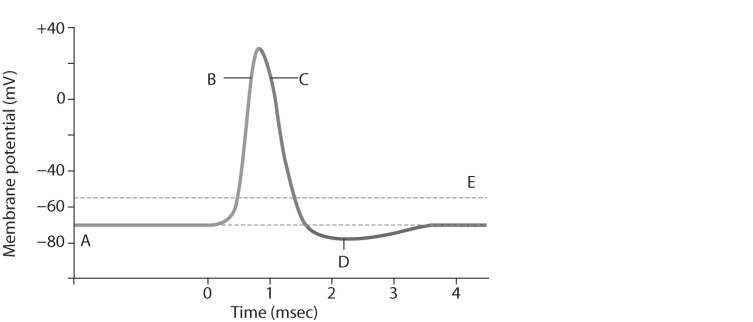 Figure 43.1
-Which letter on Figure 43.1 corresponds to the action of the sodium- potassium pump and potassium leak channels?
Figure 43.1
-Which letter on Figure 43.1 corresponds to the action of the sodium- potassium pump and potassium leak channels? (Multiple Choice)
4.9/5 (87)
(87) Figure 43.1
-How do myelin sheaths increase the speed with which action potentials are propagated along an axon?
Figure 43.1
-How do myelin sheaths increase the speed with which action potentials are propagated along an axon? (Multiple Choice)
4.7/5 (91)
(91) How could you increase the magnitude of inhibitory postsynaptic potentials IPSPs) generated at a synapse?
(Multiple Choice)
4.9/5 (87)
(87) What type of neuron can exist entirely within the central nervous system CNS)?
(Multiple Choice)
4.8/5 (84)
(84) You are walking your dog at night in the forest. Your dog barks at a strange noise and you are startled. Which of the following physiological responses are most likely to occur?
(Multiple Choice)
4.8/5 (87)
(87) If an action potential is triggered in a neuron, what must have happened?
(Multiple Choice)
4.9/5 (67)
(67) If twice as many inhibitory postsynaptic potentials IPSPs) as excitatory postsynaptic potentials EPSPs) arrive at a postsynaptic neuron in close proximity, is the integration of signals by the postsynaptic neuron likely to produce an action potential?
(Multiple Choice)
4.9/5 (83)
(83) 
Filters
- Essay(0)
- Multiple Choice(0)
- Short Answer(0)
- True False(0)
- Matching(0)