



 Chat with AI
Exam 43: Animal Nervous Systems

Exam 1: Biology and the Tree of Life35 Questions
Exam 2: Water and Carbon: the Chemical Basis of Life53 Questions
Exam 3: Protein Structure and Function40 Questions
Exam 4: Nucleic Acids and the Rna World40 Questions
Exam 5: An Introduction to Carbohydrates42 Questions
Exam 6: Lipids, Membranes, and the First Cells53 Questions
Exam 7: Inside the Cell41 Questions
Exam 8: Energy and Enzymes59 Questions
Exam 9: Cellular Respiration and Fermentation43 Questions
Exam 10: Photosynthesis41 Questions
Exam 11: Cellcell Interactions38 Questions
Exam 12: The Cell Cycle39 Questions
Exam 13: Meiosis40 Questions
Exam 14: Mendel and the Gene47 Questions
Exam 15: Dna and the Gene: Synthesis and Repair39 Questions
Exam 16: How Genes Work39 Questions
Exam 17: Transcription, Rna Processing, and Translation37 Questions
Exam 18: Control of Gene Expression in Bacteria38 Questions
Exam 19: Control of Gene Expression in Eukaryotes40 Questions
Exam 20: The Molecular Revolution: Biotechnology and Beyond39 Questions
Exam 21: Gene Structure and Development39 Questions
Exam 22: Evolution by Natural Selection42 Questions
Exam 23: Evolutionary Processes48 Questions
Exam 24: Speciation40 Questions
Exam 25: Phylogenies and the History of Life37 Questions
Exam 26: Bacteria and Archaea38 Questions
Exam 27: Protists36 Questions
Exam 28: Green Algae and Land Plants54 Questions
Exam 29: Fungi40 Questions
Exam 30: An Introduction to Animals42 Questions
Exam 31: Protostome Animals38 Questions
Exam 32: Deuterostome Animals43 Questions
Exam 33: Viruses35 Questions
Exam 34: Plant Form and Function39 Questions
Exam 35: Water and Sugar Transport in Plants42 Questions
Exam 36: Plant Nutrition37 Questions
Exam 37: Plant Sensory Systems, Signals, and Responses64 Questions
Exam 38: Plant Reproduction and Development44 Questions
Exam 39: Animal Form and Function37 Questions
Exam 40: Water and Electrolyte Balance in Animals41 Questions
Exam 41: Animal Nutrition43 Questions
Exam 42: Gas Exchange and Circulation46 Questions
Exam 43: Animal Nervous Systems40 Questions
Exam 44: Animal Sensory Systems43 Questions
Exam 45: Animal Movement42 Questions
Exam 46: Chemical Signals in Animals38 Questions
Exam 47: Animal Reproduction and Development39 Questions
Exam 48: The Immune System in Animals38 Questions
Exam 49: An Introduction to Ecology40 Questions
Exam 50: Behavioural Ecology39 Questions
Exam 51: Population Ecology49 Questions
Exam 52: Community Ecology38 Questions
Exam 53: Ecosystems and Global Ecology41 Questions
Exam 54: Biodiversity and Conservation Biology38 Questions
Select questions type


If you experimentally increase the concentration of K+ inside a cell, while maintaining other ion concentrations as they were, what would happen to the cell's membrane potential?
(Multiple Choice)
4.9/5  (76)
(76) Most synapses found so far in the mammalian central nervous system CNS) are classified as chemical rather than electrical.
(True/False)
4.8/5 (67)
(67) Which of the following manipulations would reduce the release of neurotransmitter from a presynaptic neuron terminal?
(Multiple Choice)
4.8/5 (87)
(87) What would probably happen if a long neuron had one continuous myelin sheath down the length of the axon with no nodes of Ranvier?
(Multiple Choice)
4.9/5 (89)
(89) Neurotransmitters can be either excitatory or inhibitory. Which of the following neurotransmitters usually have an inhibitory effect on the post- synaptic cell?
(Multiple Choice)
4.9/5 (82)
(82) Upon witnessing a robber hold up a convenience store at gunpoint, which of the following reactions would your nervous system initiate?
(Multiple Choice)
4.7/5 (83)
(83) A large meal is likely to result in activity in which set of nerves?
(Multiple Choice)
5.0/5 (85)
(85) 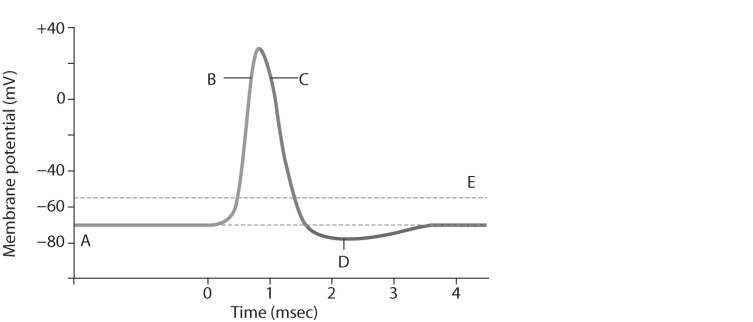 Figure 43.1
-Which letter on Figure 43.1 corresponds to a large influx of Na+ ions into the cell?
Figure 43.1
-Which letter on Figure 43.1 corresponds to a large influx of Na+ ions into the cell? (Multiple Choice)
4.8/5 (76)
(76) If a disease or disorder interferes with learning and memory, which of the following should the mechanism of the disease should involve?
(Multiple Choice)
4.9/5 (71)
(71) A toxin that binds specifically to voltage- gated sodium channels in axons would be expected to
(Multiple Choice)
4.9/5 (71)
(71) Stem cell transplants may someday be used to treat Parkinson's disease. Researchers are hopeful that these cells would alleviate the symptoms of Parkinson's disease by
(Multiple Choice)
5.0/5 (72)
(72) Which of the following statements about action potentials is FALSE?
(Multiple Choice)
4.7/5 (79)
(79) The squid giant axon is approximately 500 µm in diameter compared to 2µm for a typical human axon). Due to the size of the axon,
(Multiple Choice)
4.9/5 (74)
(74) The concentrations of ions are very different inside and outside a nerve cell due to
(Multiple Choice)
4.8/5 (86)
(86) If the sodium- potassium pump were inactivated by a drug, what would happen to the neuron's membrane potential?
(Multiple Choice)
4.8/5 (81)
(81) Tetrodotoxin blocks voltage- gated sodium channels and ouabain blocks sodium- potassium pumps. If you added both tetrodotoxin and ouabain to a solution containing neural tissue, what responses would you expect?
(Multiple Choice)
4.7/5 (71)
(71) Figure 43.1
-Which letter in Figure 43.1 corresponds to a large efflux of K+ ions from the cell?
Figure 43.1
-Which letter in Figure 43.1 corresponds to a large efflux of K+ ions from the cell? (Multiple Choice)
4.9/5 (80)
(80) A neurophysiologist is investigating nerve reflexes in two different animals-a crab and a fish. Action potentials are found to pass more rapidly along the fish's neurons. What is the most likely explanation?
(Multiple Choice)
4.8/5 (88)
(88) 
Filters
- Essay(0)
- Multiple Choice(0)
- Short Answer(0)
- True False(0)
- Matching(0)